
Ford F-150 Box Link Accessories Compared by Type and Fit

For most Ford F-150 owners seeking Box Link accessories, Zahawn Box Link Tie-Down Anchors is the straightforward pick: it is a four-anchor set designed for the factory system and lists broad model-year coverage. Choose Qitexmac Retractable Box Link Straps instead if you want retractable ratchet straps rather than separate cleats.
Box Link accessories attach at compatible factory bed points to help secure cargo; confirm your truck’s model year and bed-liner or side-panel setup before choosing.
We earn a commission if you buy through links on this page. As an Amazon Associate I earn from qualifying purchases. Products are compared on manufacturer specifications, not hands-on testing.
- Best overall: Zahawn Box Link Tie-Down Anchors – Four steel anchors with compatibility covering 2015–2026 Ford F-150 models.
- Best for key locking: F-Lptstor Box Anchors and Plates – The anchor system uses a key lock and the maker gives a 1,000-pound maximum load for all four parts.
- Best for higher stated capacity: F150 Box Link Heavy-Duty Anchors – The maker gives a 2,500-pound safe working load per anchor.
- Best for retractable straps: Qitexmac Retractable Box Link Straps – A two-piece auto-retracting strap system mounts to factory Box Link points.
| Product | Best for | Fit range | Construction | Shop |
|---|---|---|---|---|
| Zahawn Box Link Tie-Down Anchors | Broad model-year fit | 2015–2026 F-150 | 5/32-in. carbon steel | Check Price on Amazon |
| F-Lptstor Box Anchors and Plates | Key-locking anchors | 2015–2025 F-150 | Zinc, ABS, coated steel | Check Price on Amazon |
| SPEEDWOW Box Link Anchors with Plates | Earlier model years | 2015–2021 F-150 | Die-cast zinc, ABS, stainless steel | Check Price on Amazon |
| F150 Box Link Heavy-Duty Anchors | Stated per-anchor load | 2015–2025 F-150 | Forged and welded construction | Check Price on Amazon |
| Qitexmac Retractable Box Link Straps | Auto-retracting straps | 2015–2025 F-150 | Ratchet strap system | Check Price on Amazon |
Ford F-150 Box Link Accessories
Compare each option by what it includes, its vehicle fit, and the most relevant product-specific specification.
Zahawn Box Link Tie-Down Anchors

Unlike the lockable plate-and-cleat options, Zahawn’s set uses 5/32-inch-thick carbon-steel anchors. The four-pack is designed for the Ford Box Link system and the maker says it fits 2015–2026 F-150 models, including Raptor and Lightning, as well as listed F-250 and F-350 years. A corrosion-resistant coating is also specified. This is a practical choice if you want separate bed-mounted anchor points and broad stated F-150 year coverage. The specifications do not establish a usable load rating, so buyers choosing anchors for heavy cargo should verify the required rating before ordering.
Bottom line: Choose this set for steel anchors and broad stated F-150 year coverage.
F-Lptstor Box Anchors and Plates
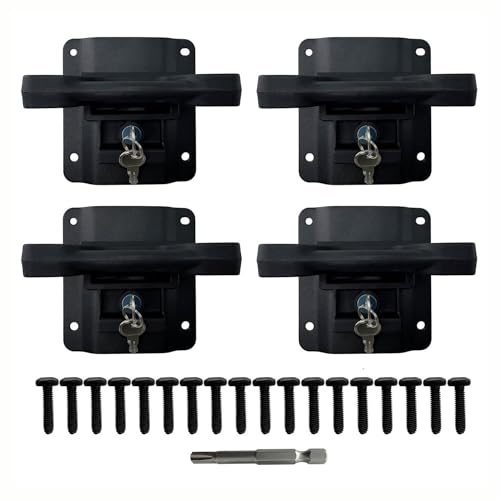
F-Lptstor stands out for its key-locked anchor system, rather than the simple steel cleats in some other options. The set combines a pickled-steel fixing plate with a sprayed plastic coating, die-cast zinc Box Link chain links, and ABS locking parts. The maker says the four parts together have a maximum load capacity of 1,000 pounds; that is a set-level figure, not a per-anchor rating. Its fit covers 2015–2025 F-150 models, along with other Ford trucks. Choose it when the locking feature matters, but do not treat the combined rating as interchangeable with a per-anchor safe working load.
Bottom line: Choose this set if key locking is a priority and the combined rating suits your cargo.
SPEEDWOW Box Link Anchors with Plates

SPEEDWOW gives a narrower F-150 fit window than the broad-year anchor sets: its range is 2015–2021, with Raptor coverage through 2022. The kit pairs die-cast zinc tie-downs with an ABS housing and stainless-steel lock assembly, plus a black powder coating described by the maker as anticorrosive. Keys and plates are included in the product name. This option can suit an earlier F-150 when a lockable cleat-and-plate arrangement is wanted. The maker mentions installation in about 15 minutes, but that estimate is not a load rating; verify capacity requirements for the cargo you plan to secure.
Bottom line: Choose this for an earlier F-150 that matches its narrower year range.
F150 Box Link Heavy-Duty Anchors

This option is distinguished by its per-anchor capacity: the maker gives a 2,500-pound safe working load and a 5,000-pound minimum breaking strength. It describes a one-piece forged and welded construction and says the anchors replace two listed Ford part numbers. The fit includes 2015–2025 F-150 models, plus specified F-250, F-350, Raptor, and Lightning years. Buyers comparing load figures should use the safe working load for planning, not the breaking-strength figure. The specifications does not fully clarify the package contents, so confirm the number of anchors included before ordering.
Bottom line: Choose this when the per-anchor working load is central to your decision.
Qitexmac Retractable Box Link Straps

Unlike standalone cleats, Qitexmac provides two rotating, retractable ratchet straps intended to mount to factory Box Link tie-down points. The maker says the system fits 2015–2025 F-150 models and other F-Series trucks, including Raptor models. Its fit caveats matter: the straps are not suitable for trucks with side bed panels, and a drop-in bed liner needs pre-cut holes; the maker also flags Duraliner setups as incompatible. This is the option for someone who wants the restraint straps integrated at the anchor points. No strap capacity is supplied in the specifications, so verify that rating for your cargo.
Bottom line: Choose these if you want retractable straps and your bed setup matches the fit caveats.
How to Choose Ford F-150 Box Link Accessories
Start with the accessory type, then match the fit and load information to your cargo. Standalone cleats give you anchor points for separate straps; a retractable strap kit combines the restraint with the mounting point. For cargo loads, compare safe working load figures, not breaking strength: the latter describes a failure threshold, not a target load. A rating for four anchors also differs from a per-anchor rating, so do not divide or multiply a figure unless the maker specifies how to use it. If the product gives no capacity, confirm one suitable for your cargo before hauling. Also check model year and bed configuration, since accessory compatibility can change across truck versions.
Box Link Fit, Bed Liners, and Model Years
Model-year fit is the first compatibility check: the options here span different year ranges, and their Raptor and Lightning coverage is not identical. Confirm the exact truck year and model rather than relying on an F-150 family label alone. Bed configuration matters too. Some accessories mount to factory Box Link points, while liners or side panels can block access or prevent a secure installation. For retractable straps, check specifically for side bed panels and whether a drop-in liner has pre-cut openings. Do not force an anchor through a blocked opening or improvise a mount. A snug fit at the intended factory point is essential; if the truck’s setup does not match the accessory’s fit conditions, choose another type.
Anchor Cleats and Retractable Straps Compared
Choose anchor cleats when you need mounting points and already have compatible tie-down straps; choose a retractable kit when an integrated strap system suits your cargo routine. A standalone cleat does not automatically include a restraint strap, while the retractable option is limited by truck-bed configuration. The table separates the two jobs so the intended use is clear.
| Accessory type | Includes | Choose when |
|---|---|---|
| Box Link anchors or cleats | Mounting points; some sets add plates or locks | You need anchor points for separate restraints |
| Retractable strap system | Ratchet straps with Box Link mounting | You want straps integrated at the factory points |
In either case, keep cargo within the rating of every component in the restraint path; the weakest-rated part sets the practical limit.
Using Box Link Tie-Downs Safely
Secure cargo so it cannot shift, slide, or lift during braking and turns. A tie-down’s working-load limit is not permission to load a single point to that limit regardless of strap angles, cargo shape, or the capacity of the other hardware. Use enough restraint points to control movement in more than one direction, and avoid sharp edges that can cut webbing. Inspect straps, hooks, locks, and anchor points before each trip; damaged or deformed parts should not carry a load. Locking cleats can help secure the hardware itself, but a lock does not increase cargo capacity or replace properly tensioned restraints.
Frequently Asked Questions
Do Ford F-150 Box Link accessories fit every model year?
No; fit ranges differ by accessory, so match the years to your truck’s exact model year and trim. The options here include ranges ending in 2021, 2025, and 2026.
What is the difference between safe working load and breaking strength?
Safe working load is the usable load limit for planning; breaking strength is the load at which a part may fail. For the anchor option with both figures, use its 2,500-pound safe working load per anchor, not its 5,000-pound breaking strength.
Can Box Link straps work with a drop-in bed liner?
The retractable strap maker says a drop-in bed liner needs pre-cut holes for proper installation. It also identifies side bed panels and certain Duraliner setups as incompatible, so check the exact bed configuration first.
Should I buy anchors or retractable tie-down straps?
Choose anchors if you need mounting points for separate restraints; choose retractable straps if an integrated strap system is preferable. In either case, confirm compatibility with the truck’s year and bed setup before installation.
How should I compare load ratings for anchor sets?
Compare figures with the same basis: a per-anchor rating is not the same as a rating for a four-piece set. Use the safe working load rather than breaking strength, and keep the load within the rating of the weakest component.