
20-60×60 Spotting Scope: Models Compared by Fit

20–60×60 Compact Spotting Scope is the closest match for most shoppers because it combines 20–60x magnification with a 60mm objective lens. Choose a larger-aperture alternative if you want an 80mm objective, or a different zoom range if 25–75x better suits your viewing.
A spotting scope is a compact telescope for observing distant subjects; its objective lens gathers light while the eyepiece magnifies the view.
We earn a commission if you buy through links on this page. As an Amazon Associate I earn from qualifying purchases. Products are compared on manufacturer specifications, not hands-on testing.
- Best overall: 20–60×60 Compact Spotting Scope – It matches the requested 20–60×60 configuration.
- Best for 80mm aperture: Flagship 20–60×80 Spotting Scope – It pairs 20–60x magnification with an 80mm objective and claims waterproof, fog-proof construction.
- Best for wider zoom range: SVBONY SV28 25–75×70 Spotting Scope – Its 25–75x magnification and 70mm objective differ from the requested configuration.
| Product | Best for | Magnification | Objective lens | Shop |
|---|---|---|---|---|
| 20–60×60 Compact Spotting Scope | Exact configuration | 20–60x | 60 mm | Check Price on Amazon |
| Flagship 20–60×80 Spotting Scope | Larger aperture | 20–60x | 80 mm | Check Price on Amazon |
| SVBONY SV28 25–75×70 Spotting Scope | Higher zoom range | 25–75x | 70 mm | Check Price on Amazon |
| 20–60×80 HD Dual-Focus Scope | Dual-focus control | 20–60x | 80 mm | Check Price on Amazon |
| Athlon Talos 20–60×80 | Angled 80mm scope | 20–60x | 80 mm | Check Price on Amazon |
20-60×60 Spotting Scopes and Alternatives
Compare the requested 60mm configuration with scopes that trade aperture or zoom range for a different setup.
20–60×60 Compact Spotting Scope

20–60×60 Compact Spotting Scope is the only scope here that matches both the requested 20–60x zoom and 60mm objective. Its maker says the FMC-coated optics and BAK-4 glass support brighter images and contrast, and the scope includes a phone adapter and tripod. The maker gives a field of view of 105–48 feet at 1,000 yards, so lower magnification provides the wider view. This setup suits someone seeking the specified size for target or wildlife viewing. The 60mm objective is smaller than the 70mm and 80mm alternatives, which may matter when comparing light-gathering aperture.
Bottom line: Choose this if matching 20–60x magnification and a 60mm objective is the priority.
Flagship 20–60×80 Spotting Scope

Flagship 20–60×80 Spotting Scope keeps the same 20–60x zoom range as the requested scope but uses an 80mm objective instead of 60mm. Its maker says the BAK-4 prism and fully multi-coated lens support brighter, clearer views, and describes the body as nitrogen-filled, waterproof and fog-proof. A phone adapter, tripod and carrying bag are included. The larger aperture makes this a fit for buyers willing to consider a different objective size while keeping the same magnification range. Its size is the key tradeoff: the length is 17.32 inches, so it is less compact than the 60mm model’s 14.6-inch length.
Bottom line: Choose this if you want 20–60x magnification with an 80mm objective.
SVBONY SV28 25–75×70 Spotting Scope
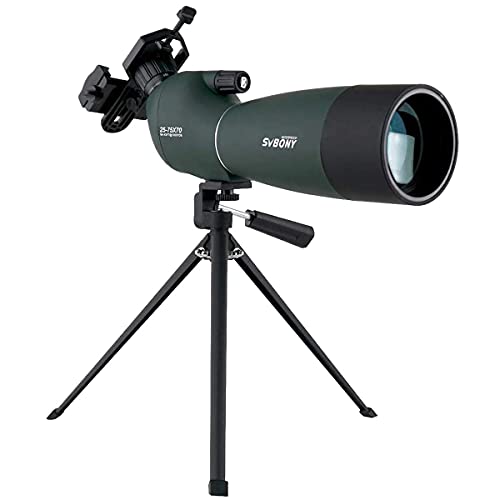
SVBONY SV28 25–75×70 Spotting Scope differs in both aperture and zoom: it has a 70mm objective and magnifies from 25x to 75x rather than starting at 20x. The maker says it is waterproof and describes the built-in sunshade as a way to reduce glare; a phone adapter and portable desktop tripod are included. Its angled form is useful to consider when choosing how you prefer to look through a scope. This is a related option for buyers who want more top-end magnification, not an exact match. The higher minimum power means it cannot provide the 20x setting available on the other models.
Bottom line: Choose this if 75x maximum magnification matters more than a 20x starting setting.
20–60×80 HD Dual-Focus Scope

20–60×80 HD Dual-Focus Scope offers a dual-focus system, unlike the single focus arrangements described for other scopes, while retaining 20–60x magnification. Its 80mm objective makes it a larger-aperture alternative to the requested 60mm size. The maker says its BAK-4 glass and broadband multi-coating enhance light transmission; the scope also includes a phone adapter and tripod. A field of view of 86.4–48.2 feet at 1,000 yards is given. Consider this option if dual-focus control is a priority, but the 80mm aperture means it does not match the requested configuration.
Bottom line: Choose this if you want dual-focus controls and an 80mm objective.
Athlon Talos 20–60×80
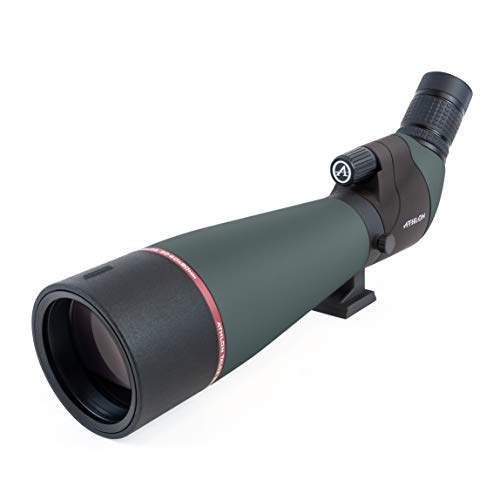
Athlon Talos 20–60×80 is an angled 20–60x scope with an 80mm objective, making it a close zoom-range alternative rather than a 60mm match. Its maker says the K9 glass prisms have a silver coating and the lenses are fully multi-coated. Nitrogen purging is described as supporting waterproofing and thermal stability, and the scope includes a rotating ring for adjusting its position around the tripod support. A carrying case and cleaning cloth are included. This suits buyers seeking the angled format and larger objective; the 80mm lens is the main difference for anyone committed to a compact 60mm scope.
Bottom line: Choose this if you prefer an angled 20–60x scope with an 80mm objective.
How to Choose a Spotting Scope
Start with objective size and magnification: a 60mm objective at 20x has a 3mm exit pupil, while the same scope at 60x has a 1mm exit pupil. Exit pupil is objective diameter divided by magnification, and a smaller exit pupil makes precise eye placement more important. Higher power also narrows the field of view and makes hand shake more visible. For steady high-magnification viewing, use a tripod rather than relying on a handheld position.
For a compact 20–60×60 setup, choose a 60mm objective; consider an 80mm model if the larger lens better suits your priorities. Glass type and coatings are separate features from aperture: they do not change the exit-pupil calculation. A useful rule is to compare scopes at the magnification you expect to use most, not only at their maximum setting.
60mm and 80mm Objective Sizes Compared
A 60mm objective is the match for this search, while an 80mm objective is the larger-aperture alternative in several options here. Aperture area increases with the square of diameter, so an 80mm lens has about 1.78 times the geometric area of a 60mm lens; actual view quality also depends on optical design, coatings and conditions. Larger aperture does not guarantee a sharper image at high power.
Use this comparison to decide which configuration is closer to your needs. The 70mm scope is also included because its 25–75x zoom offers a different range.
| Configuration | What it offers | Tradeoff |
|---|---|---|
| 60mm, 20–60x | Matches the requested size and zoom | Smaller aperture than 70mm or 80mm scopes |
| 70mm, 25–75x | Higher maximum magnification | Starts at 25x, not 20x |
| 80mm, 20–60x | Larger objective with the same zoom range | Does not match the requested 60mm size |
Magnification, Field of View and Stability
Field of view usually shrinks as magnification rises, so a low setting helps locate a subject before zooming in. For example, one 60mm model gives a field of view of 105–48 feet at 1,000 yards across its zoom range. Field-of-view figures are useful only when compared at the same distance and units; a wider low-power view is not the same as more detail at high power.
Tripod stability matters increasingly at 40x to 60x, where small movements shift the view substantially. Set the scope on firm ground, secure the tripod, and center the subject at lower power before increasing magnification. Heat shimmer and atmospheric distortion can also limit long-distance detail, even when the scope is focused correctly.
Using a Spotting Scope Safely and Carefully
Never point a spotting scope at the sun; concentrated sunlight can cause permanent eye injury. Keep the objective pointed away from direct sun while setting up, and do not try to observe a solar eclipse without equipment specifically designed for safe solar viewing.
Moisture, dust and rapid temperature changes can affect optics, so use a lens cap when the scope is not in use and let cold equipment warm gradually in a case before exposing it to humid air. For lens cleaning, first remove loose grit with a blower or soft brush; rubbing grit across glass can scratch coatings. Waterproof or fog-proof claims apply to particular construction, not to every accessory or every kind of exposure.
Frequently Asked Questions
What does 20–60×60 mean on a spotting scope?
The numbers mean variable magnification from 20x to 60x and a 60mm objective lens. At 20x, a 60mm objective produces a 3mm exit pupil; at 60x, it produces a 1mm exit pupil.
Is 60x magnification useful for target spotting?
It can help show distant detail when the air is steady and the scope is firmly supported. At 60x, atmospheric shimmer and small tripod movements are more noticeable, so begin at lower power and zoom only as needed.
Why does the image get darker at higher magnification?
Higher magnification reduces exit pupil when objective size stays the same. A 60mm scope has a 3mm exit pupil at 20x but only 1mm at 60x, so less light reaches the eye through the exit pupil.
Do I need a tripod for a spotting scope?
A tripod is strongly useful, especially above about 20x, because hand movement becomes more visible as magnification rises. A stable platform also makes it easier to hold a subject in view at long distances.
Can a spotting scope be used to look at the sun?
No; never aim an ordinary spotting scope at the sun, because concentrated sunlight can permanently injure eyes. Solar viewing requires equipment specifically designed and rated for that purpose.