
Rear Entry Ski Boots: 4 Models Compared by Fit

For a rear entry ski boot with an easier step-in design and a 102-mm last, the Nordica HF 100 is the men’s medium-flex choice; the 40-degree shell opening is the deciding feature. Choose another model if you need a different flex, a 101-mm last, or a women’s boot.
We earn a commission if you buy through links on this page. As an Amazon Associate I earn from qualifying purchases. Products are compared on manufacturer specifications, not hands-on testing.
- Best overall: Nordica HF 100 Men’s – Its shell opens 40 degrees and it pairs a 102-mm last with medium flex.
- Best for women: Atomic Nexus 95 BOA Women’s – This women’s model has a 101-mm last, BOA closure and adjustable cuff.
- Best for stiff flex: Nordica HF 120 Men’s – The HF 120 combines a 40-degree shell opening and 102-mm last with stiff flex.
- Best for 101-mm last: Atomic Nexus 110 Men’s – This stiff-flex men’s model uses a 101-mm last and RYF Kombo closure.
| Product | Best for | Last | Flex | Closure | Shop |
|---|---|---|---|---|---|
| Nordica HF 100 Men’s | Medium-flex skiing | 102 mm | Medium | HF back buckle | Check Price on Amazon |
| Nordica HF 120 Men’s | Stiff-flex skiing | 102 mm | Stiff | HF back buckle | Check Price on Amazon |
| Atomic Nexus 110 Men’s | 101-mm stiff flex | 101 mm | Stiff | RYF Kombo lever | Check Price on Amazon |
| Atomic Nexus 95 BOA Women’s | Women’s 101-mm fit | 101 mm | Stiff | BOA H+i1 dial | Check Price on Amazon |
Rear entry ski boots compared
Compare shell entry design, last width and flex against your foot shape and preferred support.
Nordica HF 100 Men’s

The HF 100 stands out for its 40-degree Easy Entry Shell opening, which gives the foot a broad path into the boot. Its 102-mm last and high-volume design suit skiers who prioritize room and straightforward entry, while the medium flex is less stiff than the HF 120 and both Atomic options. Nordica describes its HF back-buckle closure as a hands-free system that closes by pressing the buckle down with a foot. The Primaloft-insulated liner is another distinguishing feature. Choose a different model if you specifically want stiff flex or a narrower 101-mm last.
Bottom line: Choose it for easier step-in access and medium flex in a 102-mm last.
Nordica HF 120 Men’s

The HF 120 pairs the Nordica HF line’s 40-degree Easy Entry Shell with stiff flex, unlike the medium-flex HF 100. Its 102-mm last and high-volume fit make it a match for skiers who want the roomier HF shape but prefer a stiffer boot. The boot has a heat-moldable cork liner and GripWalk compatibility, while Nordica’s HF back-buckle closure is designed for hands-free operation. Stiff flex can feel demanding to skiers who want a more forgiving boot; the HF 100 is the medium-flex alternative in the same line.
Bottom line: Pick it if you want stiff flex with the roomier 102-mm HF shape.
Atomic Nexus 110 Men’s
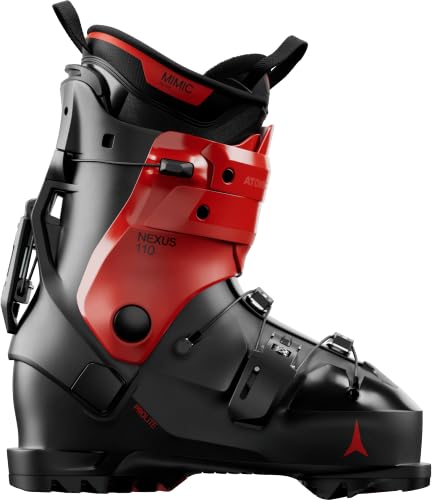
The Nexus 110 differs from the other men’s boots here with its 101-mm last, a medium-width, higher-volume shape, and Atomic’s RYF Kombo lever closure. Its stiff flex suits skiers seeking a more supportive feel, and the adjustable cuff provides an additional fit feature. NexStep Construction combines an overlap design with an easy-entry cuff; the shell and cuff can be heat-shaped with Memory Fit, and the Mimic liner has heat-moldable heel and ankle areas. It does not use the HF line’s described 40-degree shell opening, so choose an HF model if that specific opening angle matters.
Bottom line: Choose it for stiff flex, an adjustable cuff and a 101-mm Atomic last.
Atomic Nexus 95 BOA Women’s
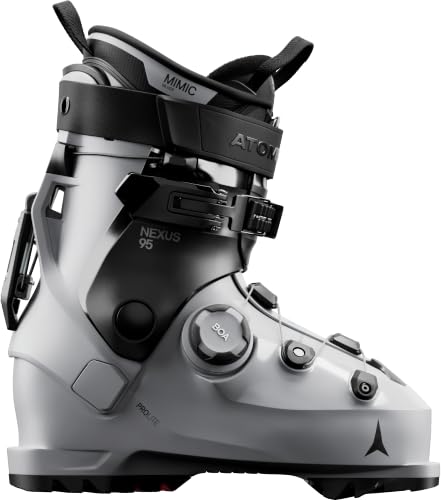
The women’s Nexus 95 BOA is the only women’s model among these four, and it uses a BOA H+i1 closure rather than the HF back buckle or the men’s Nexus lever. Atomic says the dial’s bi-directional micro-adjustments improve shell wrapping. The 101-mm last combines medium width with higher volume, and the boot also has an adjustable cuff, GripWalk compatibility, Memory Fit shell and cuff shaping, and a Mimic liner with moldable heel and ankle zones. Its stiff flex may be too demanding for someone seeking a softer boot; Atomic does not offer a softer flex among these options.
Bottom line: Pick it for a women’s 101-mm boot with BOA adjustment and stiff flex.
How to choose rear entry ski boots
Start with boot size and foot shape, then choose flex and closure; a rear-entry design alone does not guarantee a comfortable fit. A last is the boot’s forefoot width reference, but the millimeters do not describe every part of the foot or replace a proper fit assessment. Here, the 101-mm Atomic lasts are medium width with higher volume, while the 102-mm Nordica lasts are high volume. For a roomier option, compare the 102-mm HF models; for 101 mm, compare the Atomic models. Flex labels are not standardized across brands, so treat medium and stiff as within-brand comparisons rather than direct stiffness measurements. Shell shape, liner and skier ability also affect fit and feel.
Rear entry openings and closure systems
Entry systems differ in how the cuff opens and how the shell is tightened. Nordica says the HF shell opens 40 degrees, while the Atomic Nexus models use NexStep Construction, combining an overlap construction with an easy-entry cuff. Closure also varies: the HF line has a back buckle, the Nexus 110 uses an RYF Kombo lever, and the Nexus 95 BOA uses a dial with bi-directional micro-adjustments. A larger opening can make putting a boot on simpler, but it does not establish that the boot will fit your instep or heel. Try boots with the socks you ski in, and check that your heel remains seated when flexing forward.
Use this comparison to narrow the style by the feature that matters most.
| Need | Compare | Distinguishing feature |
|---|---|---|
| Wide shell opening | HF 100 or HF 120 | 40-degree Easy Entry Shell |
| 101-mm last | Nexus 95 BOA or Nexus 110 | Medium width, higher volume |
| Dial closure | Nexus 95 BOA | BOA H+i1 |
Matching boot flex to skiing
Flex is a useful sorting point, not a universal stiffness scale: shell design, temperature, body size and technique all change how a boot feels. These choices include the medium-flex HF 100 and stiff-flex HF 120, Nexus 110 and Nexus 95 BOA. A skier wanting less resistance when bending forward should begin with the medium option here; someone deliberately seeking the stiff category can compare the three stiff models. Do not choose solely from a flex number or label, since the models do not provide a shared numerical flex scale. A boot fitter can check forward flex and heel hold with your stance and ski setup.
Heat molding and boot fit checks
Heat molding changes shell or liner shape, but the process is model-specific and should be done with the correct equipment and procedure. Memory Fit is included on both Atomic Nexus boots for shell and cuff shaping, and their Mimic liners have heat-moldable heel and ankle areas. The HF 100 has a Primaloft-insulated liner; the HF 120 has a heat-moldable cork liner. Before committing to a fit, make sure the boot closes without excessive pressure and that the heel does not lift substantially as you flex. Ski boots are load-bearing equipment: use a compatible boot-and-binding sole standard, and have binding compatibility checked by a qualified shop rather than assuming GripWalk compatibility applies to every binding.
Frequently Asked Questions
What does a 101-mm ski boot last mean?
A 101-mm last is a forefoot width reference, not a guarantee of a 101-mm interior fit for every foot. The Atomic models here describe that width as medium with higher volume, so instep and heel shape still matter.
Is a 102-mm last wider than a 101-mm last?
The 102-mm last is nominally 1 mm wider at the reference point. Boot shape and volume also affect how roomy the fit feels, so the number alone cannot decide fit.
Can GripWalk boots work with older bindings?
GripWalk soles require bindings explicitly compatible with GripWalk; older alpine bindings may not be. Check the binding’s compatibility marking or have a qualified ski shop verify the boot-and-binding combination before skiing.
How should a ski boot heel fit?
The heel should stay seated as you bend forward, without substantial lift. Try the boots in ski socks and assess heel hold as well as pressure across the instep and forefoot.
What is the difference between BOA and a boot buckle?
BOA tightens the shell using a dial and cable, while a buckle closes through a lever. In these models, Atomic describes the Nexus 95 BOA dial as having bi-directional micro-adjustments; the HF boots use a back-buckle system.