
JOVS Laser Mask: Compare 3 Models by Wavelength

The JOVS 6D mask with five wavelengths is the strongest match for shoppers prioritizing wavelength variety. Choose JOVS 4D Mask, Brown instead if cordless use and three modes matter more; JOVS 6D Mask, Mocha Nude is another 6D option with focused 20° beams.
These masks use light-emitting devices intended for at-home skincare routines, rather than a substitute for medical care.
We earn a commission if you buy through links on this page. As an Amazon Associate I earn from qualifying purchases. Products are compared on manufacturer specifications, not hands-on testing.
- Best overall: JOVS 6D Mask, Coffee – Combines five wavelengths with 140 lights and soft silicone.
- Best for beam focus: JOVS 6D Mask, Mocha Nude – Its maker describes focused 20° beams and five wavelengths.
- Best for travel: JOVS 4D Mask, Brown – The 4D model is described as cordless and rechargeable, with three modes.
| Product | Best for | Wavelength count | Shop |
|---|---|---|---|
| JOVS 6D Mask, Coffee | Wavelength variety | 5 | Check Price on Amazon |
| JOVS 6D Mask, Mocha Nude | Focused beams | 5 | Check Price on Amazon |
| JOVS 4D Mask, Brown | Cordless routines | 4 | Check Price on Amazon |
JOVS Laser Masks
Compare the 6D and 4D masks by wavelength count, fit and operating features.
JOVS 6D Mask, Coffee

Five wavelengths distinguish this 6D mask: 660 nm red, 850 nm and 940 nm near-infrared, 1064 nm, and full-spectrum light listed as 510–1940 nm. It has 140 lights and a soft silicone construction, making it a fit for shoppers who want broad wavelength coverage in a flexible full-face mask. JOVS says its focused-light delivery improves energy delivery compared with traditional LED masks.
Bottom line: Pick this if five wavelengths and soft silicone are your priorities.
JOVS 6D Mask, Mocha Nude

Focused 20° beams are the defining feature of this 6D model, alongside five wavelengths and full-face coverage from 140 lights. Its features describe wavelengths spanning 660 nm to 1064 nm and an added 400–1200 nm full-spectrum mode. JOVS claims the focused beams deliver six times more energy than traditional masks; treat that as a maker claim, not a guarantee of an individual result. The fit is best for buyers drawn to the beam design. Its maker does not establish cordless operation, so portability-focused shoppers may prefer a model that explicitly names rechargeable use.
Bottom line: Choose this if the 20° beam design matters more than confirmed cordless use.
JOVS 4D Mask, Brown
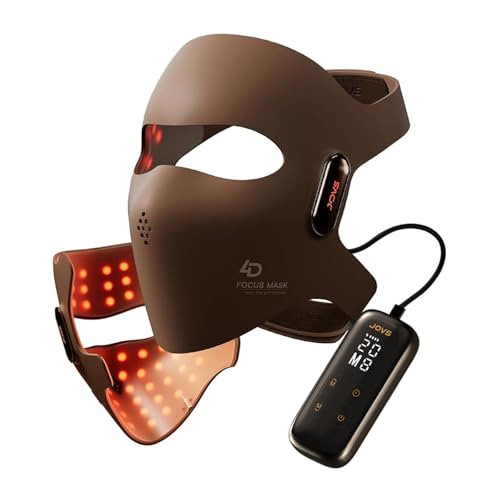
Cordless, rechargeable operation and three modes set this 4D mask apart from the two 6D choices. It has four wavelengths, including 1064 nm, and 140 lights for full-face coverage. JOVS says its FPT chip produces 20° beams and claims six times the energy efficiency of traditional LED masks. Those are maker claims rather than a promise of a particular skincare outcome. This model suits shoppers who want travel-friendly operation and multiple modes; the tradeoff is a four-wavelength configuration rather than the five wavelengths described for the 6D masks.
Bottom line: Pick this for cordless operation and three modes.
How to Choose a JOVS Laser Mask
Choose by the features that change your routine: wavelength count, modes and whether you need cordless operation. The 6D options list five wavelengths, while the 4D option lists four and three modes. A mask’s wavelength label describes the light it emits; it does not by itself establish how much light reaches skin or what result a user will get. JOVS describes 20° focused beams on the 6D and 4D models, but its energy and wrinkle-related statements are maker claims. A practical decision rule: if rechargeable use is essential, choose the model explicitly described as cordless and rechargeable; if not, compare the 6D wavelength sets and fit instead.
Understanding Wavelengths and Light Modes
Wavelengths are measured in nanometers, and the values range from visible red at 660 nm to near-infrared values including 850, 940 and 1064 nm. JOVS 6D Mask, Coffee also gives a full-spectrum range of 510–1940 nm, while the second 6D mask describes an added 400–1200 nm full-spectrum mode. These ranges are not interchangeable labels: compare the exact values and mode descriptions rather than relying on a model number alone. A broader wavelength count does not guarantee a better result, because treatment schedule, device output and individual circumstances matter. Ask a dermatologist before using light devices if you have a light-sensitive condition or take medication that increases light sensitivity.
Fit, Eye Safety and Routine
Fit matters because a face mask needs to sit securely without shifting during a session; the two 6D masks describe full-face coverage from 140 lights, and the 4D mask also describes 140 lights. The maker does not give session length, so use the device’s own directions rather than borrowing a schedule from another light mask. Keep light sources away from direct eye exposure and use any eye protection or precautions that come with the device. Stop if use causes discomfort, and seek professional advice before starting if you have an eye condition or use photosensitizing medication. Clean the mask according to its care instructions, especially the skin-contact surfaces.
Frequently Asked Questions
What does a 20-degree beam mean on a JOVS mask?
A 20° beam refers to the narrow angle that JOVS describes for its focused-light design. It is a beam characteristic, not a guarantee of a particular skin result.
Are the JOVS 6D masks the same as the 4D mask?
No; the 6D masks describe five wavelengths, while the 4D mask describes four wavelengths and three modes. The 4D model is also explicitly described as cordless and rechargeable.
Can I use a light therapy mask every day?
Use only the schedule supplied for the specific device, since treatment durations differ between light devices. If you take medication that increases light sensitivity or have an eye condition, ask a clinician before use.
Why do these masks list different wavelength ranges?
The wavelengths identify the light bands or modes each mask describes, and the values differ between models. Compare the exact nanometer values rather than assuming all masks with the same model family use identical bands.