
Best Exhaust Manifold Repair Putty: 4 Options Compared

LOCBONDSO High Temp Exhaust Repair Kit is the best fit for most exhaust-manifold putty repairs because its maker gives a heat limit of 2,012°F and a non-slumping formula. Choose Pyro-Putty for resurfacing defects rather than sealing ordinary exhaust joints.
Exhaust repair putty is a paste used to fill or seal damage in hot exhaust components, but it cannot replace sound metal when a manifold is cracked through or structurally failing.
We earn a commission if you buy through links on this page. As an Amazon Associate I earn from qualifying purchases. Products are compared on manufacturer specifications, not hands-on testing.
- Best overall: LOCBONDSO High Temp Exhaust Repair Kit – Its maker specifies heat resistance up to 2,012°F and a non-slumping paste.
- Best for resurfacing: Pyro-Putty 2400 Paste – It is described for resurfacing and repairing defects, with machinability.
- Best for larger quantity: MPD Muffler Cement Putty, 16 oz – The 16-ounce package is the largest amount here.
| Product | Best for | Package size | Named application | Shop |
|---|---|---|---|---|
| LOCBONDSO High Temp Exhaust Repair Kit | Hot-area sealing | 5.3 fl oz | Mufflers, joints, tailpipes | Check Price on Amazon |
| Pyro-Putty 2400 Paste | Surface defect repair | Pint | Resurfacing and defects | Check Price on Amazon |
| MPD Muffler Cement Putty, 16 oz | Larger repair jobs | 16 oz | Mufflers, tailpipes, catalytic converters | Check Price on Amazon |
| Walker 35958 Exhaust Putty | Pipe joint sealing | — | Muffler and pipe connections | Check Price on Amazon |
Exhaust Manifold Repair Putty Compared
Match the repair compound to the damaged area, temperature exposure and amount needed.
LOCBONDSO High Temp Exhaust Repair Kit

For a hot exhaust repair where paste control matters, this kit pairs a non-slumping formula with a 2,012°F heat limit. The 5.3-fluid-ounce gray compound is intended for holes and leaks across joints, mufflers, tailpipes and catalytic converters, making it the clearest match here for sealing rather than resurfacing.
The maker says it sets quickly and provides a durable seal. The package is smaller than the 16-ounce MPD option, so it suits a localized repair better than a job that needs a larger volume. Confirm the manifold material and repair area are appropriate for a paste before applying it.
Bottom line: Choose this for a localized exhaust leak where the heat limit and non-slumping consistency are useful.
Pyro-Putty 2400 Paste

Unlike the exhaust-joint sealers, Pyro-Putty 2400 is described as a machinable paste for resurfacing and repairing defects. Its pint-size container gives more compound than the 5.3-fluid-ounce LOCBONDSO kit, and the product claims say it gains strength with heat.
This makes it the more relevant option when a repair requires a surface that can be machined after application, rather than a simple seam seal. The specifications provide no temperature figure, so buyers needing a verified maximum heat rating should compare that requirement before choosing it. Its purpose does not establish suitability for every manifold failure.
Bottom line: Choose this when the repair involves resurfacing a defect and machinability matters.
MPD Muffler Cement Putty, 16 oz
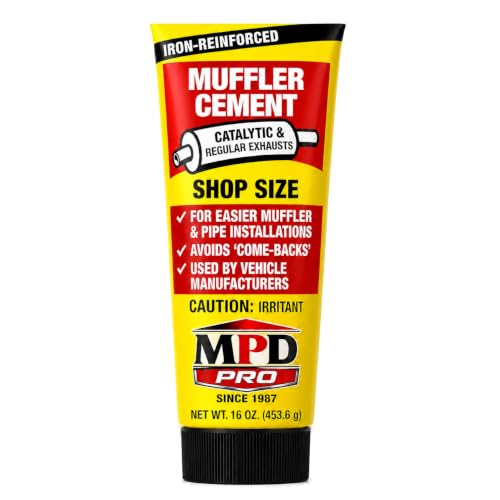
MPD stands out for its 16-ounce package, the largest quantity among these exhaust putties. The maker describes a paste for sealing holes, cracks and seams on mufflers, tailpipes and catalytic converters, and says it dries to a hard finish intended to resist vibration and thermal cycling.
That larger container can suit repairs covering more area than a small joint, but no maximum temperature is supplied in the specifications. Buyers choosing it for a manifold exposed to especially high heat should verify that the compound’s rating fits the repair. It is positioned as an exhaust sealer, not a machinable resurfacing compound.
Bottom line: Choose this when the repair area calls for a larger quantity and a hard-setting cement.
Walker 35958 Exhaust Putty

Walker 35958 is aimed specifically at sealing exhaust joints, including out-of-round muffler and pipe connections. The maker says it sets in minutes and describes the fit as universal, while also advising buyers to check dimensions and vehicle compatibility before purchase.
This targeted joint use separates it from Pyro-Putty’s resurfacing purpose and from MPD’s larger package. The fields give no package quantity or temperature ceiling, so it is a less informative choice when either factor is central to a manifold repair. It is most relevant when the problem is a connection that needs sealing, not a damaged manifold casting.
Bottom line: Choose this for an exhaust connection leak, after confirming the part fits the vehicle.
How to Choose Exhaust Manifold Repair Putty
Choose putty by the repair location and its heat exposure, not by the word “permanent” on a package. An exhaust manifold carries hot combustion gases, and a crack through the casting or a loose, warped flange needs mechanical repair or replacement rather than an exterior paste patch. For a small pinhole or joint gap, a paste rated for the operating temperature and intended substrate is the more appropriate candidate.
Exhaust sealers are commonly used at slip-fit joints and small gaps, while machinable repair compounds are meant for surface defects that need shaping after cure. If the leak is at a flange, inspect the gasket and fasteners first; putty on the outside does not correct a failed gasket or loose connection. With a visible crack longer than a few inches or any missing metal, prioritize a structural repair assessment over putty.
Putty, Cement and Machinable Paste
Exhaust putty and muffler cement are paste-form sealers, while machinable metal repair paste serves a different surface-repair role. Many exhaust cements cure with heat or air, and product formulas vary in cure time, rated temperature and whether they need a heat cycle; use the specific cure method and temperature rating as deciding criteria.
The table separates the product roles in this group rather than treating every paste as interchangeable. A sealant aimed at muffler joints may suit a small connection gap, but it is not automatically appropriate for resurfacing or a cracked manifold body. For any product without a temperature ceiling, verify the rating before using it on a high-heat manifold location.
| Repair need | Relevant type | Decision point |
|---|---|---|
| Small exhaust joint gap | Exhaust putty or cement | Temperature rating and joint fit |
| Surface defect needing shaping | Machinable repair paste | Machinability and cure process |
| Through-crack or failed flange | Mechanical repair | Replace or repair the damaged part |
Surface Preparation and Safe Application
Preparation is a major factor in whether an exhaust patch bonds: work on a cold system, remove loose rust and old sealer, then clean away oil, soot and dust. Exhaust components can remain hot after shutdown, so allow the manifold and nearby pipes to cool completely before touching them; hot metal can cause serious burns. Wear eye protection when brushing corrosion or scraping old material.
Apply only enough compound to bridge the intended gap, keeping it away from moving joints and the exhaust passage. Cure requirements are not interchangeable: some compounds require an engine heat cycle, while others need a set period before heat exposure. Do not idle a vehicle in an enclosed garage during curing because exhaust gas contains carbon monoxide, an odorless and potentially fatal gas.
When an Exhaust Manifold Needs More Than Putty
Putty is a surface seal, not a substitute for the clamp force and flat mating surfaces required at a manifold flange. A gasket leak, missing fastener or warped flange can reopen a patch as the engine heats and cools, so inspect the flange, gasket and bolt condition before applying compound. A crack that reaches a mounting boss or crosses a large section of casting needs a structural repair decision.
Exhaust leaks can send hot gases toward wiring, hoses or the passenger compartment. If fumes enter the cabin, the leak is near a sensor or wiring harness, or the patch fails after a heat cycle, stop relying on the patch and have the exhaust repaired promptly. Never crawl under a vehicle supported only by a jack; use properly rated jack stands on firm, level ground.
Frequently Asked Questions
Can exhaust putty repair a cracked manifold?
Putty may seal a small surface defect, but it is not a dependable structural repair for a through-crack. A crack that crosses the casting or reaches a mounting boss calls for a repair or replacement assessment.
How hot does exhaust manifold repair putty need to withstand?
The relevant rating depends on where the leak sits and the compound’s instructions; manifold and exhaust temperatures vary with engine load and location. Choose a product with a maximum above the exposure expected at the repair, and verify the rating if it is missing.
Should the exhaust manifold be hot when applying putty?
No, apply putty only after the exhaust system has cooled completely. Exhaust metal can cause serious burns, and a cold surface is easier to clean and prepare.
How should I prepare a manifold for exhaust putty?
Remove loose rust, old compound, soot and oil so the repair surface is clean and sound. A patch over loose scale or oily residue can detach as the metal heats and cools.
Can exhaust putty fix a leaking manifold gasket?
Putty does not restore gasket clamping force or correct a warped flange. Inspect the gasket and fasteners, and replace failed sealing hardware rather than relying on an exterior patch.