
Cat Self-Grooming Brushes: 3 Options Compared

For a cat that likes to rub against a brush, Softer Self Groomer, 2-Pack is a flexible pick because its two corner-mounted groomers can be placed where your cat passes. Choose Catstages Scratch & Groom instead if you want a scratcher with a removable brush, or Catit Senses 2.0 Self Groomer for a wall-mounted brush with adhesive strips.
Self-grooming brushes let cats rub their faces and bodies against bristles; they complement coat care, especially for long-haired cats.
We earn a commission if you buy through links on this page. As an Amazon Associate I earn from qualifying purchases. Products are compared on manufacturer specifications, not hands-on testing.
- Best overall: Softer Self Groomer, 2-Pack – The two-piece set offers corner placement for cats that like to brush themselves while passing by.
- Best for scratchers: Catstages Scratch & Groom – Combines a removable self-grooming brush with corrugated cardboard for scratching.
- Best for wall mounting: Catit Senses 2.0 Self Groomer – Mounts on a flat wall or corner with included adhesive strips, with screws as another option.
| Product | Best for | Setup | Added feature | Shop |
|---|---|---|---|---|
| Softer Self Groomer, 2-Pack | Corner placement | Corner mount | Loose-hair collection | Check Price on Amazon |
| Catstages Scratch & Groom | Scratch-and-groom | Floor scratcher | Corrugated pad | Check Price on Amazon |
| Catit Senses 2.0 Self Groomer | Wall mounting | Wall or corner mount | Interactive toy | Check Price on Amazon |
Cat Self-Grooming Brushes
Compare the mounting options and extra activities each self-grooming setup offers.
Softer Self Groomer, 2-Pack
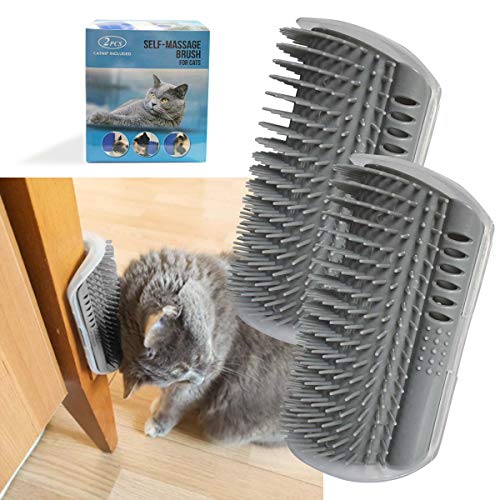
Two corner-style groomers make this set the choice when you want to try placement in more than one spot. The maker describes the base as ABS plastic and the bristles as softer plastic, intended for rubbing and collecting loose hair as cats pass. It is designed for long- and short-haired cats, and the pack contains two pieces. Placement is the main limitation: the corner format suits a wall junction better than a cat that prefers a flat, open surface. If your cat seems uncomfortable while rubbing against it, stop use.
Bottom line: Pick this set if corner placement and two grooming spots matter most.
Catstages Scratch & Groom

The Catstages combines self-grooming with a scratching surface, unlike wall-mounted brushes that focus on rubbing against bristles. Its removable curved brush can be moved around the corrugated pad to change the grooming angle, and the pad is infused with dried catnip. The combination suits cats that already enjoy scratching cardboard and may engage more with a floor-based station than a wall fixture. The tradeoff is its footprint: this is a 3-in-1 scratcher and lounger, not a compact wall-mounted brush, so reserve a stable floor area for it.
Bottom line: Choose this if your cat enjoys cardboard scratching as well as brushing.
Catit Senses 2.0 Self Groomer
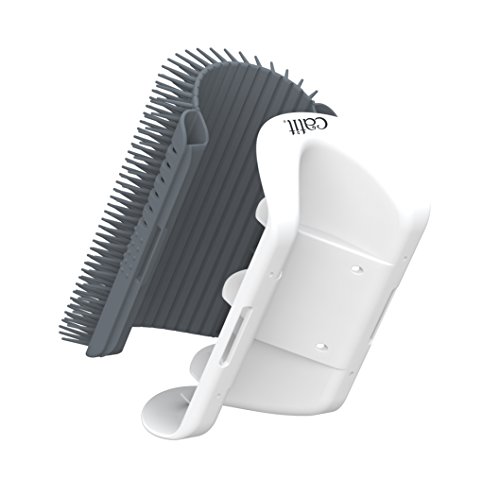
The Catit Senses 2.0 gives you a single flexible brush that can be mounted on a flat wall or a corner, so its placement is not limited to a corner. Adhesive strips are included; screws are an alternative but are not included. The maker says the brush catches loose hair as cats rub against it and can be removed from its holder for cleaning. This suits a cat with a regular rubbing route near a wall. Its limitation is the single-brush format: it does not add a scratching pad like the Catstages station.
Bottom line: Pick this for a mountable brush that can go on a flat wall or corner.
How to choose a cat self-grooming brush
Choose by your cat’s preferred rubbing spot and whether scratching is part of the routine. Wall and corner brushes work where a cat can walk up and rub against a fixed surface; a floor station adds a scratching surface and takes more room. Many adult cats groom themselves, but their tongues do not remove every loose coat or prevent mats, so these fixtures are best treated as an extra source of rubbing rather than a substitute for combing. Short-haired cats often need brushing about once a week; long-haired cats commonly need daily combing to catch tangles before they tighten. Start with brief, supervised sessions and move the brush if your cat avoids it or seems uncomfortable.
Where to place a wall-mounted cat brush
Place a mounted brush at a height where your cat can comfortably rub its cheeks and shoulders without stretching or crouching awkwardly. Cats differ in size and movement, so observe a natural rubbing spot and position the brush near it rather than choosing an arbitrary height. A flat wall opens more placement options; a corner brush fits where two surfaces meet. Adhesive strips avoid drilling but depend on a clean, suitable surface, while screw mounting requires appropriate hardware and a secure anchor. Before letting a cat push against a mounted brush, check that the holder does not shift. Keep it away from narrow paths where a startled cat could get trapped or knocked into furniture.
Self-grooming brush styles compared
Wall brushes favor quick rub-by grooming, while a scratcher-and-brush station adds a place to scratch and lounge. Use the table to match the setup to the cat’s usual activity and available space.
| Style | Works best when | Space needed |
|---|---|---|
| Corner-mounted brush | Your cat rubs against corners | Wall junction |
| Wall-mounted brush | A flat wall is near a rubbing route | Wall surface |
| Scratch-and-groom station | Your cat also scratches cardboard | Open floor area |
Safe use and coat-care limits
Inspect a self-grooming brush regularly and stop using it if bristles are loose, broken, or uncomfortable for your cat. A cat that presses its face or body against a fixture controls the contact, but that does not guarantee every coat gets brushed evenly. Long hair can tangle close to the skin, where a fixed brush may not reach; use a comb for knots and work gently rather than pulling. Keep catnip-infused products away from food and supervise initial use so you can see whether the cat tries to chew or move the station. If grooming causes persistent discomfort or a sudden change in coat condition, ask a veterinarian for advice.
Frequently Asked Questions
Can a self-grooming brush replace brushing my cat?
No, a wall brush mostly catches coat where the cat rubs against it. Short-haired cats often benefit from about weekly brushing, while long-haired cats commonly need daily combing to catch tangles.
How high should I mount a cat self-grooming brush?
Place it where your cat can rub its cheeks and shoulders without stretching or crouching. Watch where the cat already rubs, then check that the mount stays secure when pushed.
Are wall-mounted cat brushes safe for kittens?
A mounted brush can be introduced under supervision, but secure installation matters because kittens may push or paw at it. Stop use if the kitten seems uncomfortable or tries to chew loose parts.
Do catnip-infused scratchers work for every cat?
No, cats respond differently to catnip, so it may not interest every cat. A scratcher should still be placed where the cat can approach it easily, rather than relying on catnip alone.