
Raynox DCR-250 Macro Lens: Models Compared

The Raynox DCR-250 is the closest match for buyers seeking a strong close-up lens, and its maker says maximum magnification comes at the zoom lens’s most telephoto position. Choose a DCR-150 alternative for a different close-up option, or the MSN-202 if you specifically want its 1.5x super macro format.
Close-up lenses attach in front of a camera lens to shorten its focusing distance; confirm your lens’s filter size before ordering.
We earn a commission if you buy through links on this page. As an Amazon Associate I earn from qualifying purchases. Products are compared on manufacturer specifications, not hands-on testing.
- Best overall: Raynox DCR-250 2.5x Kit – Its 52–67mm snap-on mount and 49mm front filter thread are specified.
- Best for a standalone DCR-250: Raynox DCR-250 Super Macro – It is a DCR-250 snap-on lens, with maximum magnification at the zoom lens’s telephoto position.
- Best for a DCR-150 with thread specs: Raynox DCR-150 52–67mm – It specifies a 49mm front filter thread and a universal 52–67mm mount.
| Product | Best for | Magnification | Mount filter range | Filter threading | Shop |
|---|---|---|---|---|---|
| Raynox DCR-250 2.5x Kit | Accessory bundle | 2.5x | 52–67 mm | 49 mm front; 43 mm rear | Check Price on Amazon |
| Raynox DCR-250 Super Macro | Lens only | — | 52–67 mm | — | Check Price on Amazon |
| Raynox DCR-150 52–67mm | DCR-150 option | — | 52–67 mm | 49 mm front | Check Price on Amazon |
| Raynox DCR-150 Snap-On | Basic DCR-150 | — | 52–67 mm | 49 mm front | Check Price on Amazon |
| Raynox MSN-202 1.5x | 1.5x format | 1.5x | — | — | Check Price on Amazon |
Raynox DCR-250 Macro Lens Options
These close-up lenses differ in magnification claims, mount details, and included accessories.
Raynox DCR-250 2.5x Kit

This DCR-250 bundle is the only option here that includes a lens-cleaning pen and microfiber cloth alongside the close-up lens. Its snap-on mount fits filter sizes from 52 to 67 mm, and it has 49 mm front and 43 mm rear threading. The maker says high-index optical glass produces sharp images and that maximum macro magnification occurs at the zoom lens’s most telephoto position. It suits buyers who want the DCR-250 plus cleaning accessories; the added kit pieces may be unnecessary if you already have lens-cleaning tools.
Bottom line: Choose this if you want the DCR-250 bundled with cleaning accessories.
Raynox DCR-250 Super Macro
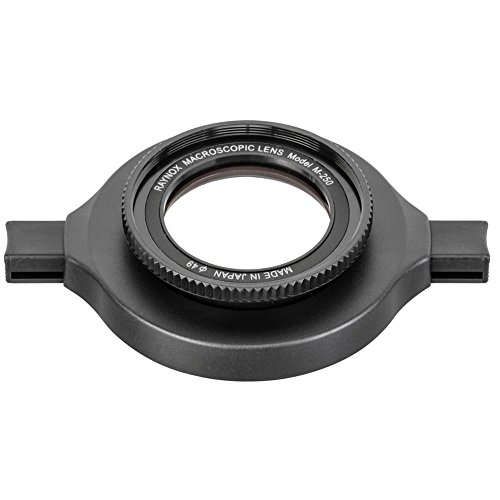
This is the simpler DCR-250 option, described as a super macro snap-on lens without the cleaning accessories included with Raynox DCR-250 2.5x Kit. The universal mount is suitable for filter sizes from 52 to 67 mm. The maker says the lens reaches maximum macro magnification when the zoom lens is at its most telephoto position, so it is aimed at buyers who want to work at the close-up end of a zoom lens. Its features do not give a magnification figure or thread size, which matters if you need those specifications to match a particular setup.
Bottom line: Pick this if you want a DCR-250 without the cleaning bundle.
Raynox DCR-150 52–67mm

This DCR-150 is a lower-magnification alternative in the Raynox close-up range, rather than the DCR-250 named in the search. Its snap-on universal adapter covers 52 to 67 mm filter sizes, and its 49 mm front filter thread is stated. The maker identifies it as compatible with full-frame D-SLR cameras and specifies two groups of three high-index optical glass elements.
Bottom line: Choose this if you specifically want the DCR-150 and its thread size.
Raynox DCR-150 Snap-On

This DCR-150 is another snap-on close-up alternative, with a 49 mm front filter thread and a universal adapter for filter sizes from 52 to 67 mm. This option suits someone looking for the DCR-150 form and the mount range.
Bottom line: Pick this if the DCR-150 snap-on format is your priority.
Raynox MSN-202 1.5x

This MSN-202 differs from the DCR-250 by offering a 1.5x super macro format rather than a DCR-series close-up lens. The specifications provide its black finish and compact physical dimensions of 4 by 4 by 1.7 inches, with a weight of 0.13 pounds. It suits buyers who specifically want that stated magnification format, but the features do not describe a mount or filter-thread size. That makes fit harder to assess for a camera lens without checking the physical compatibility first.
Bottom line: Choose this only if the 1.5x MSN-202 format suits your setup.
How Close-Up Lenses Change Focusing
A close-up lens moves a camera lens’s near-focus range closer to the subject, letting a standard lens focus on smaller subjects without a dedicated macro lens. Optical power is measured in diopters: stronger positive power generally means a shorter working distance and greater close-up potential, though usable magnification also depends on the camera lens. Zooming toward a lens’s telephoto end can increase close-up magnification with some attachments, as the DCR-250 maker notes. Keep the camera steady and use careful focus adjustments, since depth of field becomes very shallow at high magnification. A small change in camera-to-subject distance can shift the sharp plane noticeably.
Match the Snap-On Mount to Your Lens
Match an adapter’s supported filter size to the thread at the front of the camera lens; a 52 mm lens, for example, needs a mount that supports 52 mm. A step-up ring can adapt a smaller lens thread to a larger filter or accessory, but avoid stacking rings if they make the assembly unstable. The DCR-250 bundle and DCR-150 options here specify a 52–67 mm snap-on range, while the bundle also gives front and rear thread sizes. Use this quick check before choosing:
| Lens filter thread | What to confirm |
|---|---|
| 52–67 mm | Within the snap-on range |
| Below 52 mm or above 67 mm | Check for a compatible adapter or different mount |
| Thread size unknown | Read the size printed on the lens rim or cap |
Do not assume a camera body’s sensor size determines filter fit; the front thread is the relevant measurement.
Choose the Right Close-Up Strength
Pick a close-up attachment by the working distance and magnification your subject needs, not by a zoom factor alone. Diopter power and the camera lens’s focal length both influence close-focus behavior, and a zoom lens can change framing as you adjust its focal length. A stronger close-up attachment can make tiny subjects larger in the frame but usually leaves less room between the lens and subject. That can make lighting and focusing more difficult. For moving subjects or scenes needing more depth in focus, a less aggressive close-up setup may be easier to manage than maximum magnification.
Focus and Handle Macro Attachments Carefully
At close distances, small movements can move a subject out of focus, so stabilize the camera and make fine adjustments to the camera-to-subject distance. A tripod or a firm support can help, while a short timer or remote release reduces camera shake. Keep the front glass clean with a suitable lens cloth or cleaning tool; grit can scratch an optical surface if rubbed across it. Avoid touching glass with fingers, and store the attachment in a protective case when it is off the camera. For insects or other subjects that move, work patiently rather than moving the lens abruptly toward them.
Frequently Asked Questions
Does a close-up lens make every subject larger?
A close-up attachment reduces the camera lens’s minimum focusing distance, but the amount of enlargement depends on the attachment’s optical power and the camera lens. A zoom lens’s focal length and focus setting also affect the result.
Why use the telephoto end with a DCR-250?
The DCR-250 maker says maximum macro magnification occurs with the zoom lens at its most telephoto position. Zooming can also narrow the field of view, so reposition the camera to frame the subject.
How do I find my camera lens filter size?
Check the number marked on the front rim or lens cap; filter diameter is measured in millimeters. Match that number to the adapter’s supported range before attaching a close-up lens.
Can a close-up lens work with a full-frame camera?
Compatibility depends on both the camera lens and the attachment’s mount, not only on the sensor format. The DCR-150 option with full-frame D-SLR compatibility identifies that use, while buyers should confirm mount fit as well.
Why is the background soft in macro photos?
Close focusing produces very shallow depth of field, particularly at high magnification. For more of a subject in focus, use a smaller aperture if lighting permits, and keep the camera parallel to the important subject plane.