
Antifreeze for Diesel Trucks: 4 Coolants Compared

For most diesel-truck owners, Shell Rotella Nitrite-Free ELC 50/50 is a convenient pick because its 50/50 premix is ready to use and its maker specifies up to 1,200,000 miles in Class 8 over-the-road operation. Choose a concentrate instead if you need to control the dilution or match a fleet’s fill procedure; the deciding factor is always the coolant specification required by your engine.
We earn a commission if you buy through links on this page. As an Amazon Associate I earn from qualifying purchases. Products are compared on manufacturer specifications, not hands-on testing.
- Best overall: Shell Rotella Nitrite-Free ELC 50/50 – Its 50/50 premix is ready to pour, and the maker specifies up to 1,200,000 miles in Class 8 over-the-road use.
- Best for concentrate: PEAK Final Charge Global Concentrate – Concentrate lets you prepare the coolant mixture and is intended for heavy-duty diesel systems.
- Best for ready-to-use: Zerex Pre-Charged HD 50/50 – Its pre-charged green 50/50 mixture is ready to use without dilution.
| Product | Best for | Format | Color | Service interval | Shop |
|---|---|---|---|---|---|
| Shell Rotella Nitrite-Free ELC 50/50 | Ready-to-use ELC | 50/50 premix | — | Up to 1,200,000 miles* | Check Price on Amazon |
| PEAK Final Charge Global Concentrate | Flexible concentrate | Concentrate | Red | Up to 1,000,000 miles* | Check Price on Amazon |
| Zerex Extended Life Red HD Concentrate | Specified HD fleets | Concentrate | Red | 3 years / 300,000 miles / 7,000 hours* | Check Price on Amazon |
| Zerex Pre-Charged HD 50/50 | Pre-charged premix | 50/50 premix | Green | 3 years / 150,000 miles* | Check Price on Amazon |
Antifreeze for Diesel Trucks
Compare concentrate and premixed coolants, then confirm the required coolant specification for your engine before filling.
Shell Rotella Nitrite-Free ELC 50/50

For a ready-to-use extended-life coolant, Shell Rotella Nitrite-Free ELC 50/50 comes pre-diluted at 50/50, so it needs no further dilution. Its nitrite-free OAT formula is intended for diesel, gasoline, and natural-gas engines, plus light-duty cars and pickups. The maker specifies up to 1,200,000 miles for Class 8 over-the-road operation; that interval is not a universal change schedule for every truck. This option suits buyers who want premix and need to check compatibility with their engine’s coolant requirements. Its fixed dilution is less flexible than concentrate when a different mixture is required.
Bottom line: Choose this if your truck calls for compatible ELC and you want a ready-to-use 50/50 mixture.
PEAK Final Charge Global Concentrate

For buyers who want concentrate rather than premix, PEAK Final Charge Global Concentrate is made for heavy-duty diesel, gasoline, and natural-gas cooling systems. The maker says the mixture can protect for up to one million miles of on-road use with proper maintenance, and that it can be mixed with other coolants while maintaining corrosion protection when contamination stays below 25%. Concentrate suits shops or owners who need to prepare a specific fill mixture. It requires dilution before use, so it is not as convenient as ready-to-use coolant; match the ratio to the truck maker’s requirements.
Bottom line: Pick this when concentrate suits your fill process and its coolant chemistry matches the truck.
Zerex Extended Life Red HD Concentrate
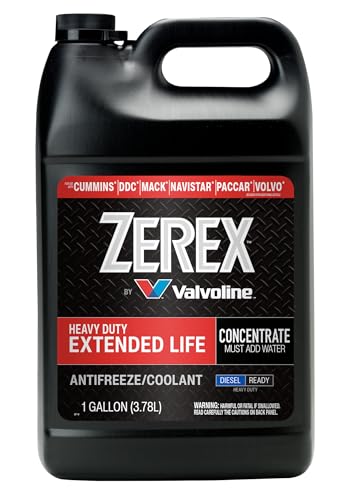
Zerex Extended Life Red HD Concentrate stands out for its heavy-duty approvals and an initial service interval expressed in both time and operating measures. It meets ASTM D6210 and Caterpillar EC-1 performance requirements, and the maker identifies Cummins approvals among its compatibility claims. After 300,000 miles, 3 years, or 7,000 hours, its program calls for adding one bottle of Zerex Extender per 50 quarts of system capacity; the fluid is replaced after one extender cycle. This concentrate is suited to buyers whose equipment specifications align with those approvals. Its service program is more involved than simply choosing a ready-to-use premix.
Bottom line: Choose it when the heavy-duty requirements and service program match your equipment.
Zerex Pre-Charged HD 50/50

Unlike concentrate, Zerex Pre-Charged HD 50/50 is a pre-charged green 50/50 mixture with deionized water, ready to use without calculating dilution. Its heavy-duty formula is described for engines including Cummins, DDC, MACK, Navistar, and Paccar, and includes corrosion, scale, and rust inhibitors. The maker gives a 3-year/150,000-mile guarantee against engine failure caused by freeze-ups or boil-overs. This format suits a buyer who wants premix and whose equipment calls for this coolant type. The interval and guarantee are specific to the product; confirm that its chemistry matches the truck’s required coolant.
Bottom line: Choose this if your engine calls for compatible pre-charged HD coolant and you prefer premix.
How to choose diesel truck antifreeze
Start with the engine maker’s coolant specification, not the coolant color or the word “universal.” Heavy-duty diesel coolant commonly needs to meet ASTM D6210; some legacy systems use conventional coolant with supplemental coolant additive (SCA) control, while extended-life OAT products use a different maintenance approach. A product’s claim to meet a standard does not establish that it fits every truck. Check the required chemistry and approvals in the engine or vehicle service information, then compare the product claims against them. If your equipment requires a specific approved coolant, choose only a product that names that requirement. Do not select by color alone: red or green dye does not identify a universal formulation.
Concentrate versus 50/50 premix
A 50/50 premix contains equal parts coolant and water, while concentrate must be diluted before it goes into a system. A common 50/50 ethylene-glycol mixture provides freeze protection to about -34°F; the actual protection depends on the coolant and mixture, so check it with a coolant tester. Premix avoids dilution math and is convenient for topping up when compatible coolant is available. Concentrate gives more control over the mixture but must be prepared with the correct water and ratio. Never fill a cooling system with straight concentrate unless the engine and coolant maker explicitly permit it; excess glycol can reduce heat transfer. For a refill, use the ratio specified for the expected operating temperatures.
Coolant mixing and diesel maintenance
Mixing coolant chemistries can weaken corrosion protection or disrupt the maintenance interval, even when the colors look alike. Avoid combining formulations unless the coolant makers and the engine manufacturer confirm compatibility; when changing chemistry, a complete drain and flush may be needed. Traditional heavy-duty coolant systems may require SCA checks and replenishment, whereas extended-life coolant follows its own service plan. A coolant test strip or refractometer can help check additive condition or freeze protection, but it does not replace the specified service schedule. Never open a hot, pressurized radiator or surge tank: allow the engine to cool fully before removing a cap, because escaping steam and coolant can cause severe burns. Keep coolant away from children and pets.
Frequently Asked Questions
Can I use automotive antifreeze in a diesel truck?
Only use it if it meets the truck’s required heavy-duty coolant specification. ASTM D6210 is a common heavy-duty diesel coolant standard, but the engine maker’s specified approval takes priority.
Is red antifreeze always suitable for a diesel engine?
No. Color is dye, not a reliable identifier of coolant chemistry or approval. Match the product’s specification to the truck’s requirement instead.
What does 50/50 coolant mean for a diesel truck?
A 50/50 mixture has equal parts coolant and water. A common ethylene-glycol 50/50 mixture protects to about -34°F, but verify the actual mixture and freeze point with a tester.
Can I mix two types of diesel engine coolant?
Avoid mixing coolant types unless the product makers and engine manufacturer confirm compatibility. Mixing can affect corrosion protection or shorten the service interval, so a chemistry change may require a drain and flush.
How often should diesel truck coolant be tested?
Follow the interval for the specific coolant and engine; conventional heavy-duty coolant may require periodic SCA testing, while extended-life products use different maintenance schedules. Test freeze protection before cold-weather operation, especially after adding water or coolant.