
Best Induction Bolt Heater: 4 Models Compared

Bolt Buster 1,800W Induction Heater suits most buyers because its 1,800W output and stated 3/8- to 3/4-inch fastener range make its intended use clearest. Choose another model if you need a specified coil count or a wider range of coil shapes for varied repair tasks.
An induction bolt heater uses electromagnetic fields to heat metal fasteners without an open flame; the coil and fastener fit are key to choosing a workable setup.
We earn a commission if you buy through links on this page. As an Amazon Associate I earn from qualifying purchases. Products are compared on manufacturer specifications, not hands-on testing.
- Best overall: Bolt Buster 1,800W Induction Heater – It specifies 1,800W output and a target fastener range of 3/8 to 3/4 inch.
- Best for coil count: 1,300W Heater with 10 Coils – Its kit includes 10 coils: eight fixed and two long DIY coils.
- Best for flexible coils: Solary 1,200W Heater with 8 Coils – Its eight-coil kit includes two 600 mm flexible coils.
- Best for 1,500W power: 1,500W Heater with 8 Coils – It combines 1,500W output with an eight-coil kit.
| Product | Best for | Power | Coils | Shop |
|---|---|---|---|---|
| Bolt Buster 1,800W Induction Heater | Automotive fasteners | 1,800W | Advanced coil kit | Check Price on Amazon |
| Solary 1,200W Heater with 8 Coils | Flexible coil reach | 1,200W | 8 coils | Check Price on Amazon |
| 1,300W Heater with 10 Coils | More coil options | 1,300W | 10 coils | Check Price on Amazon |
| 1,500W Heater with 8 Coils | General repair tasks | 1,500W | 8 coils | Check Price on Amazon |
Induction Bolt Heaters Compared
Compare the power, included coils and stated fastener fit to match a heater to the repairs you expect to handle.
Bolt Buster 1,800W Induction Heater

Bolt Buster 1,800W Induction Heater stands out for naming the fastener range it is designed around: 3/8 to 3/4 inch. The maker says its 1,800W, 110V tool heats bolts and nuts to red hot in 15–20 seconds, and its kit includes preformed coils and flexible cable. It is aimed at mechanics and automotive shops who need a handheld tool for that size range. The limitation is fit: buyers working mostly with smaller or larger fasteners should verify that the included coil setup can accommodate their hardware before choosing it.
Bottom line: Choose this if your common fasteners fall within the 3/8- to 3/4-inch range.
Solary 1,200W Heater with 8 Coils

Solary 1,200W Heater with 8 Coils is the option here with two explicitly sized 600 mm flexible coils alongside six rigid coils. The rigid coils come in 25 mm, 30 mm and 45 mm sizes, making the kit easier to match to a particular fastener than a kit described only by coil count. The maker says the 1,200W tool has a cooling fan and overheat protection. Its lower wattage than the 1,800W option may matter to buyers prioritizing output, while its mix of rigid and flexible coils suits varied access situations.
Bottom line: Choose this when the two flexible coils and named rigid-coil sizes match your access needs.
1,300W Heater with 10 Coils
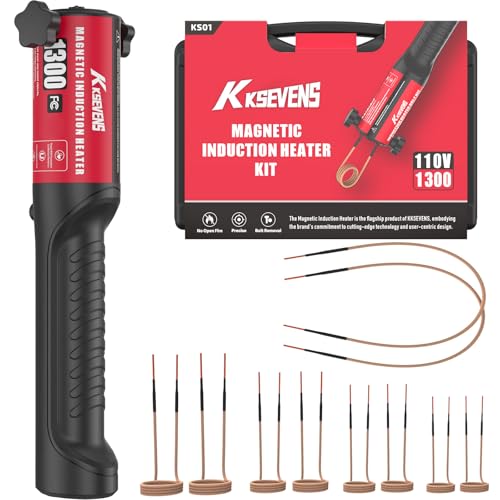
1,300W Heater with 10 Coils differs with a 10-coil kit: eight fixed coils in different sizes plus two long DIY coils. The maker describes the 1,300W, 110V handheld unit as suitable for bolt removal, heat treating and automotive repairs, and it has an ergonomic non-slip handle. This kit may appeal when having more coil pieces matters more than a specified fastener range.
Bottom line: Choose this if a 10-piece coil kit and DIY coil options are your priority.
1,500W Heater with 8 Coils

1,500W Heater with 8 Coils offers an eight-coil setup at 1,500W, between the 1,300W and 1,800W models in this comparison. The maker describes it for stuck nuts and bolts, rusty screws, exhaust hardware and bearings, and says it heats in 25 seconds without open flames or sparks. That broad repair framing may suit buyers who want one tool for automotive and workshop jobs.
Bottom line: Choose this for a 1,500W tool when its eight-coil setup suits your repair plans.
How to Choose an Induction Bolt Heater
Start with the fastener diameter and the coil that can fit around it; wattage alone does not determine whether a heater will work for your repair. Induction heats conductive metal through an alternating magnetic field, and a coil positioned close to the target generally couples more effectively than one held farther away. The workpiece’s size, material and heat loss also affect how quickly it warms.
Use a measurable rule: if your usual fasteners are 3/8 to 3/4 inch, the model that names that range gives a clearer fit than one with no stated range. For work across different access positions, compare coil shape and flexibility before comparing the total count. Higher wattage is a useful output distinction, but it does not replace a correctly sized coil.
Coil Sizes and Access for Bolt Heating
Choose a coil that can encircle the fastener without touching nearby parts; a larger gap between coil and target can reduce heating efficiency. Rigid coils are useful when the fastener is accessible and a specific shape fits, while flexible coils can be shaped around less convenient positions. Coil count alone does not tell you the usable diameter or reach.
For a concrete selection, the kit with 25 mm, 30 mm and 45 mm rigid coils names three sizes, while another includes two 600 mm flexible coils and a third adds two long DIY coils. Before ordering for a particular repair, confirm the coil’s usable inside diameter and clearance around the fastener. Keep the coil away from adjacent metal you do not intend to heat.
Induction Heating Safety Around Nearby Parts
Induction heating avoids an open flame, but the bolt and nearby metal can still become hot enough to burn skin or damage materials. Heat conducts from the fastener into connected brackets, washers and surrounding components, so a no-flame design does not make nearby wiring, fuel lines or plastic automatically safe.
Clear combustible material from the work area, wear eye protection and heat-resistant gloves, and let the part cool before handling it. Do not touch a fastener simply because the heater has been switched off. Use the tool’s cooling system and overheat protection as features, not as permission to exceed its duty limits; pause if the unit overheats or its operation changes unexpectedly.
Common Induction Bolt Heater Selection Mistakes
The most common mistake is choosing by wattage or coil count without checking fastener fit. A ten-coil kit can still be the wrong choice if none of the coils matches the bolt, while a lower-wattage tool can be a better practical match when its coil geometry suits the job. Also distinguish a fastener range from a general claim that a tool handles rusty bolts.
Another mistake is treating a maker’s heating-time claim as a guarantee for every repair. A large, heavily connected fastener can take longer to heat than a smaller isolated one because heat spreads into surrounding metal. Plan for controlled heating, protect nearby components, and use a puller or proper hand tool after loosening rather than striking a heated fastener carelessly.
Frequently Asked Questions
How does an induction bolt heater warm a fastener?
An induction coil creates a changing magnetic field that induces electrical currents in conductive metal, producing heat in the fastener. A close-fitting coil usually transfers energy more effectively than one held far away.
Can an induction heater damage nearby wiring or plastic?
Yes, nearby components can be affected by conducted heat even without an open flame. Clear or shield sensitive parts, and remember that a connected bracket can carry heat away from the bolt.
How close should the coil sit to a bolt?
Keep the coil close to the fastener without touching it or neighboring parts. A larger coil-to-metal gap can weaken coupling, so choose a coil whose shape fits the bolt and available clearance.
Do more induction heater coils mean better fit?
Not necessarily; coil dimensions matter more than the number in the kit. Check the inside diameter and shape against your fastener, since a 10-piece kit may not include the size your repair needs.
Why can a bolt take longer to heat than expected?
Fastener size, surrounding metal and heat loss all affect warm-up time. A bolt attached to a large bracket can lose heat into that mass, so a maker’s heating time is not a universal result.