
Wire Brush for Grout: 5 Options Compared

For grout, choose Lumkew V-Shaped Grout Brush, 2-Piece: its stiff polypropylene bristles are designed for grout grooves and avoid the scratching risk of metal wire. Choose SetSail V-Shaped Swivel Grout Brush instead if you need a long handle for floor work; metal-bristle brushes are better reserved for suitable hard materials, not ordinary tile grout.
We earn a commission if you buy through links on this page. As an Amazon Associate I earn from qualifying purchases. Products are compared on manufacturer specifications, not hands-on testing.
- Best overall: Lumkew V-Shaped Grout Brush, 2-Piece – Its V-shaped polypropylene bristles are made to reach narrow grout joints without metal wire.
- Best for standing work: SetSail V-Shaped Swivel Grout Brush – The pole adjusts from 26.5 to 51 inches and the head swivels 180 degrees.
- Best for mixed tasks: Six-Piece Mixed-Bristle Wire Brush Set – The set combines nylon, brass, and stainless steel brushes with small heads for tight gaps.
| Product | Best for | Bristle material | Handle length | Pack count | Shop |
|---|---|---|---|---|---|
| Lumkew V-Shaped Grout Brush, 2-Piece | Handheld grout scrubbing | PP bristles | 8.1 in | 2 brushes | Check Price on Amazon |
| SetSail V-Shaped Swivel Grout Brush | Standing floor cleaning | Stiff bristles | 26.5–51 in | 1 brush | Check Price on Amazon |
| Six-Piece Mixed-Bristle Wire Brush Set | Mixed household cleaning | Nylon, brass, stainless steel | 7 in | 6 brushes | Check Price on Amazon |
| Three-Piece Mixed Wire Brush Set | Metal and detail jobs | Nylon, brass, stainless steel | 7 in | 3 brushes | Check Price on Amazon |
| Amazon Basics Stainless Steel Mini Wire Brush, 3-Pack | Metal crevice cleaning | Stainless steel | 7 in | 3 brushes | Check Price on Amazon |
Wire brushes for grout and grout scrubbers
Choose a grout-focused nylon brush for tile joints; reserve metal bristles for surfaces that can tolerate abrasion.
Lumkew V-Shaped Grout Brush, 2-Piece

For a dedicated handheld grout tool, Lumkew V-Shaped Grout Brush, 2-Piece uses a V-shaped head and three rows of stiff polypropylene bristles to reach into narrow joints and scrub the adjacent tile area. Its 8.1-inch body has a thicker handle with a small groove to help with grip and applied pressure. The maker says the bristles stay upright after repeated scrubbing. This two-piece set suits localized cleaning around a shower, sink, or floor line. The short handle means floor-length sessions require kneeling or bending, so choose a pole brush if you need to stay upright.
Bottom line: Pick this for close, controlled scrubbing of grout lines.
SetSail V-Shaped Swivel Grout Brush

For grout cleaning without kneeling, SetSail V-Shaped Swivel Grout Brush pairs a V-shaped head with a three-section detachable metal pole that adjusts from 26.5 to 51 inches. Its head swivels 180 degrees, which helps reach tile lines from different angles, and the maker says its stiff bristles resist bending without damaging surfaces. The long reach suits open floor areas and walls more than small detail jobs. The pole takes more storage space than a handheld brush, and the features do not identify the bristle material, so check surface compatibility before scrubbing delicate tile.
Bottom line: Choose this when adjustable reach matters more than compact storage.
Six-Piece Mixed-Bristle Wire Brush Set
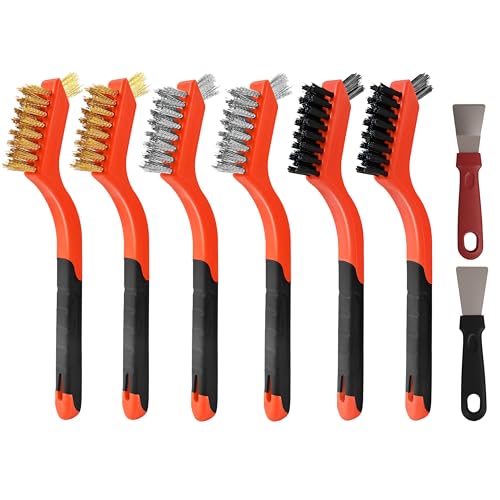
Unlike dedicated grout scrubbers, Six-Piece Mixed-Bristle Wire Brush Set is a mixed-material set with two nylon, two brass, and two stainless steel brushes, plus two cleaning scrapers. Its dual-head design includes a mini brush intended for narrow gaps such as tile grout, sink drains, and appliance seals. That makes the set useful when grout is one of several cleanup tasks, but the assortment is not a purpose-built grout brush: use the nylon head for delicate tile and avoid metal bristles on surfaces that may scratch. The short 7-inch format is for hand work, not reaching across a floor while standing.
Bottom line: Choose it for varied small cleaning jobs and use nylon on grout.
Three-Piece Mixed Wire Brush Set

For small cleaning jobs beyond grout, Three-Piece Mixed Wire Brush Set includes stainless steel, brass, and nylon brushes in a 7-inch format. The maker positions the nylon brush for delicate household appliances and the metal brushes for rust, stains, and metal parts, making it a more general-purpose set than a grout-specific scrubber. Use nylon if cleaning a tile joint; metal wire can scratch tile or wear grout, especially with force. The set is better suited to mixed material cleanup than regular grout maintenance, and its short handle means it offers no standing reach for large floor areas.
Bottom line: Pick this only if grout cleaning is one of several light-duty tasks.
Amazon Basics Stainless Steel Mini Wire Brush, 3-Pack

Unlike grout brushes, Amazon Basics Stainless Steel Mini Wire Brush, 3-Pack has stainless steel wire bristles intended for abrasive work such as rust, paint, and scale removal. Each mini brush is 7 inches long with a 1.5-inch-wide head and an offset soft-grip handle for access to tight spaces. That narrow profile may reach a crevice, but steel bristles are a poor match for routine tile grout because abrasion can scratch tile or erode grout. Keep this three-brush set for compatible hard materials rather than grout lines, and choose a nylon-bristle grout tool for bathroom or kitchen tile.
Bottom line: Use this for suitable metal cleanup, not ordinary grout scrubbing.
Choose bristles that suit tile and grout
For routine tile grout, start with nylon or polypropylene bristles, not steel wire. Tile hardness varies, and metal bristles can scratch glazed surfaces or abrade grout if pressed hard; even brass, which is softer than stainless steel, is not automatically safe for every finish. A V-shaped head concentrates bristles into a narrow joint, while a flat head covers more of the tile around it. For a small test, scrub an inconspicuous grout section with light pressure and inspect the tile finish before continuing. If the tile is polished, coated, or otherwise delicate, avoid metal bristles entirely and use a non-scratch brush.
Match brush shape and reach to the job
Handheld grout brushes around 8 inches long suit localized scrubbing in showers, around sinks, and along short floor sections. A pole brush reaching about 26 to 51 inches can reduce bending on open floors, while a swivel head can help maintain contact at different angles. More reach is not always better: a long pole is cumbersome around faucets and corners, where a short V-head gives better control. With floor grout over a broad area, choose an adjustable pole; for tight bathroom joints, choose a compact head that fits the groove.
Know when a wire brush is the wrong tool
Wire brush bristles are intended for abrasive cleanup on compatible hard surfaces, including metal rust or residue; grout and tile are not interchangeable with those surfaces. Stainless steel is harder and more aggressive than nylon, and brass can still mark finishes or loosen weak grout under pressure. Stop if grout is powdering, cracking, or coming loose, since brushing cannot repair deteriorated joints. A small nylon or polypropylene brush is the safer starting point for sound grout. Keep metal brushes for suitable metalwork, and do not substitute one just because its head fits the joint.
Scrub grout without wearing it away
Use moderate pressure and short strokes along the grout line instead of bearing down across the tile edge. Excess force, a stiff metal brush, or repeated scrubbing on deteriorated grout can remove material rather than just surface soil. Wet the area and use a cleaner labeled for the tile and grout type; acidic cleaners can damage cement-based grout and some stone, so avoid them unless the surface maker allows them. Rinse away cleaner residue and let the joint dry before assessing the result. If grout is loose or missing, repair it rather than continuing to scrub.
Brush type at a glance
Choose the brush by the surface and the reach required, not by the word “wire” alone.
| Brush type | Typical use | Grout fit |
|---|---|---|
| Nylon or polypropylene | Tile joints and delicate surfaces | Preferred starting point |
| Brass wire | Some metal cleanup jobs | Use cautiously; test first |
| Stainless steel wire | Abrasive rust and residue removal on compatible metal | Avoid on ordinary tile grout |
Frequently Asked Questions
Can a steel wire brush damage tile grout?
Yes. Stainless steel wire can scratch tile finishes and abrade grout, especially under heavy pressure, so use a nylon or polypropylene brush for routine grout cleaning.
Is brass wire safe to use on tile grout?
Not universally. Brass is softer than stainless steel, but it can still mark some finishes or wear weak grout; use a nonmetal brush unless the tile maker confirms compatibility.
What brush shape works best for narrow grout lines?
A V-shaped head can concentrate bristles into a narrow joint while its outer rows reach adjacent tile. A compact handheld brush is easier to control around corners and fixtures than a long pole.
Should grout be wet before brushing it?
Dampen the area before scrubbing to reduce dry dust and help cleaner contact the joint. Use a cleaner suitable for the grout and tile, since acids can harm cement-based grout and some stone.
When should I stop brushing old grout?
Stop if grout crumbles, cracks, or comes loose during light scrubbing. Continued abrasion can remove more material; damaged joints need repair rather than a stronger brush.