
Echo Hydrogen Water Bottles: 3 Models Compared

For an Echo hydrogen water bottle with the largest capacity and app-based tracking, choose Echo Flask Smart Hydrogen Bottle; its 12-ounce size and smart features distinguish it from the smaller Echo options. Choose Echo Go+ 10 oz for a 10-ounce sealed-top bottle, or Echo Go Glass 380 ml if you want a glass 380 ml bottle with 3- and 10-minute cycles.
Hydrogen water bottles use electrolysis to add dissolved hydrogen to water; the concentration and cycle claims here are manufacturer claims, not evidence of health effects.
We earn a commission if you buy through links on this page. As an Amazon Associate I earn from qualifying purchases. Products are compared on manufacturer specifications, not hands-on testing.
- Best overall: Echo Flask Smart Hydrogen Bottle – It combines 12-ounce capacity with an LCD touch screen and app-based hydration tracking.
- Best for sealed portability: Echo Go+ 10 oz – Its 10-ounce size, sealed top and polycarbonate construction suit carrying needs.
- Best for timed cycles: Echo Go Glass 380 ml – It gives stated 3- and 10-minute cycles with respective output claims of 1.2 and 1.8 ppm.
| Product | Best for | Capacity | Material | Stated hydrogen output | Shop |
|---|---|---|---|---|---|
| Echo Flask Smart Hydrogen Bottle | App tracking | 12 oz | — | Up to 8 ppm | Check Price on Amazon |
| Echo Go+ 10 oz | Sealed carrying | 10 oz | Polycarbonate | Adjustable; no figure given | Check Price on Amazon |
| Echo Go Glass 380 ml | Timed cycles | 380 ml | Glass | 1.2 or 1.8 ppm | Check Price on Amazon |
Echo hydrogen water bottles
Compare the Echo options by capacity, construction and the output or control features each maker specifies.
Echo Flask Smart Hydrogen Bottle

The Echo Flask is the only option here with app-based intake tracking and an LCD touch screen, making it the clearest fit for someone who wants digital hydration monitoring alongside hydrogen generation. Its 12-ounce capacity is also larger than the other two Echo bottles. The maker says output reaches up to 8 ppm; treat that as a performance claim rather than a guarantee for every water source or cycle. The feature set may be more than needed if you want a straightforward portable bottle without connected tracking.
Bottom line: Choose it if app tracking and the largest Echo capacity matter most.
Echo Go+ 10 oz
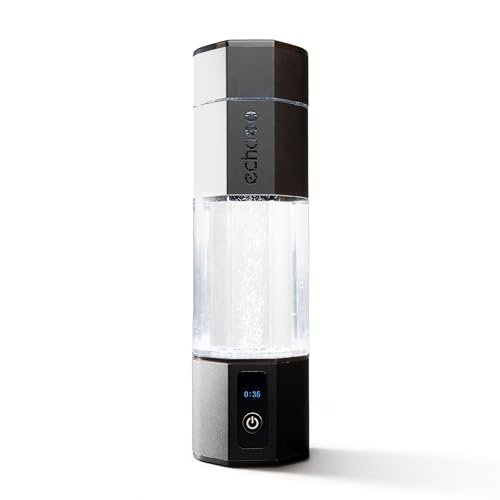
The Echo Go+ stands out for its sealed top and food-grade polycarbonate body, a practical combination for carrying a 10-ounce bottle on the move. That makes this a less direct choice for buyers comparing numerical output claims. Its capacity is below the Echo Flask’s 12 ounces, so frequent refillers may prefer the larger bottle.
Bottom line: Pick it for a sealed, lightweight-style bottle with adjustable settings.
Echo Go Glass 380 ml

The Echo Go specifies two timed cycles and corresponding output claims: 1.2 ppm after 3 minutes or 1.8 ppm after 10 minutes, making its settings more concrete than the adjustable-only Echo Go+. It has a glass bottle and 380 ml capacity. The maker says to tighten the bottle bottom and body to prevent leaks, so careful assembly matters before carrying it. Buyers who want app tracking or a capacity in ounces may find the Echo Flask easier to compare.
Bottom line: Choose it if glass construction and explicit timed cycles are your priorities.
How to compare hydrogen water bottle output
Compare stated dissolved-hydrogen concentration only when the maker also makes the cycle and measurement conditions clear. A ppm value is a concentration unit; 1 ppm in water is approximately 1 milligram per liter. Hydrogen escapes from water over time, so the time between generation and drinking can affect the amount remaining. For a meaningful comparison, look for a concentration measured at the end of a defined cycle, and note whether the bottle gives a test method. A redox-potential reading is not a direct measurement of dissolved hydrogen. If output is the deciding factor, favor a model with a numeric claim and a defined cycle over one that only says levels are adjustable.
Choosing a bottle capacity and cycle
Pick capacity around how much water you want per fill, then consider how long a cycle takes. One fluid ounce is about 29.6 ml, so a 12-ounce bottle holds about 355 ml and a 10-ounce bottle about 296 ml. Bottle capacity is not the same as the volume recommended for every generation cycle; use the maker’s fill limits. A larger vessel can reduce refills but may be less convenient to carry. The Echo Go’s options are 3 and 10 minutes, so choose the shorter cycle if speed matters more than its higher stated output claim. A timed setting alone does not establish the concentration that remains after storage.
What SPE and PEM mean in hydrogen bottles
SPE means solid polymer electrolyte, and PEM means proton exchange membrane; both terms refer to components used in electrolysis systems. In a hydrogen bottle, electrolysis separates water into gases, while the cell design and membrane help manage the process. The labels alone do not provide an output figure, test result, or a basis for ranking two bottles. Compare the cycle duration and reported dissolved-hydrogen concentration where available, and distinguish those measurable claims from broad phrases about purification or wellness. When choosing between models that use similar terminology, bottle material, capacity, controls, and the clarity of the output claim are more useful differentiators than the technology acronyms by themselves.
Cleaning and carrying a hydrogen water bottle
Clean the drinking surfaces and bottle body after use, and keep electrical charging parts dry; water and charging hardware should not be handled together. Follow the bottle maker’s cleaning directions for the cell base, since immersing an electronic generator can damage it. Check seals and threaded joints before carrying a filled bottle: loose connections can leak, and the Echo Go maker specifically calls for tightening its bottom and body. Do not assume a bottle is leakproof or dishwasher-safe unless its maker confirms that specific use. Hydrogen can dissipate after generation, so drink soon after a cycle rather than treating the bottle as a long-term storage container.
Frequently Asked Questions
How long does hydrogen water stay in a bottle?
Dissolved hydrogen can escape from water over time, so drinking soon after generation is the practical choice. The rate depends on bottle sealing, headspace and storage conditions; a cycle’s initial output does not establish the amount remaining hours later.
Does a higher ppm number mean better hydrogen water?
A higher ppm claim indicates a higher stated concentration, not a proven health benefit. Compare values only when the cycle time and measurement conditions are comparable, since otherwise the figures may not describe the same thing.
Can I use any water in a hydrogen water bottle?
Use water compatible with the bottle maker’s instructions, because dissolved minerals and contaminants can affect electrolysis cells. Avoid assuming that a hydrogen generator makes unsafe water safe to drink; hydrogen generation is not a substitute for water treatment.
What does a hydrogen bottle’s ppm figure measure?
PPM expresses concentration, and in water 1 ppm is approximately 1 milligram per liter. A meaningful bottle comparison also needs the cycle duration and a dissolved-hydrogen measurement, rather than an oxidation-reduction potential reading alone.
Should hydrogen water be stored after a cycle?
Drink it soon after generation because dissolved hydrogen can dissipate. A sealed container may slow gas loss, but the amount retained depends on closure, headspace and elapsed time.