
Best Indoor FM Antenna for Stereo Receiver: 4 Picks

Bingfu Adhesive FM Dipole suits most stereo receivers because its 10-foot cable and three included connector adapters make placement and connection more flexible. Choose Magnetic Base FM Antenna, 16 ft or Superbat Magnetic Base FM Antenna instead if you want a magnetic base, or Antop Amplified AM/FM Indoor Antenna if you need an amplified AM/FM antenna.
An indoor FM antenna receives broadcast signals for a tuner; position and orientation can matter as much as antenna style.
We earn a commission if you buy through links on this page. As an Amazon Associate I earn from qualifying purchases. Products are compared on manufacturer specifications, not hands-on testing.
- Best overall: Bingfu Adhesive FM Dipole – A 10-foot extension cable and three connector adapters support flexible placement and connections.
- Best for long cable reach: Magnetic Base FM Antenna, 16 ft – Its 16-foot cable and magnetic base allow positioning away from the receiver.
- Best for AM/FM: Antop Amplified AM/FM Indoor Antenna – The amplified antenna is designed for both AM and FM and includes matching connector adapters.
| Product | Best for | Design | Cable length | Connections | Shop |
|---|---|---|---|---|---|
| Bingfu Adhesive FM Dipole | Flexible connections | Adhesive dipole | 10 ft | F plug; 3 adapters | Check Price on Amazon |
| Magnetic Base FM Antenna, 16 ft | Longer cable reach | Retractable magnetic base | 16 ft | 75-ohm coaxial | Check Price on Amazon |
| Superbat Magnetic Base FM Antenna | Portable placement | Portable magnetic base | — | F plug; 3 adapters | Check Price on Amazon |
| Antop Amplified AM/FM Indoor Antenna | AM and FM reception | Amplified multi-directional | — | FM F female; AM spring clip | Check Price on Amazon |
Indoor FM Antennas for Stereo Receivers
Compare antenna style, cable reach and connector options to match your receiver and room layout.
Bingfu Adhesive FM Dipole

Bingfu Adhesive FM Dipole is the only adhesive-mounted dipole in this group, and its 10-foot cable gives more placement flexibility than a short receiver-side antenna. The package includes an F-type plug plus adapters for TV female socket, 3.5 mm audio plug and TV male plug connections. The maker says the antenna improves FM stereo reception, and lists compatibility with several receiver brands. It suits a setup where the included plug does not match the receiver or where the antenna needs to reach a wall. The limitation is that its adhesive mounting requires a suitable surface and placement spot.
Bottom line: Choose this if your receiver needs an adapter or you want an adhesive-mounted dipole.
Magnetic Base FM Antenna, 16 ft

Magnetic Base FM Antenna, 16 ft has the longest specified cable here at 16 feet, paired with a retractable antenna and magnetic base for positioning on a metal surface. The maker says it is designed to improve indoor FM reception and is compatible with a range of receiver brands. That extra reach can help when the receiver sits away from a window or a better signal location. Choose it if a magnetic mounting point is available and the 75-ohm coaxial connection fits your setup. Its tradeoff is the dependence on a metal surface for stable magnetic placement.
Bottom line: Pick this when extra cable reach and a metal mounting spot matter most.
Superbat Magnetic Base FM Antenna

Superbat Magnetic Base FM Antenna stands out for a portable magnetic base, which can be repositioned on a metallic surface rather than fixed to a wall. It has an F-type male plug and includes TV female socket, TV male plug and 3.5 mm audio plug adapters. The maker describes it for indoor stereo receivers and radio tuners, and says it can be carried and set up on a metal surface. This is a useful fit for a movable radio setup or someone who wants to experiment with placement. No cable length is provided, so verify that the included cable reaches your intended spot before ordering.
Bottom line: Choose this for portable magnetic placement and multiple adapter options.
Antop Amplified AM/FM Indoor Antenna
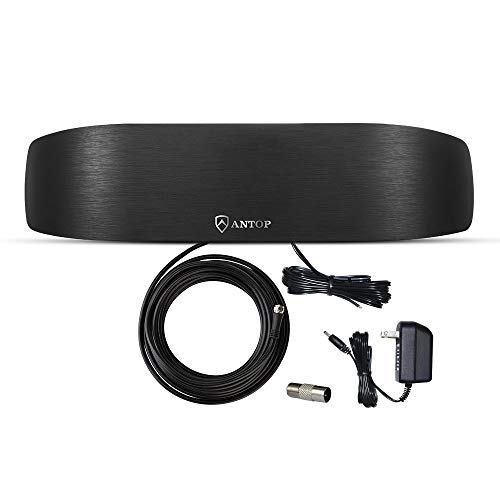
Antop Amplified AM/FM Indoor Antenna is the only amplified AM/FM model here, with a multi-directional design, signal booster and 4G filter. It includes an IEC male-to-F female coax adapter and connections for an FM F female input and AM spring clips. The maker gives a 50-mile range claim; actual reception depends on local broadcast signals and antenna placement. Choose it if you want one indoor antenna for both AM and FM and your receiver supports the included connections. Its connector types differ from the F-type male plugs on the other choices, so check the receiver’s input before choosing.
Bottom line: Choose this for an amplified indoor antenna serving both AM and FM.
How to Choose an Indoor FM Antenna
Start with the receiver connection, then choose the antenna style and cable reach that fit your room. FM broadcast spans roughly 88 to 108 MHz, so signal reception depends on frequency, antenna orientation and obstacles such as walls or metal. A simple dipole can work well when positioned away from the receiver and rotated to find a clearer signal; an amplified model adds electronics but cannot guarantee reception where the broadcast signal is weak. Match the antenna’s plug or adapter to the receiver’s FM input before buying. For a placement point more than 10 feet from the receiver, favor a cable length that reaches without stretching or running across a walking path.
Where to Place an Indoor FM Antenna
Place an indoor FM antenna high and near an exterior wall or window, then rotate or reposition it while checking reception. Buildings, hills and nearby electronics can affect the signal, and a few feet of movement may change reception. Keep the antenna away from large metal objects that can interfere with the signal; a magnetic base needs a metal surface to hold securely. For a dipole, spread or orient its elements rather than bunching them beside the receiver. If reception remains poor in several positions, an indoor antenna may not overcome weak local coverage; an outdoor antenna may be the more suitable category.
FM Antenna Styles and Connections
Dipole, magnetic base and amplified antennas solve different setup problems. A dipole mounts flat or on a wall and its orientation can be adjusted; a magnetic base is convenient when a nearby metal surface is available. Amplified indoor models may support both AM and FM, but they still need the correct receiver inputs. Use this guide to narrow the style before comparing adapters.
| Setup need | Style to consider | Check before choosing |
|---|---|---|
| Wall or flat mounting | Adhesive dipole | Mounting surface and cable reach |
| Moveable mounting on metal | Magnetic base | Metal surface and receiver plug |
| One antenna for AM and FM | Amplified AM/FM | FM and AM input types |
Connector names matter: F-type, TV coaxial and 3.5 mm plugs are not interchangeable without the right adapter. Match the receiver’s socket to the antenna plug before installation.
Common Indoor FM Antenna Setup Mistakes
A common mistake is leaving the antenna coiled behind the receiver, where nearby wiring and the cabinet can affect reception. Uncoil and reposition it, then compare reception at several orientations before deciding the location is unsuitable. Another mistake is choosing by a maker’s distance claim alone: range does not account for terrain, building materials or station power. Confirm that any adapter matches the receiver’s actual socket, and avoid forcing a plug that does not fit. Keep long cables routed where they will not be pulled or tripped over; a longer cable helps placement only when it can be routed safely.
Frequently Asked Questions
How long should an indoor FM antenna cable be?
Choose a cable long enough to reach a higher or window-side location without tension; 10 to 16 feet can cover many room layouts. A longer cable is useful only if it can be routed without crossing a walkway.
Does turning an FM antenna improve reception?
Yes, changing the antenna’s angle or position can improve reception because FM signals are affected by obstructions and orientation. Try several positions near a window or exterior wall before settling on one.
Can one indoor antenna receive AM and FM?
Some indoor models are designed for both bands and use separate AM and FM connections. Confirm that the receiver has inputs matching those connections, since FM coax and AM spring clips are different.
What connector does a stereo receiver FM antenna use?
Receiver inputs vary, so check the socket shape before choosing an antenna. F-type coax, TV coaxial and 3.5 mm plugs need matching inputs or a compatible adapter.
Will an indoor FM antenna work through a wall?
FM signals can pass through some building materials, but concrete, metal and dense construction can weaken reception. Place the antenna near a window or exterior wall and reposition it if reception is inconsistent.