
Ontel Miracle Smile Water Flosser: 4 Models Compared

Ontel Miracle Smile Water Flosser is the Ontel Miracle Smile water flosser to consider if you want its H-shaped head, four water jets and three pressure modes. Choose another model if a tank capacity, built-in nozzle storage or a separate tongue-cleaner tip matters more.
A water flosser directs a pulsating stream between teeth and along the gumline; it complements brushing rather than replacing it.
We earn a commission if you buy through links on this page. As an Amazon Associate I earn from qualifying purchases. Products are compared on manufacturer specifications, not hands-on testing.
- Best overall: Ontel Miracle Smile Water Flosser – Its H-shaped flossing head has four water jets and three pressure modes.
- Best for nozzle storage: COSLUS C51 Water Flosser – The compact body stores two nozzles and has a 300 mL tank.
- Best for shower use: Waterpik Cordless Pulse 3100 – It is rechargeable, designed for shower use and includes a tongue-cleaner tip.
| Product | Best for | Head or tip design | Pressure options | Tank capacity | Shop |
|---|---|---|---|---|---|
| Ontel Miracle Smile Water Flosser | H-shaped head | H-shaped head; 4 jets | 3 pressure modes | — | Check Price on Amazon |
| COSLUS C51 Water Flosser | Nozzle storage | 2 stored nozzles | 3 modes; 6 pressure levels | 300 mL | Check Price on Amazon |
| COSLUS C20 Water Flosser | Large reservoir | — | Multiple operation modes | 300 mL | Check Price on Amazon |
| Waterpik Cordless Pulse 3100 | Shower use | Precision tip; tongue cleaner | 2 settings | 6 oz | Check Price on Amazon |
Ontel Miracle Smile Water Flosser and Alternatives
Compare the head designs, pressure choices and reservoir capacities that distinguish these cordless water flossers.
Ontel Miracle Smile Water Flosser

The H-shaped flossing head with four water jets sets this model apart from the conventional tip designs in this group. It is cordless and USB rechargeable, with three pressure modes for choosing a preferred setting. The design suits shoppers specifically seeking the Ontel Miracle Smile’s multi-jet head.
Bottom line: Pick this if the H-shaped head and four jets are the features you want.
COSLUS C51 Water Flosser

The C51 distinguishes itself with storage for two nozzles inside its compact body, rather than the H-shaped head design of the Ontel model. It has a 300 mL tank, three modes and six pressure levels, and is described for orthodontic use, sensitive gums and multiple users. That combination suits households sharing a flosser or travelers who want nozzles kept with the device. The charging adapter is not included; check that a compatible USB-C power source is available, as the cable transition is underway.
Bottom line: Choose this for stored nozzles and six pressure levels.
COSLUS C20 Water Flosser

The C20 is a black portable model with a 300 mL tank, giving it a reservoir capacity that the Ontel model does not provide. It is rechargeable and cordless, and the product name identifies orthodontic and sensitive-gum use as intended purposes. The maker describes its water pulse technology as using dual threads and gives a pulse rate of 1,400–1,800 per minute.
Bottom line: Choose this if the 300 mL reservoir is your priority.
Waterpik Cordless Pulse 3100
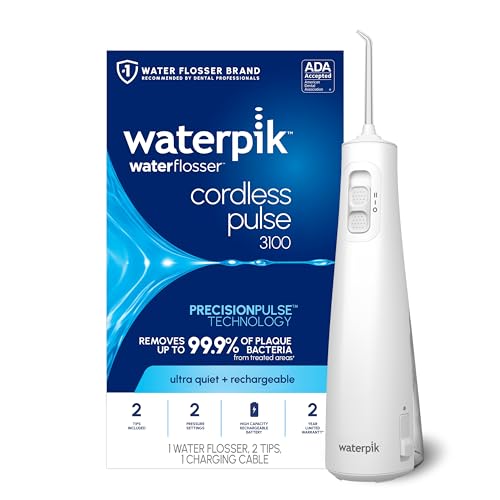
It has two settings and a removable 6-ounce reservoir, plus a rechargeable battery and non-slip grip. The two-tip set includes one precision tip and one tongue-cleaner tip. This is a practical fit for someone who wants that accessory combination and shower compatibility. Its two settings offer fewer pressure choices than the Ontel’s three modes, so shoppers seeking more selectable modes may prefer another option.
Bottom line: Pick this for shower compatibility and a tongue-cleaner tip.
How to choose a water flosser
Choose by head access, pressure control and reservoir size, not by mode count alone. A standard flosser tip is easier to steer tooth by tooth, while a multi-jet head directs water across a broader area; either way, the user still needs to guide the stream along the gumline. A 300 mL reservoir holds about 10 fluid ounces, while a 6-ounce tank holds less and may need refilling sooner. Start with the lowest comfortable pressure, especially if the gums are sensitive, then increase only if needed. A model with six pressure levels offers finer adjustment than one with two settings, but the extra steps matter only if you want that control.
How to use a water flosser safely
Use a water flosser over a sink and keep the stream aimed into the mouth to limit splashing. Place the tip near the gumline, lean over the basin and move slowly from tooth to tooth; pause briefly between teeth rather than sweeping quickly across the front surfaces. A low pressure setting is a sensible starting point for new users, and a stream should not cause pain or persistent bleeding. Water flossing removes debris from hard-to-reach spaces but does not replace brushing with fluoride toothpaste. For braces, direct water around brackets and beneath the wire, using a tip that can reach those spaces.
Water flosser head designs and reservoir sizes
Head shape affects handling, while tank volume affects how often a refill interrupts a session. A conventional precision tip offers targeted placement, and an H-shaped multi-jet head covers a broader path in one pass; neither design removes the need to trace the gumline. The reservoir figures below are those given for these models, converted to fluid ounces where needed.
| Design or capacity | What it means for choice |
|---|---|
| H-shaped, four-jet head | Consider when you want a multi-jet head design |
| Precision tip | Consider when you want a targeted stream |
| 300 mL, about 10.1 fl oz | More capacity than a 6 fl oz reservoir |
| 6 fl oz reservoir | Smaller tank; expect to refill sooner |
Reservoir size alone does not establish how long a tank lasts: pressure, flow rate and pauses all affect water use. For users who want fewer refills, choose a 300 mL tank over a 6-ounce tank.
Frequently Asked Questions
Should a water flosser replace brushing teeth?
No. Water flossing is an add-on to brushing with fluoride toothpaste, not a substitute for it. Brush for two minutes twice daily and use the flosser to clean between teeth and along the gumline.
What pressure should a new water flosser user start with?
Start at the lowest setting and raise it only if the stream feels comfortable. Stop if the stream causes pain or persistent bleeding, and seek dental advice if those symptoms continue.
How do you use a water flosser with braces?
Aim the stream around each bracket and beneath the wire, moving slowly from tooth to tooth. A low initial pressure setting helps with control while you learn to direct the stream.
Is a 300 mL water flosser tank larger than 6 ounces?
Yes. A 300 mL reservoir is about 10.1 U.S. fluid ounces, compared with 6 fluid ounces, so the larger tank holds about 4.1 fluid ounces more.
Can you use a cordless water flosser in the shower?
Only use a model identified for shower use. The Cordless Pulse 3100 is described as suitable for shower use; do not assume that another cordless model has the same protection.