
Stainless Steel Vinyl Wrap for Appliances Compared

For most appliance projects, Extra-Wide Silver Contact Paper is the easiest fit to plan around because its 48-inch width can cover broad, flat panels with fewer joins. Choose a narrower roll if you are wrapping a small panel or need a manageable strip; contact paper is a thin, adhesive-backed film for decorating smooth surfaces.
These wraps imitate a stainless-steel look rather than adding a metal appliance surface, so measure the face and sides you intend to cover before choosing a roll.
We earn a commission if you buy through links on this page. As an Amazon Associate I earn from qualifying purchases. Products are compared on manufacturer specifications, not hands-on testing.
- Best overall: Extra-Wide Silver Contact Paper – Its 48-inch width suits broad panels and can reduce the number of joins.
- Best for long runs: 24-Inch Stainless Steel Contact Paper – The 118-inch roll length works for tall panels or multiple smaller sections.
- Best for precise cutting: Cohoo Home Silver Contact Paper – Grid lines on the backing help guide measured cuts.
- Best for brushed finish: Livelynine Brushed Nickel Contact Paper – Its brushed-nickel finish differs from the other silver options.
| Product | Best for | Roll width | Roll length | Shop |
|---|---|---|---|---|
| Extra-Wide Silver Contact Paper | Broad appliance panels | 48 in | 80 in | Check Price on Amazon |
| 24-Inch Stainless Steel Contact Paper | Long appliance runs | 24 in | 118 in | Check Price on Amazon |
| Cohoo Home Silver Contact Paper | Guided measuring | 17.7 in | 78.7 in | Check Price on Amazon |
| Livelynine Brushed Nickel Contact Paper | Brushed appearance | 15.8 in | 78.8 in | Check Price on Amazon |
Stainless Steel Vinyl Wrap for Appliances
Compare each roll’s dimensions and finish, then match the usable sheet area to the panels you plan to cover.
Extra-Wide Silver Contact Paper

The 48-inch width is the main distinction of this roll, making it a practical starting point for broad refrigerator or dishwasher panels where a narrower sheet may require more joins. The 80-inch length gives you room to plan a large face or several smaller sections. The vinyl film has a smooth, silver metallic appearance and a self-adhesive backing; the maker says it is waterproof, oil-proof, removable, and heat resistant. Measure each panel before cutting, since one continuous piece still needs to fit the panel’s shape and edges. This wide roll may be harder to handle alone than a narrower strip.
Bottom line: Choose this for a broad, flat appliance face where extra width can simplify coverage.
24-Inch Stainless Steel Contact Paper

The 118-inch length makes this roll stand out for tall appliance fronts or several smaller projects, while its 24-inch width is narrower than Extra-Wide Silver Contact Paper. Its dimensions cover about 19.67 square feet before trimming, based on the roll measurements. The maker describes it as waterproof and says it can be applied to flat appliance paint; it is not magnetic, despite its metal-like appearance. That distinction matters if you expect magnets to stick to the finished surface. A 24-inch width can leave a seam on a panel wider than the roll, so plan the seam position before applying.
Bottom line: Pick this for longer sections where a 24-inch strip is wide enough.
Cohoo Home Silver Contact Paper
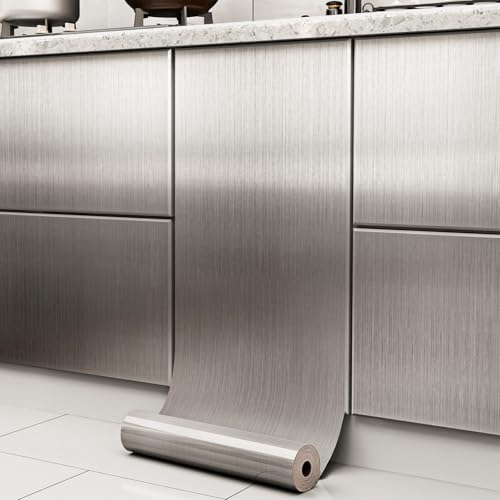
Grid lines on the backing make this 17.7-by-78.7-inch roll the choice for buyers who want a visible guide while cutting. The maker identifies the film as PVC and says it is waterproof, removable, and suitable for smooth surfaces such as refrigerators, countertops, and cabinets. Its coverage is 9.71 square feet, making it a smaller-format choice than the 24-inch and 48-inch rolls. The grid can guide straight measurements, but it does not replace checking the appliance’s curves, handles, or edges before cutting. The relatively narrow width may require a seam on broad doors.
Bottom line: Choose this when backing grid lines are useful for measuring a smaller project.
Livelynine Brushed Nickel Contact Paper

The brushed-nickel look sets this roll apart from the other silver metallic options, so it suits a project where a brushed texture is the priority. It measures 15.8 by 78.8 inches and covers 8.65 square feet. The maker describes the material as aluminum vinyl and says it is self-adhesive, removable, waterproof, and oil-proof; grid lines on the backing support measured trimming. Its narrow width is limiting on broad refrigerator doors, where multiple strips may be needed. Check the appearance against nearby handles and trim before covering a full appliance, since a brushed look is visually distinct from a plain metallic finish.
Bottom line: Pick this for a smaller panel when a brushed-nickel appearance is the goal.
How to choose appliance vinyl wrap
Start with the surface area and the roll width, because width determines how many joins a broad panel may need. Measure the height and width of each flat section, add the sides you intend to cover, and compare that total with the roll’s usable dimensions; trimming and alignment consume material. Smooth, clean, dry, nonporous surfaces generally give adhesive films a better chance to bond than textured or dusty ones. A measurable rule: if a single panel is wider than the roll, plan for a seam or choose a wider sheet. Avoid placing decorative film over vents, controls, or surfaces exposed to direct appliance heat. Treat claims such as heat resistance as a maker claim, not proof that the film is suitable beside burners or heating elements.
Measure appliance panels before cutting
Measure each face at its widest and tallest points, then account separately for door edges, handles, and side panels. A roll’s width and length describe the sheet, not necessarily the amount that will remain after trimming around corners and hardware. For a panel wider than the selected roll, decide where the seam will fall before cutting; align it with a natural edge or divide the panel into balanced strips. This simple chart compares the available widths with their best planning use, not guaranteed finished coverage.
| Roll width | Planning implication |
|---|---|
| 48 in | Most room for broad panels |
| 24 in | Long strips with moderate width |
| 17.7 in or 15.8 in | Smaller panels or multiple joined strips |
Round measurements up rather than down: a short cut cannot be stretched to cover a missed edge.
Prepare the surface and apply the film
Clean and fully dry the appliance surface before applying adhesive film; grease, dust, and moisture can interfere with contact. Remove or work around detachable handles when practical, and mark cut lines on the backing so the visible face stays clean. Apply the sheet gradually from one edge, smoothing as you go to limit trapped air and wrinkles. Curved corners and recessed panels are harder than flat faces because film must conform without pulling away; cut relief slits only where they will remain hidden. Keep the film away from seams, vents, control labels, and hot zones. A decorative wrap is not a repair material or a substitute for the appliance’s original surface.
Where appliance contact paper is and is not suitable
Adhesive contact paper is best suited to smooth, flat appliance exteriors, not every surface in a kitchen. Painted metal can be a candidate when clean and sound, while textured coatings, damaged paint, and oily residue make adhesion less predictable. Do not cover burners, oven interiors, exhaust vents, or parts that become hot during normal operation; vinyl film is not a heat shield. Before wrapping a refrigerator or dishwasher, consider edges and door movement so the film does not bridge a moving gap or obstruct a seal. Test a small hidden area if removability matters, because adhesive can interact differently with finishes and age. Keep the film clear of manufacturer labels and safety markings.
Frequently Asked Questions
Can stainless steel contact paper go on a refrigerator?
Yes, smooth refrigerator exteriors are a common surface for adhesive contact paper. Clean and dry the finish first, and avoid covering seals, vents, controls, or safety labels.
Will magnets stick to stainless steel vinyl wrap?
Not necessarily: a metal-look vinyl film does not make the surface magnetic. One of these wraps explicitly says it is not magnetic, so do not rely on a decorative covering to hold magnets.
How do I avoid seams on a fridge door?
Choose a roll wider than the panel’s measured width if you want to cover it in one piece. A panel wider than the sheet needs a planned seam or multiple strips, and trim allowance reduces usable width.
Can I put vinyl wrap beside a stove?
Keep vinyl away from burners and other surfaces exposed to direct heat. Heat-resistance claims do not establish safe use at every temperature, so do not use decorative film as a heat barrier.
How should I clean wrapped appliances?
Use a soft damp cloth and avoid abrasive pads or sharp scrapers that can scratch or lift the film. One maker recommends wiping with a wet cloth; always keep cleaning gentle around edges and seams.