
Heated Scarves for Women: 4 Models Compared

For a long, wrap-style heated scarf, choose EN’DA Rechargeable Heated Scarf: its 78.5-by-12-inch size gives more coverage than the compact neck warmer design of Kannino Graphene Heated Neck Scarf. Heated scarves use battery-powered heating elements to warm the neck; choose a different model if you want a temperature range or runtime to guide your decision.
We earn a commission if you buy through links on this page. As an Amazon Associate I earn from qualifying purchases. Products are compared on manufacturer specifications, not hands-on testing.
- Best overall: EN’DA Rechargeable Heated Scarf – Its 78.5-by-12-inch dimensions suit buyers seeking a longer, wider scarf.
- Best for runtime guidance: Eventek Heated Scarf – It gives maker-claimed runtimes of 4–8 hours at three heat settings.
- Best for larger battery capacity: Graphene Heated Neck Warmer – Its 6,000mAh battery is the largest capacity given among these options.
- Best for compact fit: Kannino Graphene Heated Neck Scarf – Its 33.5-by-3.5-inch dimensions make it the narrowest, shortest option.
| Product | Best for | Battery capacity | Temperature settings | Dimensions | Shop |
|---|---|---|---|---|---|
| EN’DA Rechargeable Heated Scarf | Long scarf coverage | 5,000mAh | 3 levels | 78.5 × 12 in | Check Price on Amazon |
| Eventek Heated Scarf | Runtime guidance | 5,000mAh | 3 levels | — | Check Price on Amazon |
| Graphene Heated Neck Warmer | Larger battery capacity | 6,000mAh | — | — | Check Price on Amazon |
| Kannino Graphene Heated Neck Scarf | Compact neck coverage | 5,000mAh | 3 levels | 33.5 × 3.5 in | Check Price on Amazon |
Heated scarves for women
Compare the battery, heat controls and dimensions to find a heated scarf that suits your preferred coverage.
EN’DA Rechargeable Heated Scarf
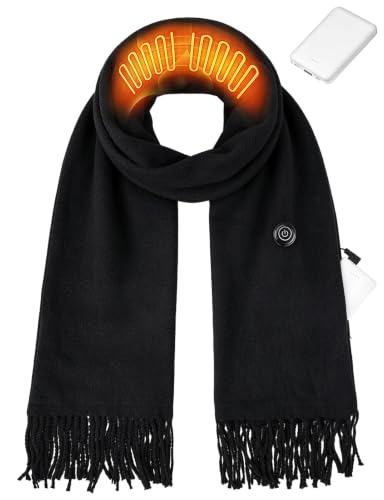
EN’DA Rechargeable Heated Scarf stands out for its 78.5-by-12-inch dimensions, which offer a long, wide scarf shape rather than a narrow neck wrap. It comes with a 5,000mAh rechargeable battery and uses a long press on the power button to turn on and switch among three temperature levels. The maker says it heats in 5 seconds and uses a temperature-control chip for even heating.
Bottom line: Choose this if you want a long, wide heated scarf.
Eventek Heated Scarf

Eventek Heated Scarf is the option with the clearest heat-level and runtime breakdown: its maker claims up to 8 hours on low, 6 hours on medium and 4 hours on high. The temperatures are 106–109°F, 113–122°F and up to 131°F, respectively. The scarf has a 5,000mAh rechargeable battery, which the maker says weighs 100 grams, and a built-in sensor with over-temperature protection. Pick it if choosing a setting by heat and duration matters.
Bottom line: Choose this if stated runtimes help you plan wear time.
Graphene Heated Neck Warmer

Graphene Heated Neck Warmer differs from the scarf-shaped options by being described as a neck warmer, with graphene heating directed to the neck area. It has a built-in 6,000mAh lithium-polymer battery and a button control. The maker says the graphene element provides fast, stable and evenly distributed warmth. This is a fit for someone prioritizing the largest battery capacity here and a simple control.
Bottom line: Choose this if battery capacity is your main comparison point.
Kannino Graphene Heated Neck Scarf

Kannino Graphene Heated Neck Scarf is the shortest and narrowest option by the dimensions provided: 33.5 by 3.5 inches, in a one-size design. It pairs a 5,000mAh battery with three graphene heating levels; the maker gives approximate temperatures of 104°F, 122°F and 140°F. The one-sided thick plush construction is intended to cover the neck. Choose it for a compact neck-focused wrap rather than broad scarf coverage.
Bottom line: Choose this for a narrow wrap focused on the neck.
How to choose a heated scarf
Choose by coverage, controls and the battery information you can compare. A long scarf can wrap differently from a narrow neck warmer, so compare dimensions rather than relying on the word “scarf” alone. Battery capacity is measured in milliamp-hours (mAh), but capacity by itself does not determine runtime: heat setting, heating element and battery design also affect how long a device runs. When the maker provides hours by setting, treat those as estimates for that model, not a guarantee for every use. For a long outdoor outing, favor a model with a runtime at the setting you expect to use. If heat sensitivity is reduced, use extra caution with any electrically heated wearable; stop use if the heat feels uncomfortable.
| Need | What to compare |
|---|---|
| More scarf coverage | Length and width |
| Planned wear duration | Runtime by heat setting |
| Neck-focused fit | Neck warmer style and dimensions |
Heated scarf fit and coverage
Use the scarf’s length and width to estimate coverage before choosing a style. A scarf measuring 78.5 by 12 inches offers substantially more material to arrange around the neck than a 33.5-by-3.5-inch wrap. Those measurements do not establish how a scarf will fit every wearer, since how it is tied and layered changes its reach. If you need to cover the lower face or tuck the ends into a coat, look for adequate length and width for that arrangement. If a compact neck-only wrap is the goal, a narrower design may be less bulky. Do not cover or fold a heating area in a way the maker prohibits; check the product’s use guidance for safe wearing and battery placement.
Heat settings and battery runtime
More heat generally uses battery power faster than a lower setting, so compare runtime at the temperature you expect to wear. One maker claims 8 hours at 106–109°F on low, 6 hours at 113–122°F on medium and 4 hours at up to 131°F on high for its model. Those figures are maker claims for that product, not universal runtimes for heated scarves. A 5,000mAh or 6,000mAh battery figure alone cannot predict the hours of warmth because mAh does not specify the heating element’s power draw. For commuting or outdoor use, choose a model with a runtime at your preferred setting and carry a charged battery only as directed by its maker.
Safe use and care for heated scarves
Use an electrically heated scarf only as directed and stop wearing it if the heat becomes uncomfortable. Heated wearables place a heat source close to skin; people with reduced heat sensation should take particular care because they may not notice excessive warmth promptly. Keep the battery and electrical connections dry unless the maker explicitly says otherwise, and disconnect power before cleaning. Do not assume a fabric is machine washable: washability depends on the heating element, wiring and battery connection. Check whether the battery must be removed and what cleaning method is permitted before washing. Store the scarf dry, with the battery disconnected if the maker directs, and inspect the cable and connector for damage before use.
Frequently Asked Questions
How long do heated scarves run on one charge?
Runtime depends on the battery, heating system and selected heat level. One model here has maker-claimed runtimes of 4 to 8 hours across its three settings; do not treat that as a runtime guarantee for other scarves.
Does a higher mAh battery last longer?
A higher mAh rating indicates greater battery capacity, but it does not by itself establish longer runtime. Heating-element power draw and heat setting also affect how long the battery lasts.
Can I wash a battery-powered heated scarf?
Only clean it using a method approved for that specific scarf. Disconnect the battery before cleaning, and verify whether the battery must be removed and whether hand washing or machine washing is permitted.
Are heated scarves safe for sensitive skin?
People with reduced heat sensation should use extra caution because a close-to-skin heat source may become uncomfortable before they notice. Stop use if the scarf feels too hot, and follow the maker’s safety directions.
What size heated scarf should I choose?
Choose based on the coverage you want: longer and wider dimensions allow more material to wrap or drape, while narrow, short dimensions suit a neck-focused fit. If you need a specific wrap or tuck, compare the actual measurements with the coverage required.