
Bio Cleaner Cleaning Clay: Earth Brite Compared

Earth Brite’s 7-ounce clay cleaner is the closest match for bio cleaner cleaning clay because it is a white-clay product for hard, non-porous surfaces. Choose a different pack size if you want two tubs or a larger bundle with accessories.
Cleaning clay is a solid or paste-like cleaner used with a sponge; abrasive particles can mark delicate finishes, so test a hidden spot before cleaning a visible area.
We earn a commission if you buy through links on this page. As an Amazon Associate I earn from qualifying purchases. Products are compared on manufacturer specifications, not hands-on testing.
- Best overall: Earth Brite Clay Cleaner, 7 oz – The single 7-ounce white-clay bar is the straightforward choice for trying the product type.
- Best for a two-tub supply: Earth Brite Clay Cleaner, 2-Pack – The pack contains two 7-ounce tubs of Earth Brite clay cleaner.
- Best for bundled accessories: Earth Brite Clay Cleaner Bundle, 3-Pack – The bundle combines clay cleaner tubs with a sponge and bonus towel kit.
| Product | Best for | Pack size | Cleaner type | Shop |
|---|---|---|---|---|
| Earth Brite Clay Cleaner, 2-Pack | Two-tub supply | 7 oz × 2 | White-clay bar | Check Price on Amazon |
| Earth Brite Clay Cleaner, 7 oz | Single-tub trial | 7 oz × 1 | White-clay bar | Check Price on Amazon |
| Earth Brite Clay Cleaner Bundle, 3-Pack | Accessory bundle | 7.05 oz × 3 | White-clay cleaner | Check Price on Amazon |
Bio Cleaner Cleaning Clay Options
Compare the matching clay cleaners by quantity and included accessories before choosing a pack.
Earth Brite Clay Cleaner, 2-Pack

The two-tub pack is the choice when one tub may not be enough for your cleaning routine. Each tub contains 7 ounces of Earth Brite white-clay cleaner. The maker describes it as suitable for hard, non-porous surfaces including stainless steel, glass, and PVC, and says it cleans, polishes, and protects in one step.
The larger quantity is useful for keeping a spare, but it is less suitable if you want to try a single tub first. Test an inconspicuous area before use, especially on a finish that could be scratched by an abrasive cleaner.
Bottom line: Choose this pack if you want two 7-ounce tubs of the same clay cleaner.
Earth Brite Clay Cleaner, 7 oz
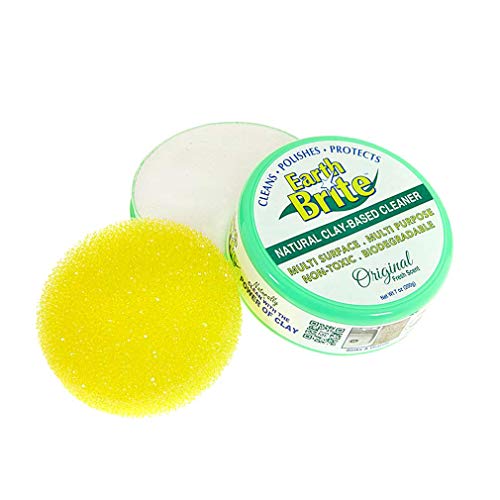
The single 7-ounce tub gives you Earth Brite’s white-clay cleaner without committing to a multi-tub pack. The maker identifies hard, non-porous surfaces such as stainless steel, glass, and PVC as suitable uses, including stovetops, bathtubs, and tiles. The product is also described as biodegradable and free of bleach and ammonia.
This is the simplest match if you want one tub for occasional cleaning. Its limitation is quantity: households cleaning several areas regularly may prefer a multi-pack. Clay cleaners can scratch sensitive coatings, so try a small hidden area first and avoid delicate finishes unless their care guidance allows abrasive cleaners.
Bottom line: Pick the single tub if you want to try a clay cleaner or need one tub for occasional use.
Earth Brite Clay Cleaner Bundle, 3-Pack

The three-pack bundle stands apart by including a sponge and a bonus diamond towel cleaning kit with the clay tubs. The product name gives the tub size as 300 grams, while the pack details specify 7.05 ounces per pack; Earth Brite’s cleaner is described as white clay for hard, non-porous surfaces such as stainless steel, glass, PVC, and tile.
The accessories may suit someone assembling a cleaning set, but the bundle is more than a single-tub buyer needs. Before using a clay cleaner on any surface, check a hidden area for scratching or dulling, particularly on polished or coated finishes.
Bottom line: Choose this bundle if you want multiple tubs and the included sponge and towel kit.
How to Choose Bio Cleaner Cleaning Clay
Start with the surface you plan to clean, then compare tub quantity and accessories. Earth Brite identifies hard, non-porous surfaces including stainless steel, glass, and PVC, while its product names also call out stovetops, tubs, tiles, and grills. That does not mean every finish on those objects is identical: coatings and polished surfaces can be more vulnerable to abrasion than bare material.
Use a simple decision rule: if the surface has a delicate coating, a high-gloss finish, or a care label warning against abrasives, do not use clay cleaner until you have confirmed compatibility. Otherwise, test an inconspicuous area first and check for scratching, dulling, or residue. Then select one tub for occasional jobs, two for a spare, or the larger accessory bundle if you need its included tools.
Clay Cleaner Surface Fit and Scratch Risk
Clay cleaner is intended here for hard, non-porous surfaces, but suitability depends on the finish as well as the base material. Stainless steel can be brushed, polished, or coated; glass can be treated or textured; and bathroom fixtures may have a finish that differs from the underlying metal or ceramic. The word “hard” alone does not establish that a surface will tolerate an abrasive cleaner.
Keep grit from being dragged across a visible surface: test a hidden spot before cleaning the main area, and stop if the test leaves a scratch or dull patch. Avoid assuming a cleaner suited to one tile or stovetop is suited to every tile or stovetop. This matters especially for painted, nonstick, coated, and high-gloss finishes, where abrasion can be visible and difficult to reverse.
Clay Cleaner Pack Sizes and Included Tools
Pack size changes how much cleaner you have, not which surfaces it suits. A single 7-ounce tub is the simplest way to keep the purchase to one container; the two-pack provides two 7-ounce tubs; the bundle lists three 7.05-ounce tubs and includes a sponge and towel kit. Choose based on how many areas you expect to clean rather than assuming that a larger pack works better.
The comparison below separates quantity from tools, since accessories do not change surface compatibility. For the three-pack, the product name also gives a 300-gram tub figure; 300 grams is about 10.6 ounces, which conflicts with the pack-size figure of 7.05 ounces. Confirm the tub size before ordering if that difference affects your choice.
| Need | Choice | What changes |
|---|---|---|
| Try one tub | Single pack | One 7-ounce tub |
| Keep a spare | Two-pack | Two 7-ounce tubs |
| Get included tools | Accessory bundle | Three tubs, sponge, and towel kit |
Using Clay Cleaner Without Damaging Finishes
Use a hidden-spot test before applying any clay cleaner across a visible area. Cleaning clays and other abrasive cleaners can remove grime by friction, but friction can also scratch or dull a finish; avoid vigorous rubbing until the test area stays unchanged. Earth Brite is described for hard, non-porous surfaces, but a named surface category does not guarantee compatibility with every coating or treatment.
Separate cleaning from polishing expectations: a maker’s claim that a cleaner polishes or protects does not establish that it is safe for every finish. Do not use a product on surfaces whose manufacturer excludes abrasive cleaners. For glass, check the test spot under angled light, where fine scratches or haze are easier to notice; for glossy coatings, inspect for dulling before continuing.
Frequently Asked Questions
Can clay cleaner scratch stainless steel?
Yes, abrasive cleaners can scratch stainless steel, particularly if grit is rubbed across a polished or coated finish. Test an inconspicuous spot first and stop if the finish changes.
Is clay cleaner suitable for glass surfaces?
Earth Brite identifies glass among its hard, non-porous uses, but glass treatments and finishes differ. Test a hidden area and inspect it in angled light before cleaning a visible pane or fixture.
What does a two-pack of clay cleaner contain?
The Earth Brite two-pack contains two 7-ounce tubs. Choose it when you want a spare; a single tub is a simpler option for occasional cleaning.
Should I use clay cleaner on nonstick cookware?
Avoid using an abrasive cleaner on nonstick coatings unless the cookware maker explicitly permits it. Scratches can damage the coating, so choose a cleaner intended for that finish instead.
How can I tell if a clay cleaner is safe for tile?
Test the cleaner on a hidden tile area and check for scratches, haze, or dulling before continuing. Glazed, polished, and textured tiles have different finishes, so a successful test on one tile does not guarantee another is safe.