
Best Zero Degree Ratchet: 5 Tools Compared by Fit

Zero Degree 38150 1/4-Inch Ratchet is the best fit for most buyers seeking a zero degree ratchet because it is a standalone 1/4-inch drive gearless ratchet, not an extension tool. Choose Zero Degree 38131 3/8-Inch Metric Set if you also want a 3/8-inch metric socket set, or consider the offset extensions for added reach rather than a ratchet head.
A ratchet turns a socket while the handle moves through a limited arc; drive size must match the socket or adapter.
We earn a commission if you buy through links on this page. As an Amazon Associate I earn from qualifying purchases. Products are compared on manufacturer specifications, not hands-on testing.
- Best overall: Zero Degree 38150 1/4-Inch Ratchet – A standalone 1/4-inch drive gearless ratchet with a claimed swing angle under 1°.
- Best for metric sockets: Zero Degree 38131 3/8-Inch Metric Set – Combines a gearless ratchet with a 25-piece 3/8-inch drive metric socket set.
- Best for three drive sizes: RZKNIP Offset Extension Wrench – Includes 1/2-, 1/4- and 3/8-inch adapters and measures 15 inches long.
| Product | Best for | Drive compatibility | Length | Material | Shop |
|---|---|---|---|---|---|
| Zero Degree 38150 1/4-Inch Ratchet | Tight-space fasteners | 1/4-inch drive | 7.65 inches | Nickel-plated high-carbon steel | Check Price on Amazon |
| Zero Degree 38131 3/8-Inch Metric Set | Metric socket work | 3/8-inch drive | — | — | Check Price on Amazon |
| RZKNIP Offset Extension Wrench | Three drive adapters | 1/2-, 1/4-, 3/8-inch adapters | 15 inches | Aluminum alloy | Check Price on Amazon |
| Yetaha Blue Offset Extension Wrench | Steel extension reach | Three standard drive adapters | 15 inches | High-carbon steel | Check Price on Amazon |
| COMATIP Offset Extension Wrench Set | Slim extension reach | 1/2-, 1/4-, 3/8-inch adapters | 15.4 inches | Steel core, chrome-plated | Check Price on Amazon |
Zero Degree Ratchets and Offset Extensions
Compare standalone ratchets with offset extension tools by drive fit, reach and construction.
Zero Degree 38150 1/4-Inch Ratchet

Unlike the longer extension tools, Zero Degree 38150 1/4-Inch Ratchet is a standalone 1/4-inch drive ratchet. Its maker says the gearless mechanism turns fasteners at angles under 1° and uses magnetically stabilized roller bearings; the ratchet also has a direction-changing feature and quick socket release. Nickel-plated high-carbon steel forms the body. At 7.65 inches long, it is suited to compact sockets and small-drive work where handle clearance is limited. Its 1/4-inch drive is the constraint: check that your socket and adapter use the same drive before choosing it, since it will not directly fit 3/8- or 1/2-inch sockets.
Bottom line: Choose this for a compact standalone 1/4-inch drive ratchet.
Zero Degree 38131 3/8-Inch Metric Set
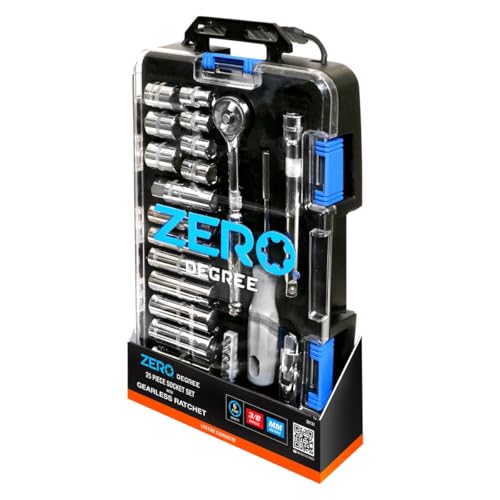
Zero Degree 38131 3/8-Inch Metric Set pairs the gearless ratchet with a 25-piece metric socket set, unlike the standalone ratchet and the adapter-based extensions. The set uses a 3/8-inch drive, which is a common middle size for general automotive and household socket work. Its defining tradeoff is that it is a bundled socket set rather than a single ratchet, so it makes sense when the metric sockets are useful alongside the tool. Match the fastener to the socket size and confirm the set covers the sizes you need before choosing; the set’s piece count alone does not tell you its size range.
Bottom line: Pick this when a 3/8-inch drive metric socket set is part of the need.
RZKNIP Offset Extension Wrench
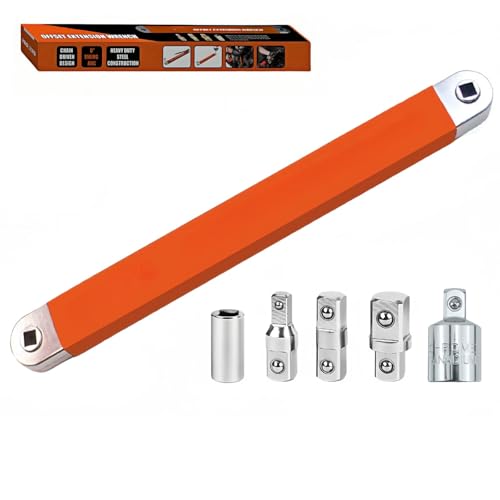
RZKNIP Offset Extension Wrench differs from the standalone ratchets by extending an existing drive tool rather than supplying a ratchet head. It is 15 inches long and 0.75 inches wide, with 1/2-, 1/4- and 3/8-inch square-head adapters; its body is aluminum alloy. The maker positions the offset design for tight-space access. This option suits someone who already has compatible drive tools and needs reach in a confined area. The adapter arrangement is the key limitation: verify that the tool end and socket connection match your ratchet and socket setup, since the extension is not itself the standalone gearless ratchet requested.
Bottom line: Choose this when extra reach and three adapter sizes matter more than a standalone ratchet.
Yetaha Blue Offset Extension Wrench

Yetaha Blue Offset Extension Wrench is a 15-inch offset extension wrench made from high-carbon steel, rather than a compact standalone ratchet. Its maker says the tool has a zero degree swing arc, a built-in high-strength chain and three standard drive adapters. That configuration is aimed at reaching confined work areas with a compatible drive setup, including automotive repair and construction tasks. It is a better match for buyers prioritizing extension reach and steel construction than for someone who needs only a conventional ratchet handle. Confirm the adapters match your ratchet and socket drives before work; the three-adapter description does not name their individual sizes.
Bottom line: Pick this for a steel 15-inch extension tool intended for confined work areas.
COMATIP Offset Extension Wrench Set

COMATIP Offset Extension Wrench Set offers the longest reach among these offset extensions at 15.4 inches, with a 0.63-inch thickness and 1/2-, 1/4- and 3/8-inch square-drive adapters. Its high-strength steel core is chrome-plated and enclosed in a protective plastic shell. The slim profile and multiple adapters suit buyers trying to carry one extension option across several common drive sizes. Unlike a standalone ratchet, it depends on a separate compatible drive tool. Treat the extension as a reach aid, not a way to multiply force: excessive leverage can damage fasteners or tools, especially when a torque specification matters.
Bottom line: Choose this for the slimmest extension profile and three adapter sizes.
How to choose a zero degree ratchet
Choose by tool type first: a standalone ratchet turns a socket, while an offset extension adds reach to a compatible drive tool. Ratchet drive sizes commonly include 1/4, 3/8 and 1/2 inch; the socket and ratchet need matching drives, or a correctly sized adapter. Conventional ratchets use a pawl engaging gear teeth, and finer tooth spacing generally allows a smaller handle swing before the next engagement. For clearances below 1 inch, a compact head and the maker’s swing-angle claim are relevant, but access also depends on socket depth and the surrounding obstruction. Compare the actual fastener and available clearance rather than treating “zero degree” as a guarantee that every socket can turn in any space.
Ratchet drive sizes and socket fit
Match the drive square before comparing socket size: 1/4-inch drive commonly serves smaller sockets, 3/8-inch covers many general-purpose jobs, and 1/2-inch is used for larger sockets and heavier fasteners. Those are broad tool-use patterns, not a substitute for checking the fastener or maker’s torque requirements. An adapter can connect different drive sizes, but it adds length and another connection point, which can affect access and stability. The products with adapters specify three common drives, while the standalone products do not replace all three sizes. Use this quick guide to narrow the configuration:
| Need | Choose |
|---|---|
| Compact standalone tool for a 1/4-inch socket | 1/4-inch drive ratchet |
| Metric socket assortment at 3/8-inch drive | 3/8-inch metric socket set |
| More reach with multiple square drives | Offset extension with matching adapters |
Using an offset ratchet extension safely
An extension changes reach, not the fastener’s required torque, so avoid adding a pipe or another extension to increase leverage. A longer handle can apply much more force than intended and can damage a fastener, socket or tool; use a torque wrench when a service specification gives a torque value. Seat the adapter fully on the square drive and the socket fully on the fastener before applying force. Keep hands clear of pinch points where the tool may slip or suddenly move. If the tool flexes, the adapter wobbles or the socket does not sit square, stop and correct the fit instead of forcing the connection.
Common fit mistakes with zero degree tools
The most common mistake is choosing by the “zero degree” label without checking whether the product is a standalone ratchet or an extension wrench. A second is confusing drive size with socket size: drive is the square connection measurement, while socket size describes the fastener head it fits. A third is assuming an extension’s length ensures access; the head, socket depth and nearby obstacles all affect whether the fastener can be reached. Check drive compatibility first, then measure the available path to the fastener and leave room to attach the socket. For a clearance narrower than the extension’s width, that extension cannot pass through the opening.
Frequently Asked Questions
What does zero degree mean on a ratchet?
The term is used for tools advertised for very small swing clearances, but it does not guarantee that every socket will turn in no space. Compare the maker’s swing-angle claim with the handle, socket and obstruction clearance available.
Is an offset extension wrench a ratchet?
An offset extension is not necessarily a standalone ratchet; some are designed to work with a separate ratchet or drive tool. Check whether the tool includes a ratchet head or only extension and adapters before selecting it.
How do I match a ratchet to a socket?
Match the square drive size, such as 1/4, 3/8 or 1/2 inch, between the ratchet and socket. An adapter can bridge different drive sizes, but it adds another connection and may make tight access harder.
Can a longer ratchet extension increase torque?
An extension adds reach but is not a safe substitute for a longer handle or torque wrench. Avoid adding leverage, and use a torque wrench when the fastener has a specified torque limit.
How much clearance does a ratchet need to turn?
The needed clearance depends on the handle’s swing arc and the socket’s headroom, not just the ratchet’s drive size. In openings under 1 inch, check the tool’s swing angle and measure the complete ratchet-and-socket profile.