
12 Volt Electrical Connectors: 3 Kits Compared by Fit

For a general-purpose assortment, Kuject 320-Piece Heat-Shrink Connector Kit combines ring, fork, spade and butt connectors, making it the broadest fit for common automotive and marine wiring jobs. Choose a narrower kit instead if you need only a particular terminal style or a defined wire-gauge range.
These crimp terminals join wires or attach them to studs and tabs in 12-volt circuits; matching the terminal to the wire gauge and connection point matters more than the vehicle label.
We earn a commission if you buy through links on this page. As an Amazon Associate I earn from qualifying purchases. Products are compared on manufacturer specifications, not hands-on testing.
- Best overall: Kuject 320-Piece Heat-Shrink Connector Kit – The kit includes ring, fork, spade and butt connector styles for varied wiring jobs.
- Best for a larger assortment: Oiojuct 600-Piece Heat-Shrink Connector Kit – The 600-piece kit includes butt, ring, spade and fork terminals.
- Best for defined wire sizes: TICONN 120-Piece Heat-Shrink Ring Terminal Kit – The assortment covers AWG 22 to 10 and uses a 3:1 heat-shrink ratio.
| Product | Best for | Pieces | Terminal styles | Shop |
|---|---|---|---|---|
| Kuject 320-Piece Heat-Shrink Connector Kit | Mixed wiring jobs | 320 | Ring, fork, spade, butt | Check Price on Amazon |
| Oiojuct 600-Piece Heat-Shrink Connector Kit | Larger assortments | 600 | Butt, ring, spade, fork | Check Price on Amazon |
| TICONN 120-Piece Heat-Shrink Ring Terminal Kit | Sealed ring terminals | 120 | Ring terminals | Check Price on Amazon |
12 Volt Electrical Connectors Compared
Compare terminal styles, assortment size and wire-gauge coverage before choosing a kit for your wiring task.
Kuject 320-Piece Heat-Shrink Connector Kit
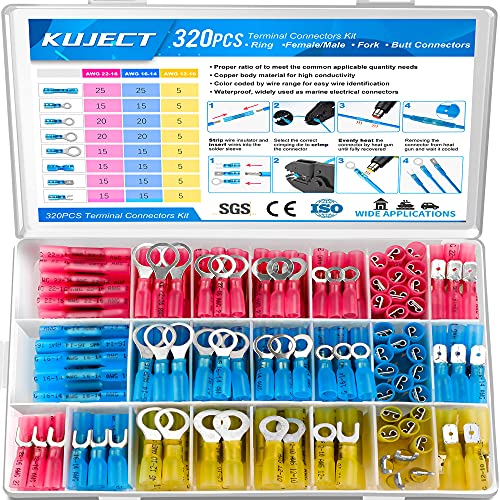
Kuject 320-Piece Heat-Shrink Connector Kit is the general-purpose pick among these kits because its 320 pieces include ring, fork, spade and butt connectors. The maker says the copper-core terminals provide conductivity and that adhesive-lined heat-shrink tubing seals the barrel when heated; translucent tubing allows visual inspection. That mix suits jobs where the wire may need to join another wire, attach to a stud or disconnect at a spade. The tradeoff is that the assortment’s wire-gauge coverage is not established here, so verify the terminal size against your wire before crimping.
Bottom line: Choose this for mixed automotive or marine repairs that need several terminal styles.
Oiojuct 600-Piece Heat-Shrink Connector Kit

Oiojuct 600-Piece Heat-Shrink Connector Kit has the largest piece count among these three multi-style kits, with 600 assorted terminals. It includes butt, ring, spade and fork connectors, and the maker describes the heat-shrink connections as waterproof for marine and automotive applications. That combination is useful when a project calls for several connection formats and you want a broad assortment on hand. The practical limitation is that the exact gauge span is not established here; match the connector barrel to the wire gauge rather than relying on the kit’s overall piece count.
Bottom line: Pick this when assortment quantity is the main need and you can verify wire-gauge fit.
TICONN 120-Piece Heat-Shrink Ring Terminal Kit

TICONN 120-Piece Heat-Shrink Ring Terminal Kit stands apart with an AWG 22–10 range and ring-terminal focus, rather than a mix of butt, fork and spade styles. Its dual-wall insulation has a 3:1 shrink ratio, and the maker says heat-activated adhesive creates a moisture-blocking seal. This makes it a targeted choice for ring connections where a sealed joint and defined wire range matter. The limitation is its narrower terminal style: choose another assortment if the job needs quick-disconnect spades or butt splices, and confirm ring size for the stud.
Bottom line: Choose this for ring-terminal work within its AWG 22–10 range.
How to choose 12 volt electrical connectors
Choose a connector by wire gauge, connection style and exposure to moisture, in that order. A butt splice joins two wire ends; a ring terminal secures a wire under a screw or stud; a spade or fork terminal attaches to a tab or screw terminal. Match the printed AWG range to the conductor, not its insulation diameter. For a moisture-exposed joint, adhesive-lined heat-shrink tubing can seal around the wire insulation when properly heated, while an unsealed insulated terminal does not provide the same barrier. A 12-volt label alone does not tell you whether the connector is sized correctly: wire gauge and circuit current determine whether the joint is appropriate.
Wire gauge and current in 12-volt circuits
Wire length and load affect voltage drop in a 12-volt circuit, so connector selection should follow the wire size and circuit design rather than a generic amp number. A longer run has more resistance and can lose more voltage than a short run of the same gauge. Automotive wiring charts commonly distinguish short chassis runs from longer runs and account for insulation temperature and bundling, so do not treat a connector’s AWG range as an ampacity rating. For example, a terminal that accepts AWG 12 does not establish that every AWG 12 circuit is safe at a particular current. Use a circuit-specific wire chart and fuse sized to protect the wire; never upsize a fuse to compensate for a poor crimp.
Crimping and sealing connector joints
A sound crimp needs a terminal sized for the conductor and a crimp die matched to that terminal. Strip only enough insulation to seat the bare wire fully in the barrel; stray strands and insulation trapped in the crimp can weaken contact. For heat-shrink terminals, use controlled heat so the tubing contracts and adhesive flows without scorching nearby insulation. The joint should be mechanically secure before heat is applied, and the seal should extend onto intact wire insulation. Do not use a flame near fuel vapors or flammable materials; a heat gun is easier to control. Pull-test each completed connection gently before installing it, and isolate power before wiring.
Connector styles and the job they suit
Terminal geometry determines how a wire connects to the rest of the circuit. Use a butt splice to join two wire ends in line, a ring terminal for a stud or screw that can be removed, and a spade or fork when the device has a matching tab or terminal. A fork can often slip out from under a loosened screw without fully removing it, while a ring stays captured until the fastener is removed. Compare the style to the hardware already on the device before selecting an assortment.
| Wiring job | Connector style | Fit check |
|---|---|---|
| Join two wires | Butt splice | Both conductors fit the barrel |
| Attach to a stud | Ring terminal | Ring opening matches the stud |
| Attach to a tab or screw point | Spade or fork | Terminal matches the device contact |
Frequently Asked Questions
Can I use a 12-volt connector on a 24-volt system?
Voltage compatibility cannot be established from the connector style alone. Check the terminal’s voltage rating and insulation specification for the circuit; wire gauge and current capacity also need to suit the application.
How do I choose the right connector size for a wire?
Match the connector’s AWG range to the conductor’s gauge, such as a terminal marked AWG 22–10 for wire within that range. Strip the insulation and confirm the conductor seats fully in the barrel without loose strands.
Are heat-shrink connectors suitable for marine wiring?
Adhesive-lined heat-shrink connectors are intended to seal a crimp against moisture when fully shrunk over the wire insulation. For marine use, also protect the connection from physical damage and use a connector matched to the wire and circuit.
What tool should I use to crimp insulated terminals?
Use a crimping tool with a die made for the terminal type and size; an ordinary pair of pliers does not form a controlled crimp. A loose crimp can overheat, so check that the wire is secure before insulating or powering the circuit.
Should I solder a crimp connector after crimping?
A correctly sized crimp terminal is designed to make its electrical and mechanical connection through crimping, so solder is not automatically needed. Avoid wicking solder far into a flexible wire, where the stiffened section can become vulnerable to vibration fatigue.