
Rough Country Winches: 3 Recovery Models Compared

Rough Country PRO Series 12,000 suits most full-size off-road recovery needs because its 12,000-pound rating and 85-foot rope give it the highest capacity and longest reach among these winches. Choose Rough Country ProSeries 4,500 UTV/ATV for a lighter UTV or ATV, or Rough Country PRO Series 9,500 if its 9,500-pound capacity better matches your vehicle; a winch is an electrically powered recovery tool that pulls a vehicle using a rope or cable.
We earn a commission if you buy through links on this page. As an Amazon Associate I earn from qualifying purchases. Products are compared on manufacturer specifications, not hands-on testing.
- Best overall: Rough Country PRO Series 12,000 – Its 12,000-pound rating and 85-foot synthetic rope lead this group in capacity and rope length.
- Best for UTVs: Rough Country ProSeries 4,500 UTV/ATV – The compact 4,500-pound unit includes wireless control and a dash-mounted rocker switch.
- Best for mid-size recovery: Rough Country PRO Series 9,500 – Its 9,500-pound rating and 85-foot rope offer a middle capacity with the longer rope.
| Product | Best for | Rated pull | Rope length | Motor | Shop |
|---|---|---|---|---|---|
| Rough Country PRO Series 12,000 | Full-size recovery | 12,000 lb | 85 ft | 6 HP | Check Price on Amazon |
| Rough Country ProSeries 4,500 UTV/ATV | UTV and ATV | 4,500 lb | 50 ft | 1.4 HP | Check Price on Amazon |
| Rough Country PRO Series 9,500 | Mid-size recovery | 9,500 lb | 85 ft | 5.5 HP | Check Price on Amazon |
Rough Country winches compared
Match rated pulling capacity and rope length to the vehicle and recovery setup you plan to use.
Rough Country PRO Series 12,000

Rough Country PRO Series 12,000 stands apart with the strongest rated pull in this group, at 12,000 pounds, and pairs it with 85 feet of 3/8-inch synthetic rope. Rough Country says its 6 HP, 12V electric motor, wired handheld remote, and IP67-rated housing are built for off-road recovery. The longer rope can help when the anchor point is farther away, while the wired remote keeps the operator connected by cable. This is the clearest fit for a heavier vehicle when its winch rating meets the vehicle-weight rule. Its dimensions are 23.25 by 13.5 by 12.5 inches, so check mounting clearance before ordering.
Bottom line: Pick this for a heavier recovery setup that needs the highest capacity and longest rope here.
Rough Country ProSeries 4,500 UTV/ATV
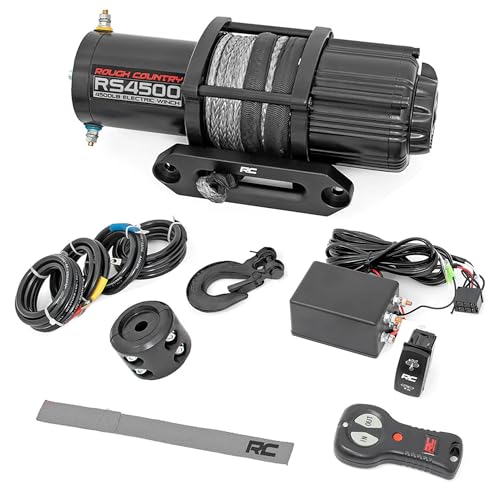
Rough Country ProSeries 4,500 UTV/ATV is the compact-capacity option, rated at 4,500 pounds and sized for UTV and ATV recovery rather than the higher-capacity vehicle setups. Rough Country says its 1.4 HP, 12V motor uses a 166:1 gear ratio, and the package includes 50 feet of synthetic rope, wireless remote, dash-mounted rocker switch, and IP67 protection. Having both wireless and dash controls gives operators two ways to actuate the winch. At 16.5 by 11 by 7 inches and 23.15 pounds, it is substantially smaller and lighter than the two PRO Series models. Its 50-foot rope is shorter, so account for anchor-point distance.
Bottom line: Choose this for UTV or ATV recovery where the 4,500-pound rating is sufficient.
Rough Country PRO Series 9,500

Rough Country PRO Series 9,500 offers a middle ground in rated pull: 9,500 pounds, with the same 85-foot, 3/8-inch synthetic rope length as the 12,000-pound model. Rough Country says its 5.5 HP, 12V electric motor and IP67-rated housing are intended for off-road recovery; a wired handheld remote is included. This is a suitable capacity tier when the vehicle and recovery setup call for less than 12,000 pounds but more than 4,500. Its 23.25-by-13.5-by-12.5-inch dimensions are close to those of the larger PRO Series model, so it does not save much mounting space compared with that option.
Bottom line: Pick this when a 9,500-pound rating fits the vehicle and you want the longer rope.
How to size a Rough Country winch
Start with vehicle weight: a common recovery guideline is a winch rated at least 1.5 times the vehicle’s gross vehicle weight. For a 6,000-pound vehicle, that rule points to at least 9,000 pounds of rated pull, before accounting for cargo or unusually difficult recoveries. The rating is not a promise of that force at every rope layer; pulling capacity generally falls as rope builds up on the drum. Choose Rough Country PRO Series 12,000 for the highest rating here, but match any choice to the vehicle’s actual weight and recovery plan. A snatch block can redirect a pull and, when rigged as a simple doubled line, reduce the load on the winch while slowing line speed. Use recovery points rated for the load, not a tow ball.
Synthetic rope care and handling
Synthetic winch rope is lighter to handle than steel cable, but abrasion and heat can damage its fibers. Keep the rope clean of grit, which can work between strands, and inspect it along its length for cuts, melted areas, or crushed sections before recovery. Replace damaged rope rather than relying on a knot or splice as a field repair. Spool rope under light, even tension so lower wraps do not bury loosely wound upper wraps. During a pull, keep people clear of the line and its recoil path; a rope damper can help reduce movement if a line or fitting fails, but does not make standing near a loaded line safe. Follow the rope maker’s care limits for cleaning and retirement.
Remote controls and recovery setup
Remote type changes where the operator can stand and how the winch is controlled. A wired remote remains tethered to the winch, while a wireless remote allows control without that cable; Rough Country ProSeries 4,500 UTV/ATV also includes a dash-mounted rocker switch. Regardless of control style, the operator should choose a position outside the line of pull and keep bystanders clear before energizing the winch. Recovery anchors matter as much as motor capacity: use a rated recovery point attached to the vehicle structure, and connect with recovery hardware whose working load rating suits the setup. A winch is designed for controlled pulling, not a substitute for a kinetic recovery strap or an improvised anchor. Stop if the vehicle, anchor, or line shifts unexpectedly.
Compare winch capacity and rope reach
Use this comparison to narrow the options by capacity, reach, and controls, then confirm that the intended mount and vehicle weight are compatible. A longer rope gives more line to work with, but does not increase the winch’s rated pull. The two higher-capacity models use wired handheld controls; the UTV/ATV model adds wireless and dash controls. Winch rating alone cannot establish whether a model fits a vehicle, because mounting pattern, clearance, electrical supply, and recovery points also matter.
| Need | Capacity and rope | Control setup |
|---|---|---|
| Highest pull | 12,000 lb; 85 ft | Wired handheld |
| Mid-tier pull | 9,500 lb; 85 ft | Wired handheld |
| UTV/ATV setup | 4,500 lb; 50 ft | Wireless and dash switch |
Frequently Asked Questions
How much winch capacity does my vehicle need?
A common sizing rule is a rated pull of at least 1.5 times the vehicle’s gross vehicle weight. For a 6,000-pound vehicle, that means at least 9,000 pounds; include cargo and consider added resistance from mud or steep terrain.
Does synthetic winch rope need regular inspection?
Yes, inspect the full rope before use and after hard recoveries. Look for cuts, abrasion, melted fibers, or crushed sections, and replace rope with damage rather than trusting a weakened section under load.
Can a winch pull at its full rating on every rope layer?
No, rated pulling capacity generally decreases as more rope is wound onto the drum. Keep the working line as close to the drum as practical when safe, and consult the winch capacity chart for exact layer ratings.
Where should people stand during a winch pull?
Keep people away from the loaded line and its recoil path, including positions directly in front of or behind the vehicle. Operate from a clear location and use rated anchors and recovery hardware.