
Sock Dividers for Drawers: 4 Organizers Compared

For sock dividers for drawers, Criusia 64-Cell Organizer Set offers the most flexible sorting with three bins and 64 cells, including larger 16-cell sections for bulkier socks. Choose a different format if you want a few roomy sections rather than many individual cells, or need a larger set for multiple drawers.
We earn a commission if you buy through links on this page. As an Amazon Associate I earn from qualifying purchases. Products are compared on manufacturer specifications, not hands-on testing.
- Best overall: Criusia 64-Cell Organizer Set – Three bins provide 64 cells, including a 16-cell section alongside two 24-cell sections.
- Best for simple sorting: Bructhun 3-Pack 3-Compartment Bins – Each of the three bins has three sections, giving socks roomier compartments.
- Best for multiple drawers: Criusia 12-Pack 116-Cell Set – The 12-bin set has 116 total compartments in several cell layouts.
| Product | Best for | Bins | Compartments | Dimensions | Shop |
|---|---|---|---|---|---|
| Criusia 64-Cell Organizer Set | Mixed sock sizes | 3 | 64 total | 12.5 × 12.5 × 4 in | Check Price on Amazon |
| joyoldelf 2-Pack 24-Cell Organizer | Two-drawer sorting | 2 | 48 total | 13.4 × 13.4 × 3.5 in | Check Price on Amazon |
| Criusia 12-Pack 116-Cell Set | Many drawers | 12 | 116 total | 11.8 × 11.8 × 4 in | Check Price on Amazon |
| Bructhun 3-Pack 3-Compartment Bins | Roomier sections | 3 | 9 total | 11 × 5.5 × 4.8 in | Check Price on Amazon |
Sock Dividers for Drawers
Compare compartment layouts, bin counts, and dimensions to match your socks and drawer space.
Criusia 64-Cell Organizer Set
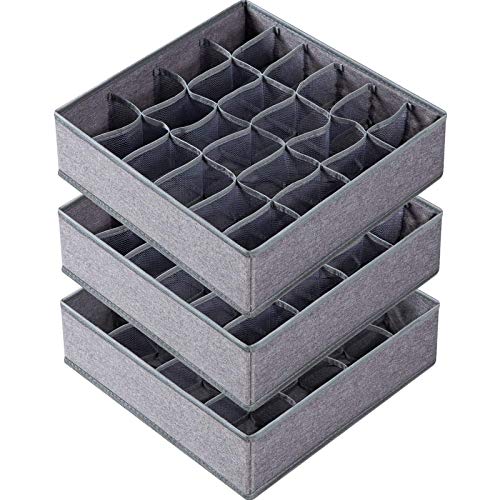
The 16-cell bin makes this set different from organizers built only around smaller compartments. The three gray fabric bins provide 64 cells total: one bin with 16 larger cells and two with 24 cells each. The maker says the organizers are made from PBT fabric and are intended for socks, underwear, ties, and belts. This layout suits drawers where bulkier socks need more room than everyday pairs. The limitation is that the set uses three separate bins, so measure the drawer floor and height before choosing it for a compact drawer.
Bottom line: Choose this set if you want separate sections for everyday and bulkier socks.
joyoldelf 2-Pack 24-Cell Organizer

Two matching 24-cell bins make this set useful when you want the same sorting pattern in more than one drawer. Each bin is gray and collapses flat for storage when not in use; the maker describes a zip-secured base for setting it up. The set is pitched for socks and handkerchiefs as well as small accessories, so it can serve more than one drawer purpose. Its fixed cell layout offers less flexibility for larger socks than a mixed-cell set. Check the drawer’s interior dimensions against each bin’s 13.4-inch sides before buying.
Bottom line: Pick this set for two matching bins with 24 cells apiece.
Criusia 12-Pack 116-Cell Set

This 12-bin set stands out for spreading sock storage across many drawers or household members. The 116 cells are divided among several formats, including 24-cell bins, 8-cell bins, and 6-cell bins; the maker also identifies two 6-cell bins for shirts or bras up to C cup. The gray organizers are fabric and 4 inches high. That variety can help separate socks from other small clothing items without forcing every category into the same cell size. The tradeoff is a larger set to place and arrange, so count the drawers you plan to organize before committing to all 12 bins.
Bottom line: Choose it when you need multiple bins and several compartment sizes.
Bructhun 3-Pack 3-Compartment Bins

Three compartments per bin create a simpler layout than the many-cell options, with three bins in the set. Each gray fabric bin measures 11 × 5.5 × 4.8 inches and folds flat when unused. The maker presents the sections for sorting socks by type, color, or family member, and also mentions underwear and tights. This format suits shoppers who want broad categories rather than one cell for each pair. The 4.8-inch height is taller than the other bins, so check drawer clearance before stacking or using it in a shallow drawer.
Bottom line: Pick these bins if broad categories matter more than many individual cells.
How to choose sock dividers for drawers
Choose compartment count based on how you sort socks: one cell per pair favors a higher cell count, while a few broad sections suit sorting by type or family member. Count the bins as well as the cells; a multi-bin set can divide categories across drawers, but takes more floor area. Measure the drawer’s inside length and width, then compare them with each bin’s footprint rather than its outside-facing drawer dimensions. Also measure vertical clearance: a bin that fits the drawer floor can still interfere with a shallow drawer or stacked clothing. Leave enough room to lift socks in and out without catching the fabric on the drawer top.
Match cell size to sock thickness
Use smaller cells for thin everyday socks and larger openings for thick, folded pairs or bulky athletic socks. A high total cell count does not guarantee that every cell fits every sock style; organizers with mixed cell sizes give more options, while uniform grids keep the layout consistent. Fold a representative pair the way you plan to store it, then compare its footprint with a sample compartment when possible. Avoid stuffing a cell until the fabric strains or the divider bends, since overfilling makes pairs harder to remove and can distort the organizer. If you store other items in the same drawer, reserve larger sections for bulky accessories.
Measure drawer clearance before setting up bins
Measure the usable interior, not the drawer front, because side rails and slides can reduce space. Check length and width at the narrowest points, then measure height with the drawer closed; allow clearance so fabric edges do not snag. For multiple bins, add their footprints together and plan their arrangement before filling them. Collapsible fabric organizers are convenient to store flat, but setup styles can differ; a zip base, when present, needs to be secured before loading. Do not force a bin into a space that bows its sides, since that can make compartments harder to use.
Keep socks sorted without overcrowding
Group socks by wearer, use, or thickness, and keep the sorting rule consistent so a cell stays easy to scan. Place frequently worn pairs toward the front and less-used seasonal pairs farther back. Refold pairs when they no longer sit comfortably in their cells rather than pushing them down; crowded compartments hide pairs and make retrieval awkward. Fabric bins can be folded away when not needed, while a set of several fixed bins works best when you have a planned place for each one. Keep drawer contents dry and clean, since organizers are storage aids, not sealed containers for damp laundry.
Frequently Asked Questions
How many cells should sock drawer dividers have?
Choose roughly one cell per pair if you want each pair separated, and fewer, wider sections if you sort by category. Larger or thicker socks need more room than thin everyday pairs.
How do I measure a drawer for sock organizers?
Measure the inside length and width at the narrowest points, then measure the closed drawer’s usable height. Compare those measurements with the organizer’s footprint and height, leaving clearance so the bin does not snag.
Are fabric sock organizers collapsible?
Some fabric organizers fold flat when not in use, but setup differs by model. Secure any zip base before loading a bin, and avoid storing damp socks in fabric organizers.
What sock divider layout works for thick socks?
Choose larger cells or a mixed-cell organizer for thick folded socks. A high cell count with uniformly small compartments can be awkward when pairs take up more space.
Can sock dividers hold underwear too?
Many fabric compartment organizers can also sort underwear and other small clothing items. Keep bulkier items in larger sections so they do not crowd the socks.