
Bradford White Water Heaters: Models Compared by Size

For most households choosing among these Bradford White water heaters, the 50-gallon, 240-volt tank offers more stored hot water than the 40-gallon model, while both use 4,500-watt elements. The right choice depends on household demand, available space and the electrical setup.
Choose a compact utility tank instead for a point-of-use or limited-demand application; the 6- and 12-gallon models are 120-volt units, not direct substitutes for a full-size tank.
We earn a commission if you buy through links on this page. As an Amazon Associate I earn from qualifying purchases. Products are compared on manufacturer specifications, not hands-on testing.
- Best overall: Bradford White RE350S6 50-Gallon – Its 50-gallon capacity exceeds the 40-gallon tank while retaining 240-volt power and 4,500-watt elements.
- Best for 40-gallon capacity: Bradford White RE340T6 40-Gallon – A full-size 40-gallon tank with 240-volt power and 4,500-watt elements.
- Best for 12-gallon utility use: Bradford White RE112T6 12-Gallon – Its 12-gallon capacity and 120-volt supply suit a smaller-demand installation.
- Best for 6-gallon utility use: Bradford White 6-Gallon Utility Heater – The 6-gallon tank is the smallest electric heater, with a 120-volt supply.
| Product | Best for | Capacity | Voltage | Dimensions (H × W × L) | Shop |
|---|---|---|---|---|---|
| Bradford White RE350S6 50-Gallon | higher stored capacity | 50 gallons | 240 V | 48 × 24 × 24 in. | Check Price on Amazon |
| Bradford White RE340T6 40-Gallon | standard tank capacity | 40 gallons | 240 V | 62 × 20 × 20 in. | Check Price on Amazon |
| Bradford White RE112T6 12-Gallon | small utility demand | 12 gallons | 120 V | 15 × 15 × 28 in. | Check Price on Amazon |
| Bradford White 6-Gallon Utility Heater | minimal utility demand | 6 gallons | 120 V | 14 × 14 × 17 in. | Check Price on Amazon |
| Corro-Protec Powered Anode Rod | anode replacement | — | — | — | Check Price on Amazon |
Bradford White water heater models
Compare tank capacity, electrical supply and dimensions before choosing a model for your demand and installation space.
Bradford White RE350S6 50-Gallon
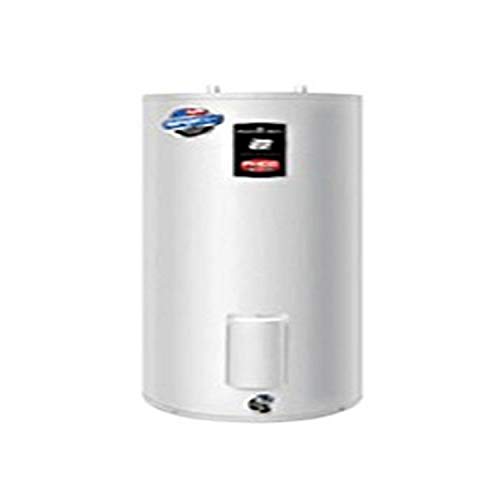
The RE350S6 provides 50 gallons of storage, compared with 40 gallons in the other full-size 240-volt option. It uses non-simultaneous 4,500-watt elements and includes a magnesium anode rod; Bradford White says the rod adds corrosion protection. Its 48-inch height is shorter than the 40-gallon unit, but its 24-inch width and length need more floor space. Choose this model when the extra stored capacity matters and the installation can accommodate the wider footprint. Its 150-pound stated weight also calls for a suitable floor and handling plan.
Bottom line: Pick this when you want 50 gallons of storage and have room for a 24-inch-wide tank.
Bradford White RE340T6 40-Gallon

The RE340T6 is the narrower full-size choice: its 20-by-20-inch footprint is smaller than the 50-gallon model’s, though it stands 62 inches high. It has 40 gallons of capacity, 4,500-watt non-simultaneous elements and a magnesium anode rod. Bradford White says the rod provides added corrosion protection. This unit suits installations where a compact footprint matters more than the extra 10 gallons in the larger tank. The 150-pound weight and tall profile are important constraints, so measure the route into the installation area as well as the final clearance.
Bottom line: Choose this if a 20-inch footprint fits better than a wider 50-gallon tank.
Bradford White RE112T6 12-Gallon
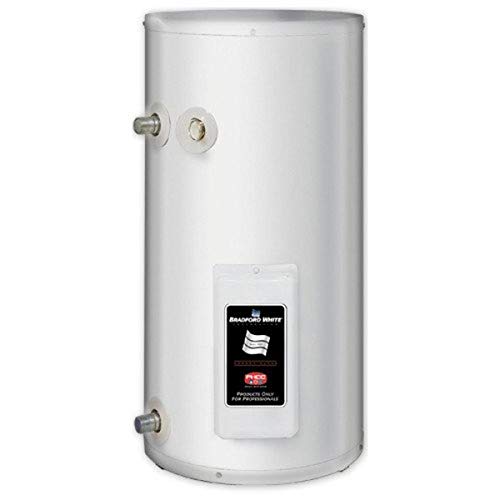
The RE112T6 is a small 120-volt utility heater rather than a full-size household tank. Its 12-gallon capacity makes it the larger of the two compact utility choices here, and its dimensions are 15 inches high by 15 inches wide by 28 inches long. The product identifies it as an electric residential utility energy-saver water heater. It may suit a limited-demand or secondary installation where a standard 240-volt tank is impractical. Its 12-gallon storage is far below the 40- and 50-gallon options, so it is not the choice for matching their stored-water capacity.
Bottom line: Use this for a smaller utility application that needs more storage than a 6-gallon tank.
Bradford White 6-Gallon Utility Heater
The 6-gallon utility heater is the smallest tank in this group and uses 120-volt power. Its dimensions are 14 inches high by 14 inches wide by 17 inches long, making it more compact than the 12-gallon utility unit. It is identified as an electric residential utility energy-saver heater. Choose it for a limited-demand point-of-use need where compact size matters more than stored volume. A 6-gallon tank cannot provide the same reserve as a 40- or 50-gallon household model, so estimate simultaneous hot-water use before treating it as a main heater.
Bottom line: Pick this for a compact installation with modest hot-water demand.
Corro-Protec Powered Anode Rod

The Corro-Protec is an accessory, not a water heater: it is a powered anode rod intended for hot-water-outlet installation on compatible tanks. Its maker says the model is designed for 10- to 120-gallon heaters and a standard 3/4-inch NPT thread, with compatibility for Bradford White models including the RE340T6. The manufacturer also claims odor removal and reduced sediment buildup; those are maker claims, not tank specifications. This may suit an owner addressing anode access or odor concerns. It does not add tank capacity or replace a heater, and compatibility must match the exact tank and connection.
Bottom line: Consider it only as a compatible tank accessory, not as a replacement heater.
How to choose a Bradford White water heater
Start with tank capacity, then confirm voltage, dimensions and the hot-water demand pattern. A 40- or 50-gallon tank stores substantially more water than the 6- and 12-gallon utility models, but capacity alone does not establish how quickly a heater can recover after use. The full-size electric models here use 240 volts and 4,500-watt elements; the compact utility choices use 120 volts. An existing circuit is not proof that a new heater is compatible, so have the electrical supply checked against the unit’s requirements before installation. As a practical screening rule, if the available footprint is under 24 inches wide, the 50-gallon tank’s 24-inch width will not fit; verify the actual clearance needed for connections and service too.
Tank dimensions and installation clearance
Measure the installation route, final footprint and overhead height before selecting a tank. The 40-gallon model measures 20 by 20 inches across and 62 inches high, while the 50-gallon unit is 24 by 24 inches across and 48 inches high. Compact utility tanks have different orientations and much smaller capacities, so use their exact dimensions rather than assuming they fit a standard tank closet. Leave room for plumbing, electrical access and maintenance; the tank’s dimensions are not the full working clearance. Water heaters are heavy equipment, and a full tank adds substantial load, so the supporting floor and safe handling plan matter. Confirm required clearance and connection locations with an installer before committing to a fit.
Full-size tanks versus utility heaters
Full-size storage heaters and utility heaters serve different demand levels. A 40- or 50-gallon tank is intended for a broader household hot-water reserve; 6- and 12-gallon utility tanks are better suited to limited-demand or secondary uses. Electric resistance heaters convert electricity directly to heat in immersed elements, and thermostat controls cycle heating as tank water cools. The two full-size choices use non-simultaneous elements, meaning the elements do not heat at the same time. That distinction matters when comparing electrical load, but does not make the compact models equivalent substitutes. Select by the actual number of fixtures and concurrent uses, then verify recovery and circuit requirements for the exact application.
| Need | Relevant capacity | Choice direction |
|---|---|---|
| More stored water | 50 gallons | Full-size 240-volt tank |
| Narrower footprint | 40 gallons | 20-inch-wide full-size tank |
| Limited utility demand | 6 or 12 gallons | Compact 120-volt heater |
Water-heater maintenance and safety
Storage water heaters need periodic inspection because mineral sediment can collect at the tank bottom and sacrificial anodes gradually corrode as they protect the tank. Many manufacturers recommend checking the anode about every 3 to 5 years, with water chemistry affecting the interval; follow the exact model’s maintenance schedule. A tank flush can reduce sediment accumulation, but hot water can scald and the drain discharge may be very hot, so isolate power and manage discharge safely. Temperature settings near 120°F are commonly used to reduce scald risk while limiting excessive heat, though household needs and local requirements can differ. Electrical work and tank replacement involve shock, burn and heavy-load hazards; use a qualified installer for connections and lifting.
Frequently Asked Questions
How many gallons should a household water heater hold?
A 40- or 50-gallon tank is a common full-size range, while 6- and 12-gallon tanks are generally utility-scale choices. Household size, bathing patterns and overlapping uses determine whether the larger reserve is needed.
What does non-simultaneous element operation mean?
Non-simultaneous electric elements heat one at a time rather than both at once. This affects how the heater manages electrical demand; confirm the required circuit and wiring for the specific model.
How often should a water heater anode be checked?
Many manufacturers recommend checking a sacrificial anode every 3 to 5 years. Hard or otherwise aggressive water can consume an anode faster, so inspect more often if the tank’s maintenance guidance or water conditions call for it.
What temperature is commonly used for stored hot water?
About 120°F is a common household setting that helps reduce scald risk while providing hot water. Higher settings increase burn risk, so households with children, older adults or reduced sensitivity should take extra precautions.
Can a 120-volt utility heater replace a 240-volt tank?
Not as a like-for-like capacity choice: the compact models here hold 6 or 12 gallons, compared with 40 or 50 gallons for the full-size tanks. Suitability depends on demand, recovery needs and whether the electrical supply matches the unit.