
Best Black Light to Find Dog Urine: 5 Options Compared

Vansky 51-LED UV Light is the best black light to find dog urine for most people because its 51 LEDs use 395 nm UV, and the maker says they reveal dried pet urine. Choose TrixHub 365-nm Rechargeable UV Light instead if you specifically want a rechargeable 365 nm light with a power display, or a larger LED count if you want to scan wider areas.
A UV black light makes some dried residues fluoresce, helping locate areas to inspect and clean; a glow alone does not prove urine is present.
We earn a commission if you buy through links on this page. As an Amazon Associate I earn from qualifying purchases. Products are compared on manufacturer specifications, not hands-on testing.
- Best overall: Vansky 51-LED UV Light – Its 51 LEDs emit 395 nm UV, and the maker says they reveal dried dog and cat urine.
- Best for wide-area scans: GLOSSDAY 100-LED UV Flashlight – It has 100 LEDs and an IP44 protection class.
- Best for rechargeable use: TrixHub 365-nm Rechargeable UV Light – It uses 365 nm UV and includes a rechargeable design and LCD power display.
| Product | Best for | Wavelength | LED count | Size | Shop |
|---|---|---|---|---|---|
| Vansky 51-LED UV Light | Dried stain checks | 395 nm | 51 | 5.9 × 2.16 × 2.16 in. | Check Price on Amazon |
| GLOSSDAY 100-LED UV Flashlight | Larger scan areas | 395 nm | 100 | 7.6 × 2.95 × 2.95 in. | Check Price on Amazon |
| Vansky 12-LED Mini UV Light | Small, targeted checks | 395 nm | 12 | 3.74 × 1.08 × 1.2 in. | Check Price on Amazon |
| TrixHub 365-nm Rechargeable UV Light | 365-nm scanning | 365 nm | 5 | 5.63 × 1.61 × 1.06 in. | Check Price on Amazon |
| Vansky 100-LED 395-nm UV Light | High LED count | 395 nm | 100 | 8.27 × 3.31 × 3.39 in. | Check Price on Amazon |
Black lights to find dog urine
Compare wavelength, LED count, and form factor, then scan dried areas in a dark room for a clearer view.
Vansky 51-LED UV Light

Vansky 51-LED UV Light pairs 51 LEDs with 395 nm UV, a middle ground between compact lights and larger 100-LED models. The maker says it can reveal dried dog and cat urine; its instructions also point to a dark room and completely dry stains for the clearest fluorescence. Its 5.9-inch length gives it a flashlight-style shape for checking carpet or upholstery. The limitation is that it will not identify urine by itself: detergent residue and other fluorescent materials can also glow, so treat the light as a locator rather than a test.
Bottom line: Choose it for a dedicated dried-stain scan in a compact flashlight format.
GLOSSDAY 100-LED UV Flashlight

GLOSSDAY 100-LED UV Flashlight stands out with 100 LEDs and an IP44 protection class, rather than the smaller arrays in the other options. Its 395 nm wavelength makes it suited to the same dark-room scan for dried urine, and the aluminum-alloy body is part of its construction. At 7.6 inches long and about 0.68 pounds, it is the largest and heaviest option here by the measurements, which may matter when scanning overhead or carrying it around the home. The maker’s claim of higher brightness is not a standardized comparison, so prioritize the LED count and size.
Bottom line: Pick it if a 100-LED array and stated IP44 protection fit your scanning needs.
Vansky 12-LED Mini UV Light
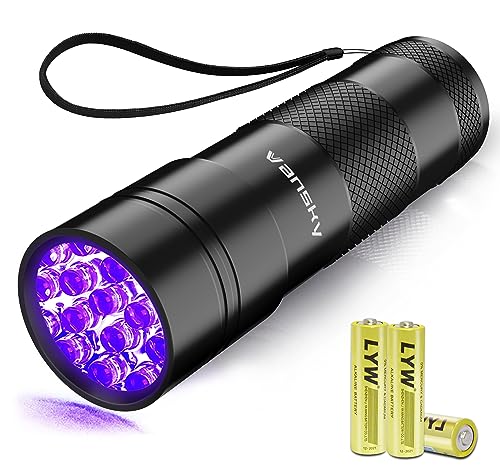
Vansky 12-LED Mini UV Light is the smallest option by its dimensions, at 3.74 inches long, and has a 12-LED 395 nm array. That compact format suits targeted checks around a specific carpet patch or sofa cushion rather than sweeping a large room quickly. The maker says it detects dried stains in a completely dark environment and explicitly cautions that fresh liquid will not fluoresce. A 12-LED light gives fewer emitters than the 51- and 100-LED choices, so buyers with broad floor areas to scan may prefer a higher-count model.
Bottom line: Choose it for compact, close-up scans of a limited area.
TrixHub 365-nm Rechargeable UV Light

TrixHub 365-nm Rechargeable UV Light is the only 365 nm option in this group, and it uses five core-mounted LEDs with a rechargeable design and LCD battery display. The maker says its filter lens blocks 99% of visible light, which is intended to reduce visible-light spill while checking fluorescent traces. At 5.63 inches long, it remains handheld. Its five-LED array is much smaller than the 51- and 100-LED choices, so it may be less convenient when covering a wide area; consider it when wavelength and a battery readout matter more than emitter count.
Bottom line: Pick it when you want a rechargeable 365 nm light with a battery display.
Vansky 100-LED 395-nm UV Light

Vansky 100-LED 395-nm UV Light combines 100 LEDs with 395 nm UV and is described by its maker for indoor and outdoor inspection. Its length is about 8.27 inches, making it longer than the other options with dimensions; that can be useful to know if storage space or close-quarters scanning matters. The maker also promotes broad coverage, but the specifications do not establish a standardized coverage measurement, so do not assume a particular scan width. As with other 395 nm lights, use it to locate suspicious dried areas, then verify them through cleaning and rechecking.
Bottom line: Choose it for a 100-LED 395 nm option intended for indoor and outdoor inspection.
How to choose a black light for dog urine
Start with a dark room and a dry floor: dried urine is the target, while fresh wet urine may not fluoresce clearly. Many consumer pet-stain lights use 395 nm LEDs; 365 nm is another common UV-A wavelength and may look less violet, but wavelength alone cannot confirm a stain is urine. A higher LED count can be useful for scanning broad surfaces, though it does not provide a standardized brightness or coverage measurement. For a small suspected spot, a compact flashlight is easier to position; for a large room, prioritize a larger array if handling its size is comfortable. Scan slowly, mark suspicious areas, clean them, and recheck after they dry. Other residues can fluoresce, so do not treat glow as proof.
How to scan carpet and upholstery
Darken the room as much as practical and let damp carpet or upholstery dry before scanning. Move the light close to the surface and sweep in overlapping passes; a slow scan makes small fluorescent patches easier to notice than quickly sweeping a whole room. Check corners, edges, rug undersides, and the areas around furniture where pets may revisit. Fluorescent detergent, lint, and other materials can resemble a stain, so compare a suspected patch with nearby unaffected fabric and use odor or location as additional context, not confirmation. Mark a patch before cleaning so you can return to the same spot. Avoid shining UV light into eyes or directly onto skin; keep children and pets from staring into the beam.
395 nm and 365 nm black lights compared
Both 395 nm and 365 nm lights are UV-A tools used to make some fluorescent substances visible, but the visible violet glow and filter design can differ. A 395 nm flashlight is common in consumer stain-detector models and often has a higher LED count; 365 nm models may use fewer emitters and may add filtering or battery features. No wavelength guarantees that a glowing mark is urine, and no LED count by itself tells you the true coverage area. Use this decision guide to match the tool to the job, then scan dried areas in darkness.
| Need | Useful choice | Reason |
|---|---|---|
| Small spot or tight space | Compact light | Easier to position close to the surface |
| Broad floor scan | Higher LED count | More emitters for sweeping a larger area |
| Want a battery readout | Rechargeable model with display | Shows remaining charge on the device |
Common mistakes when looking for pet urine
The most common mistake is scanning a wet stain and expecting the same fluorescence as dried residue. Drying time depends on fabric thickness, airflow, and how much liquid was present, so wait until the surface is dry rather than relying on a fixed number of minutes. Another mistake is assuming every glow is urine: cleaning products and other fluorescent materials can also react to UV. Avoid scanning in bright daylight or under strong room lighting, which can make faint fluorescence harder to see. Finally, do not point the UV beam toward anyone’s eyes; UV-A exposure is not a reason to look directly into a light, and children should use it only with adult supervision.
Frequently Asked Questions
Does dog urine glow under a black light?
Some dried dog urine fluoresces under UV light, but the glow can be faint and depends on the surface and conditions. Other residues can fluoresce too, so the light does not confirm urine on its own.
Should I scan fresh or dried dog urine?
Scan dried areas, because fresh wet urine may not fluoresce clearly. Let the surface dry fully before checking, especially on carpet or upholstery that holds moisture.
Is 365 nm or 395 nm better for finding urine?
Either wavelength can reveal some fluorescent residues, and neither proves that a mark is urine. Choose based on features such as LED count, size, and whether you want a rechargeable display model.
Can I use a black light in a bright room?
A dark room makes faint fluorescence easier to notice than bright ambient light. Turn off room lights and close curtains where possible, then scan slowly over the dry surface.
Is a glowing spot definitely dog urine?
No; detergents and other fluorescent materials can also glow under UV. Compare the spot with nearby material and use location and odor as clues, then clean and recheck after it dries.