
Best Bluetooth RCA Adapter: 5 Receivers Compared

The 1Mii B06Pro suits most people because it combines RCA, 3.5 mm, optical, and coaxial outputs with broad codec support. Choose another receiver if you need a simple one-button setup or want a model with a built-in volume control.
A Bluetooth RCA adapter is a receiver: it takes wireless audio from a phone or other source and sends it through analog RCA outputs to a stereo or powered speakers.
We earn a commission if you buy through links on this page. As an Amazon Associate I earn from qualifying purchases. Products are compared on manufacturer specifications, not hands-on testing.
- Best overall: 1Mii B06Pro – Offers RCA, 3.5 mm, optical, and coaxial connections plus aptX HD and aptX Low Latency support.
- Best for simple pairing: Esinkin Bluetooth Audio Adapter – Uses a single button for pairing and says it automatically reconnects to the previously paired device.
- Best for volume adjustment: YMOO B06T3 – Has a central button for raising or lowering the receiver’s volume.
| Product | Best for | Connections | Audio support | Claimed range | Shop |
|---|---|---|---|---|---|
| 1Mii B06Pro | More connection options | RCA, 3.5 mm, optical, coaxial | aptX HD, aptX Low Latency, 3D audio | Up to 197 ft line of sight; 60–100 ft indoors | Check Price on Amazon |
| Esinkin Bluetooth Audio Adapter | Simple pairing | RCA, 3.5 mm | Bluetooth audio streaming | 30–40 ft indoors without obstacles | Check Price on Amazon |
| YMOO B06T3 | On-device volume | RCA, 3.5 mm | Bluetooth 5.3 | About 100 ft | Check Price on Amazon |
| Auris bluMe HD | Hi-fi codec support | — | aptX HD, aptX Low Latency, LDAC, AAC | Long range; no figure provided | Check Price on Amazon |
| KAIY NFC Bluetooth Receiver | NFC quick connection | RCA, 3.5 mm; TF card playback | NFC pairing | — | Check Price on Amazon |
Bluetooth RCA Adapters Compared
Compare the output connections and audio features first, then consider the range that suits your room or setup.
1Mii B06Pro

The B06Pro stands apart with four output types: RCA, 3.5 mm, optical, and coaxial. It supports aptX HD, aptX Low Latency, and a switchable 3D audio mode. The maker says its dual antennas and Class 1 Bluetooth provide up to 197 feet of range in open air and 60–100 feet indoors without obstacles; interference and obstructions can reduce that. This receiver suits a stereo setup where connection flexibility or wireless distance matters. Its extra outputs and audio modes are unnecessary if you only need basic RCA streaming.
Bottom line: Choose this receiver if your stereo has multiple input types or you need the longer claimed range.
Esinkin Bluetooth Audio Adapter
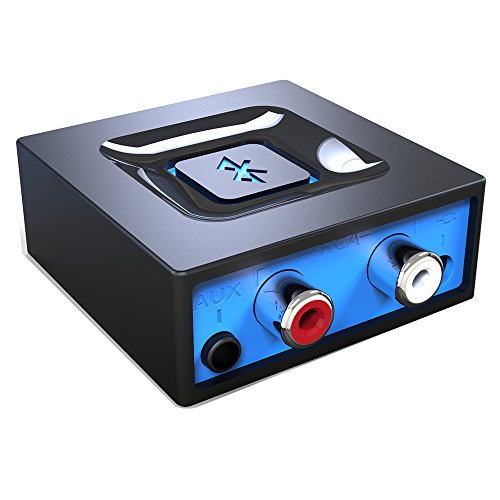
The Esinkin focuses on straightforward controls: one press connects or disconnects Bluetooth, while holding the button for three seconds turns it on or off. It connects to a stereo or speaker system over RCA or 3.5 mm, and the maker says it reconnects automatically to the previously paired device. Its claimed indoor range is 30–40 feet without obstacles. This is a fit for a basic home stereo where easy reconnection matters more than multiple output types. It does not offer the optical and coaxial connections or named codec options found on some alternatives.
Bottom line: Pick this for a simple RCA or 3.5 mm setup with one-button operation.
YMOO B06T3

The YMOO B06T3 adds a dedicated central volume control, a useful distinction if you want to adjust output at the receiver rather than only from the source device. It provides RCA and 3.5 mm outputs, and the maker says its Bluetooth 5.3 connection reaches about 100 feet. The volume boost has a limit, with a tone indicating when it has reached that ceiling. This model suits listeners who want physical volume adjustment and standard analog outputs. It does not list optical or coaxial outputs, so it will not connect directly to those digital inputs.
Bottom line: Choose this if receiver-side volume adjustment is a priority.
Auris bluMe HD

The Auris bluMe HD distinguishes itself with a built-in 384 kHz/32-bit upsampling DAC and support for aptX HD, aptX Low Latency, LDAC, and AAC. Auris says it is designed to add high-definition Bluetooth audio to an existing stereo, AV receiver, or amplifier. This is a fit for buyers prioritizing codec choices and digital-to-analog conversion in a home audio setup. The maker calls its range long but gives no figure here, so it is harder to compare reach with receivers that provide a distance claim. Confirm that your stereo’s input matches the receiver’s output before ordering.
Bottom line: Pick this for its DAC and broad codec support, after confirming the connection fit.
KAIY NFC Bluetooth Receiver

The KAIY receiver adds NFC quick connection and TF card playback alongside RCA and 3.5 mm outputs. Those extra playback and pairing options distinguish it from receivers focused solely on streaming from a paired phone. The maker presents it for wired speakers, AV receivers, and home or car stereos, making it a candidate when the TF card function is useful. Check that your stereo accepts the receiver’s analog output.
Bottom line: Choose this if NFC pairing or TF card playback is useful in your setup.
How to Choose a Bluetooth RCA Adapter
Choose an adapter by matching its output to an available stereo input, then compare the codecs and range that matter to your use. RCA is an analog connection, typically a pair of red and white plugs; a 3.5 mm stereo connection carries left and right audio through one plug. Optical and coaxial connections are digital, so they are useful only when the receiving equipment has the matching input. Bluetooth audio commonly uses A2DP, but codec support varies by both receiver and sending device. For a no-hassle match, prioritize compatible ports over codec names; codec benefits require support at both ends.
Use case to priority
| Need | Priority |
|---|---|
| Connect to older stereo | Matching RCA or 3.5 mm output |
| Use a digital stereo input | Matching optical or coaxial output |
| Watch video | Low-latency support at both ends |
Codec names alone do not guarantee better sound or lower delay if the phone or computer does not support the same format.
Bluetooth Range and Stereo Placement
Range claims are best-case estimates, not guaranteed room coverage. Open-air line-of-sight figures can be much higher than indoor performance because walls, furniture, and nearby wireless equipment weaken or disrupt a 2.4 GHz Bluetooth signal. Keep the adapter away from a crowded router area and avoid placing it inside a closed metal cabinet. For a receiver several rooms away, compare indoor claims rather than relying on an open-air maximum. A longer claimed range can help in a large open layout, but it does not remove the effect of obstacles or interference.
Bluetooth receivers sit at the stereo end of the connection, so the sending phone still needs to remain within the connection’s effective range. If playback cuts out, move the phone and receiver closer together and test with fewer obstacles between them.
Bluetooth Codecs and Audio Delay
Bluetooth codec support must match between the sender and receiver to be used. AAC, aptX HD, aptX Low Latency, and LDAC are codec names, not universal guarantees that every phone will send audio in that format. For watching video, aptX Low Latency is relevant only when the source also supports it; otherwise audio may lag behind the picture. A dedicated Bluetooth receiver cannot make an unsupported codec available on the phone. The receiver’s analog output also feeds the stereo’s amplification, so keep the stereo set to the appropriate input and control listening level from the source or receiver.
For music-only listening, prioritize the codec your device supports and a stable connection. For video, confirm low-latency compatibility across both devices before choosing by codec label.
Connecting and Using RCA Outputs
RCA outputs carry analog stereo audio to an amplifier or powered speaker input; they do not power passive speakers directly. Connect the receiver’s left and right outputs to a matching stereo input, select that input on the stereo, and pair the phone with the receiver. If your speakers are passive, an amplifier or receiver must remain in the signal path. A common mistake is plugging into an output instead of an input on the stereo, which will not provide the intended signal path. Keep the stereo’s volume low during initial pairing and raise it gradually to avoid a sudden loud signal.
Some receivers also provide 3.5 mm, optical, or coaxial outputs, but each must connect to a corresponding input on the sound system. Choose the matching port rather than assuming every adapter supports every connection.
Frequently Asked Questions
Can a Bluetooth RCA adapter power passive speakers?
No, an RCA Bluetooth receiver provides an audio signal, not speaker power. Passive speakers need an amplifier or stereo receiver between the adapter and the speakers.
Will aptX Low Latency reduce video delay?
It can reduce delay only when both the Bluetooth receiver and the sending device support aptX Low Latency. If either end lacks support, the audio may still lag during video playback.
Does Bluetooth range pass through walls?
Walls and furniture can reduce usable Bluetooth range compared with an open-air claim. For multi-room use, favor an indoor range figure and test placement away from routers and metal enclosures.
What do the red and white RCA plugs connect to?
They connect left and right analog audio channels to a matching stereo input. The stereo or amplifier then drives passive speakers; the Bluetooth receiver alone does not power them.
Can I stream from a TV to an RCA receiver?
Only if the TV can transmit Bluetooth audio to a receiver device. A TV’s Bluetooth function may be receive-only, so check that it supports audio output over Bluetooth before pairing.