
Best Hand Pump Foam Sprayer: 5 Models Compared

Suds Lab F5 Foam Master is the best hand pump foam sprayer for most people because its 70-ounce bottle pairs three interchangeable spray modes with cordless manual operation. Choose another model if you need an expressly stated working capacity, pH compatibility range, or adjustable fan direction.
We earn a commission if you buy through links on this page. As an Amazon Associate I earn from qualifying purchases. Products are compared on manufacturer specifications, not hands-on testing.
- Best overall: Suds Lab F5 Foam Master – Its 70-ounce canister and fan, mist and stream nozzles cover different spray tasks.
- Best for chemical compatibility: VIKING V+ Foam Pump Sprayer – Its pH range is 4–10 and its working capacity is 1.25 liters.
- Best for larger tank capacity: 1.8L Hand Pressure Foam Blaster – Its 1.8-liter tank provides substantial volume for longer spray sessions.
| Product | Best for | Capacity | Spray options | Shop |
|---|---|---|---|---|
| Suds Lab F5 Foam Master | Multiple spray modes | 70 oz | Fan, mist, stream | Check Price on Amazon |
| 1.8L Hand Pressure Foam Blaster | Larger tank | 1.8 L | Foam, water nozzle | Check Price on Amazon |
| EAFOMTZR 70oz Foam Sprayer | Adjustable direction | 70 oz | Adjustable vertical or horizontal | Check Price on Amazon |
| VIKING V+ Foam Pump Sprayer | Defined pH range | 1.25 L working; 2 L tank | Horizontal, vertical fan | Check Price on Amazon |
| Slick Products Hand Pump Foam Sprayer | Off-road washing | 70 oz | Foam or mist | Check Price on Amazon |
Hand Pump Foam Sprayers Compared
Compare tank capacity and nozzle control first, then choose a sprayer that suits the cleaning solution and area you plan to cover.
Suds Lab F5 Foam Master
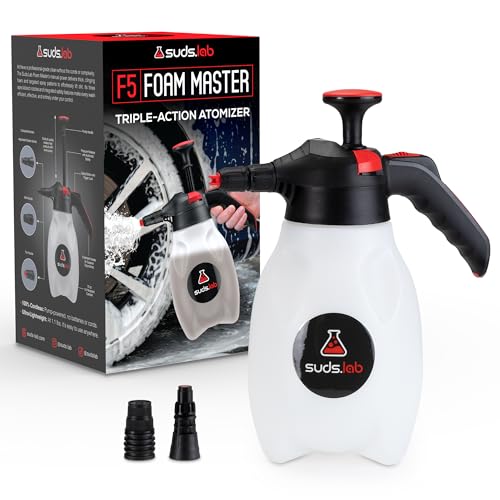
Suds Lab F5 Foam Master stands apart with three interchangeable nozzles: fan, mist and stream. Its 70-ounce UV-resistant canister and fully manual pump suit car washing, bike cleaning and outdoor gear when you want to work without batteries or a motor. The sprayer weighs 1.1 pounds according to the maker, which may appeal for longer sessions. The nozzle set provides more pattern choices than a single adjustable nozzle, but buyers who need a defined chemical compatibility range should compare that requirement before choosing.
Bottom line: Pick this if switching among fan, mist and stream patterns matters most.
1.8L Hand Pressure Foam Blaster

1.8L Hand Pressure Foam Blaster has the largest tank capacity among these sprayers at 1.8 liters, or about 61 ounces. Its foam nozzle is for soap applications, while the extra water nozzle can be used for watering plants and flowers. The manual pump works without a pressure washer, foam gun or garden hose, making it a practical choice for smaller wash setups. The maker notes that pressure may need rebuilding during use at low pressure; buyers seeking multiple foam patterns should consider a model with more nozzle options.
Bottom line: Choose this when tank volume and a separate water nozzle are priorities.
EAFOMTZR 70oz Foam Sprayer
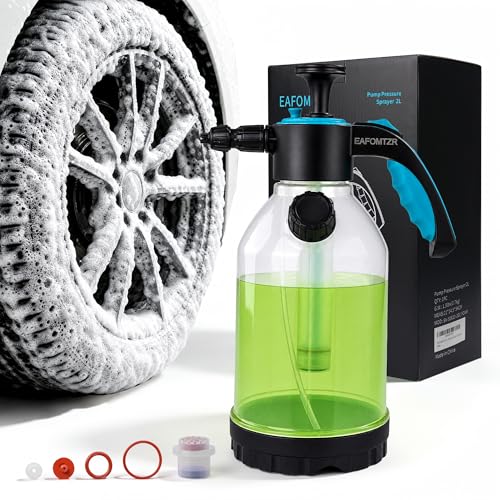
EAFOMTZR 70oz Foam Sprayer differentiates itself with a nozzle that rotates between vertical and horizontal spray directions, which can help orient coverage across vehicle panels or other surfaces. Its 70-ounce bottle is designed for car washing, home cleaning, window cleaning, pet bathing and garden care. The maker also describes chemical-resistant materials and a built-in pressure release valve, useful features to weigh when selecting a manual pressure sprayer. The maker does not provide a capacity in liters or an adjustment for foam density, so buyers who need those specific comparisons may prefer a model with more quantified specifications.
Bottom line: Pick this for nozzle direction adjustment across different surfaces.
VIKING V+ Foam Pump Sprayer
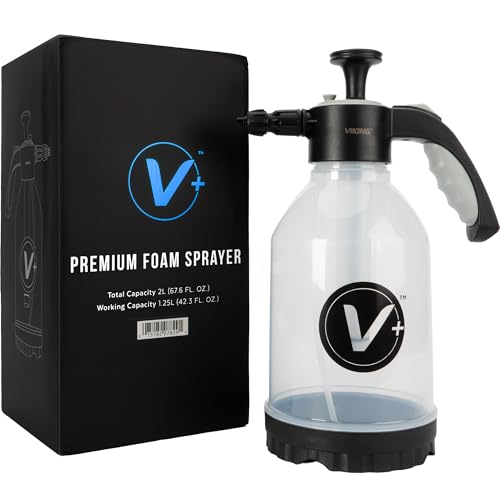
VIKING V+ Foam Pump Sprayer is the clearest choice for users matching a cleaner to a compatibility range: its nitrile rubber seals are specified for soaps and cleaners from pH 4 to 10. The polyethylene canister holds 2 liters, with 1.25 liters of working capacity, and has level indicators and a stable base. Its adjustable nozzle makes horizontal or vertical fan patterns, and the trigger locks for spraying. The working fill is lower than the tank’s full volume, so choose another option if maximizing usable solution per fill is the deciding factor.
Bottom line: Choose this if your cleaning solution falls within pH 4–10.
Slick Products Hand Pump Foam Sprayer

Slick Products Hand Pump Foam Sprayer is aimed specifically at vehicle cleaning away from a pressure washer or hose, including off-road use at campsites and trails. The 70-ounce bottle switches between foam and mist, with an ergonomic pump and trigger control for applying cleaners to cars, trucks, motorcycles, ATVs and UTVs. That focused vehicle use makes it a straightforward fit for pre-soaks and detail sprays. Its spray choices are foam and mist rather than several distinct interchangeable patterns, so buyers who need a stream or adjustable fan direction should compare other options.
Bottom line: Pick this for portable vehicle washing where a hose is unavailable.
How to choose a hand pump foam sprayer
Start with capacity, spray control and the solution you intend to use. A 70-ounce tank is about 2.1 liters; the 1.8-liter model holds about 61 ounces, while the VIKING has a 2-liter tank but 1.25 liters of working capacity. For a quick vehicle pre-soak, a foam-only or foam-and-mist setup may be enough; choose fan, stream or direction adjustment when coverage shape matters. Match chemical compatibility before filling: the VIKING specifies a pH range of 4–10. If your cleaner falls outside that range or its label calls for other materials, verify compatibility before using the sprayer.
| Need | Useful feature |
|---|---|
| Change spray pattern | Interchangeable nozzles or adjustable fan |
| Cover a large area between fills | Higher usable capacity |
| Match a cleaner range | Compatibility range aligned with cleaner pH |
Foam sprayer capacity and usable fill
Tank size and working capacity are not always the same measurement. The VIKING tank holds 2 liters overall but gives 1.25 liters of working capacity, while the 1.8-liter blaster specifies its tank volume without a separate working-fill figure. A 70-ounce bottle is roughly 2.1 liters, but that conversion does not establish its usable fill line. Use the printed fill marks rather than filling to the brim; pressurizing a hand sprayer requires space above the liquid. For jobs covering several vehicles, prioritize usable capacity and refill access over the largest headline tank figure.
Hand pump foam sprayer nozzles and spray patterns
Nozzle design determines whether a manual sprayer can adapt beyond laying down foam. Fan patterns spread solution over broader panels; a stream directs it into a narrower area, and mist gives lighter coverage. Rotating a nozzle between horizontal and vertical orientation changes the fan direction, not necessarily the amount of foam. Pump pressure also affects output, so build pressure as needed and re-pressurize if the spray weakens. Avoid using a foaming sprayer as a substitute for rinsing: loosened soap and dirt still need to be removed using an appropriate rinse method.
Using and caring for a manual foam sprayer
Mix cleaning solution at the product maker’s recommended dilution, and test spray on a small area before covering a whole vehicle or surface. Keep pressure within the sprayer’s operating limits and release pressure through its valve before opening a pressurized canister. Never point a pressurized nozzle at people or animals. After use, empty leftover solution and rinse the bottle, pickup path and nozzle with clean water; residue can clog small passages or affect later jobs. Check seals and nozzle parts for wear before each use, especially after using cleaners that may be incompatible with the sprayer materials.
Frequently Asked Questions
How much soap should I put in a hand pump foam sprayer?
Use the dilution ratio on the soap label rather than a universal amount. Concentrations differ, and too much detergent can leave residue or make rinsing harder.
Can a hand pump foam sprayer work without a hose?
Yes, these models build spray pressure by hand and do not require a pressure washer. They do not eliminate the need for a separate water source to rinse away dirt and soap.
How many pumps does a foam sprayer need?
The needed pump strokes depend on the tank fill and the sprayer’s pressure design. Stop when the sprayer reaches its pressure limit, and re-pressurize if output weakens during use.
Can I use any cleaner in a foam pump sprayer?
No; cleaner compatibility depends on the sprayer’s seals and bottle materials. For the VIKING, the range is pH 4–10, so confirm the cleaner label falls within that range.
Should I leave pressure inside a foam sprayer after cleaning?
No; release pressure through the pressure-release valve before opening the bottle. Depressurizing first reduces the risk of liquid spraying unexpectedly when the cap is loosened.