
Bed Divider for Queen Bed: 3 Separators Compared

For a queen bed, JZHLLA Large Adult Bed Divider is the most directly sized adult separator: its 24-by-15-by-8-inch triangular form is marketed for queen and king beds. Choose BAIIBIHEP 67-Inch Middle Bed Rail instead if you want a longer 67-inch rail between sleeping zones; ROYALAY Adult Bed Divider, 24-Inch is another adult option with a foldable design.
A bed divider separates areas of a shared mattress, but these products differ in length and form, so match the separator to your sleeping arrangement and available bed space.
We earn a commission if you buy through links on this page. As an Amazon Associate I earn from qualifying purchases. Products are compared on manufacturer specifications, not hands-on testing.
- Best overall: JZHLLA Large Adult Bed Divider – Its 24-by-15-by-8-inch size is explicitly intended for queen and king beds.
- Best for longer separation: BAIIBIHEP 67-Inch Middle Bed Rail – Its 67-inch rail spans more of the bed than the compact adult separators.
- Best for portability: ROYALAY Adult Bed Divider, 24-Inch – The adult divider folds for carrying and is sized 24 by 8 by 15 inches.
| Product | Best for | Length | Height | Width | Shop |
|---|---|---|---|---|---|
| JZHLLA Large Adult Bed Divider | Queen-bed separation | 24 in | 15 in | 8 in | Check Price on Amazon |
| BAIIBIHEP 67-Inch Middle Bed Rail | Longer sleep zones | 67 in | 15.75 in | — | Check Price on Amazon |
| ROYALAY Adult Bed Divider, 24-Inch | Foldable adult divider | 24 in | 15 in | 8 in | Check Price on Amazon |
Bed Dividers for Queen Beds
Compare the products by their dimensions and form to choose the kind of separation that suits your shared bed.
JZHLLA Large Adult Bed Divider

For an adult separator expressly sized for queen and king beds, this triangular divider measures 24 by 15 by 8 inches. The maker says its shape is stable and helps divide a shared bed into separate sleeping areas. Its compact footprint may suit sleepers who want a central boundary without a long rail running across the mattress. The limitation is its 24-inch length: it does not create a full-length barrier, so shoppers wanting a longer divider should consider a rail-style option instead.
Bottom line: Choose it if you want a compact adult separator for a queen bed.
BAIIBIHEP 67-Inch Middle Bed Rail
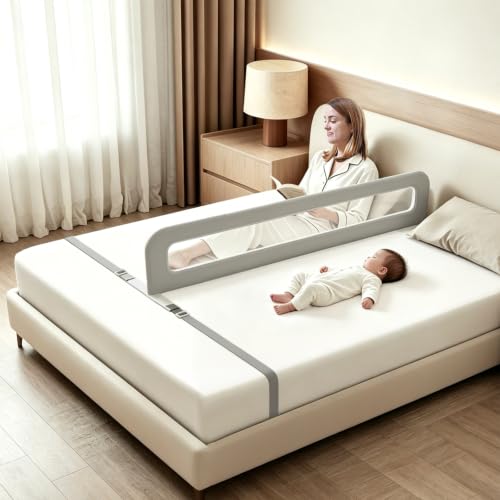
Unlike the compact adult wedges, this middle rail runs 67 inches along the bed and is designed to create separate sleeping zones. It has a 15.75-inch height, a soft mesh panel, a sponge-wrapped frame, and a removable cover with a zipper for washing. The maker describes it for adults as well as infants and toddlers, and says it can combine with other bedside rails to enclose a bed. Its longer rail and child-oriented design make it less suited to buyers who only want a small central separator.
Bottom line: Choose it when a longer rail matters more than a compact adult divider.
ROYALAY Adult Bed Divider, 24-Inch

For shoppers who value portability, this adult divider folds and measures 24 by 8 by 15 inches, matching the compact dimensions of the other wedge-style separator. The maker describes it as a visual partition for shared sleeping and says the two stated sizes can be chosen according to bed size and partner body type. This 24-inch version is identified for queen and king beds. Its limitation is the same short span common to compact dividers: it provides a localized boundary rather than a long rail across the bed.
Bottom line: Pick it if you want a foldable, compact separator for shared sleeping.
How to choose a bed divider for a queen bed
Choose by the kind of boundary you need: a short wedge makes a localized separation, while a rail can extend much farther along the mattress. A standard US queen mattress is 60 inches wide by 80 inches long, so compare the divider’s intended direction and dimensions with the space you want to divide. A 24-inch separator covers only part of a queen’s 80-inch length; a 67-inch rail provides a longer boundary. Measure the bed and account for pillows, bedding, and each sleeper’s preferred space before choosing. If you need a barrier that spans most of the mattress, use the measured span—not the product’s queen-bed wording—as the deciding condition.
Consider whether the product is intended for adults or child fall protection. A divider’s name alone does not establish that it is appropriate for every sleeper or setup.
Adult wedges and longer rails compared
Adult wedge-style separators and middle rails solve different space problems. Wedges are short, raised barriers placed between sleepers; rails extend along the bed to make a longer boundary. The adult wedges measure 24 inches long, while the middle rail measures 67 inches, so length is the clearest difference among these choices. Compare the following dimensions with the direction and portion of the bed you want to separate.
This table compares only the measurements; it does not imply that the products have the same construction or intended use.
| Form | Length | Best suited to |
|---|---|---|
| Adult wedge | 24 in | Localized separation |
| Middle rail | 67 in | Longer boundary between sleep zones |
Measure the usable bed area before deciding: a 24-inch wedge is a different choice from a rail nearly as long as a queen mattress is wide.
Queen-bed fit and placement
A queen mattress measures 60 by 80 inches in the standard US size system, but the divider’s length alone does not tell you how it will sit on a particular bed. Confirm the intended placement, available surface, and whether the divider needs to work beneath or alongside bedding before ordering. A 24-inch wedge creates a shorter boundary; a 67-inch rail reaches across more of the bed, but its height and width also affect how much space it occupies. Keep the barrier positioned so it does not create a gap that could trap a sleeper. Bed frames, mattress thickness, and bedding can change how a divider fits in practice.
For a baby, do not treat a divider as a substitute for a separate safe sleep surface. The American Academy of Pediatrics recommends room-sharing without bed-sharing, with infants placed on a firm, flat, separate sleep surface.
Safe use around children
Infants should sleep on their own firm, flat sleep surface in the caregivers’ room rather than in an adult bed; a divider does not change that recommendation. The American Academy of Pediatrics also advises keeping soft objects and loose bedding out of an infant’s sleep area. For toddlers, avoid using a barrier as a guarantee against falls, and keep any rail or bumper away from gaps where a child could become trapped. The 52-inch foam bumper in the product set is not a bed divider, so it does not serve the same purpose as an adult separator or middle rail.
Check the manufacturer’s age and setup guidance for any child-related product, and do not use a barrier on a top bunk unless it is specifically approved for that setting.
Frequently Asked Questions
How wide is a standard queen mattress?
A standard US queen mattress is 60 inches wide and 80 inches long. Measure your actual bed before choosing a divider because frames and mattress dimensions can differ.
Will a 24-inch divider split the whole bed?
No, a 24-inch divider covers only a portion of an 80-inch queen mattress length. Choose a longer barrier if you need a boundary across most of the bed.
Can a bed divider make bed-sharing safe for a baby?
No, a divider does not replace a separate infant sleep surface. The American Academy of Pediatrics recommends room-sharing without bed-sharing, using a firm, flat, separate sleep surface.
Are foam bumpers and bed dividers the same?
No, a foam bumper is intended as a low edge barrier, while an adult bed divider separates areas between sleepers. A 52-inch bumper should not be treated as a full-length divider.
What should I measure before choosing a bed divider?
Measure the mattress and the exact span you want the barrier to cover. On a standard 80-inch queen mattress length, a 24-inch wedge and a 67-inch rail provide substantially different coverage.