
BEBIRD Ear Wax Removal Tools: 4 Models Compared

For the broadest tip selection, choose BEBIRD Ultra 2K: its maker specifies a 2K camera and 54 tips for wet, dry or stubborn wax. Choose a different model if you prioritize a flexible camera tube for curved canals or a smaller tip set.
These camera otoscopes show the ear canal on a phone while pairing that view with scoop or tweezer attachments; they are not a substitute for professional care.
We earn a commission if you buy through links on this page. As an Amazon Associate I earn from qualifying purchases. Products are compared on manufacturer specifications, not hands-on testing.
- Best overall: BEBIRD Ultra 2K – Its maker specifies 2K imaging and 54 tips for multiple wax types.
- Best for curved canals: BEBIRD D39R – The flexible silicone camera tube is designed to fit curved canals.
- Best for phone viewing: BEBIRD R1 – Its maker specifies a 1080P camera and app-based live viewing.
| Product | Best for | Camera | Included tips | Design feature | Shop |
|---|---|---|---|---|---|
| BEBIRD Ultra 2K | Broad tip selection | 2K | 54 | 3.6 mm flexible lens | Check Price on Amazon |
| BEBIRD R1 Ultra | High-resolution viewing | 10 MP, 3× | 11 | Safety stopper, scale | Check Price on Amazon |
| BEBIRD R1 | Phone-based viewing | 1080P, 3 MP | 10 | 6 LED lights | Check Price on Amazon |
| BEBIRD D39R | Curved canals | 3P precision lens | 12 | Flexible silicone tube | Check Price on Amazon |
BEBIRD ear wax removal tools
Compare camera resolution, tip selection and design before choosing a camera otoscope for home viewing.
BEBIRD Ultra 2K

BEBIRD Ultra 2K stands apart with the largest tip set among these options: 54 attachments for wet, dry or stubborn wax. Its maker says the 2K camera sends real-time images over 5G Wi-Fi and describes the lens as anti-fog and IP67-rated. The flexible lens measures 3.6 mm, and the kit includes visual tweezers and a dropper. This is the clearest match for someone prioritizing attachment variety, but the camera view does not make deep insertion or self-removal risk-free; stop if anything hurts or your view is unclear.
Bottom line: Choose this if attachment variety and a 2K camera are your priorities.
BEBIRD R1 Ultra

BEBIRD R1 Ultra differentiates itself with a 10-megapixel camera and 3× magnification, plus 11 tips and a safety stopper with a scale. The maker says its camera provides a clear view without distortion and describes the tips as suited to wet and dry wax. The set also includes visual tweezers, a dropper tool and three silicone pieces. It fits buyers who want a more defined view and a marked insertion guard, but a stopper cannot eliminate the risk of injuring the canal or eardrum.
Bottom line: Pick this if magnification and a marked insertion guard matter most.
BEBIRD R1
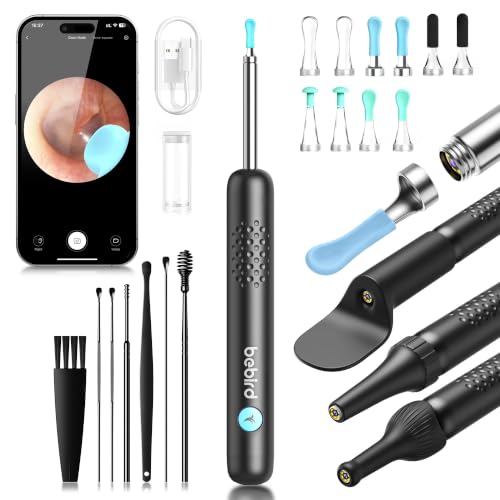
BEBIRD R1 is the phone-viewing option with a specified 1080P, 3-megapixel camera and six LED lights. Its maker says the Bebird app connects by Wi-Fi to iOS or Android phones and tablets, with live transfer at 20 frames per second; the kit has 10 replacement tips and a three-piece silicone set. That combination suits someone who wants to see the image on a compatible device while inspecting. Its resolution and tip count are lower than BEBIRD Ultra 2K, so consider another model if those are your deciding factors.
Bottom line: Choose this if app-based live viewing is the deciding feature.
BEBIRD D39R

BEBIRD D39R differs through a flexible silicone camera tube intended for curved ear canals, along with a storage case and 12 tips. Its maker says the precision lens captures images without lag or delay, and the kit includes tweezers and three silicone pieces. The flexible design may suit buyers who need a different shape from a rigid camera tool, but flexibility does not make it appropriate to push farther into the ear. The maker advises first-time users to get used to the sensation and move gently and slowly.
Bottom line: Consider this if a flexible camera tube is more important than a higher stated resolution.
How to choose a BEBIRD ear wax camera
Start with the camera and attachment combination, not the largest tip count. The products here range from a 1080P, 3-megapixel camera to a 2K camera; the R1 Ultra instead specifies 10 megapixels and 3× magnification. Resolution figures use different formats, so they do not guarantee a sharper or safer view in every phone app. Tip counts range from 10 to 54, but extra attachments do not make wax removal medically necessary. Earwax normally moves outward on its own, and cotton swabs or other objects can push wax deeper or injure the canal. Avoid a camera cleaner if you cannot see clearly, keep your hand steady, or feel pain; seek clinical advice instead.
Flexible versus rigid camera reach
A flexible camera tube and a rigid tool feel different in a curved canal, but neither should be forced inward. BEBIRD D39R has a flexible silicone tube designed for curved canals, while BEBIRD Ultra 2K specifies a flexible 3.6 mm lens; the facts do not define the reach or bend radius of the other cameras. Ear canals vary in angle and diameter, so a camera that looks small on paper may still be uncomfortable. Use this practical rule: if you need to bend or push the tool to keep the image centered, stop rather than advancing it. The canal skin is delicate and the eardrum is farther inside; a visual feed is not a depth sensor or a safety guarantee.
Ear cleaning methods compared
For most people, no instrument is needed for routine earwax care. The ear canal usually clears wax naturally; medical removal may use suction, a curette or irrigation depending on the person and the wax. Home camera tools add a view and tip attachments, but do not provide the clinician’s training or a reliable assessment of the eardrum. Use this comparison to decide whether a tool matches your need, not as permission to insert it.
| Need | Approach | Key consideration |
|---|---|---|
| Routine care | Leave the canal alone; clean the outer ear | Wax often exits naturally |
| Camera viewing | Camera otoscope | Stop if view or hand control is uncertain |
| Blocked ear or symptoms | Clinician assessment | Cause may not be wax |
Do not irrigate or use drops without medical guidance if you have a perforated eardrum, ear tubes, prior ear surgery or drainage.
Safe use and when to get help
Ear pain, discharge, sudden hearing loss, dizziness or bleeding calls for medical assessment rather than home scraping. A camera can show part of the canal but cannot reliably rule out infection, an eardrum problem or another cause of symptoms. Never insert a tip while another person is moving, and do not use an ear camera on a child unless a clinician has advised you how; sudden movement can cause injury. Keep reusable tips clean and dry according to their care instructions, and do not share them between people without proper cleaning. If wax is repeatedly blocking hearing, a clinician can identify the cause and remove it with an appropriate method.
Frequently Asked Questions
Do BEBIRD ear cameras remove ear wax safely?
A camera does not make inserting a tip into the ear risk-free. Earwax often clears naturally, and pushing objects into the canal can compact wax or injure the canal or eardrum; stop if you feel pain or cannot keep the view steady.
Can I use an ear camera if I have ear tubes?
Ask a clinician before using an ear camera, drops or irrigation if you have ear tubes. The same caution applies after ear surgery, with a known eardrum perforation, or when the ear is draining.
How often should I clean ear wax at home?
There is no routine schedule for removing wax because healthy ears usually move it outward on their own. Clean only the outer ear, and seek care if wax causes persistent blockage or hearing change.
What symptoms mean I should stop using an otoscope?
Stop immediately for pain, bleeding, dizziness, drainage or sudden hearing loss. These symptoms need medical assessment because a camera view cannot confirm that the eardrum and canal are healthy.
Are BEBIRD camera tips interchangeable between models?
Do not assume tips fit across BEBIRD models; tip shape and connection can differ. Confirm the replacement tip is made for the exact model before attaching it.