
Best Cart for a Dog to Pull: 5 Options Compared

For most dogs pulling cargo, Two-Wheel Basket Cart is the clearest fit because its two-wheel wagon has a lidded metal basket and 12-inch wheels. Choose a passenger cart instead if the goal is to carry people, since those designs are much larger and intended for seating.
A dog-pulling cart attaches behind a harness so the dog moves a load on wheels; a secure harness fit and gradual conditioning matter more than adding weight quickly.
We earn a commission if you buy through links on this page. As an Amazon Associate I earn from qualifying purchases. Products are compared on manufacturer specifications, not hands-on testing.
- Best overall: Two-Wheel Basket Cart – Its lidded basket is designed to hold supplies, and its 12-inch wheels suit everyday paths.
- Best for a two-brake passenger cart: Welded-Iron Passenger Cart – It pairs a harness-linked handlebar with a rear foot brake and offers adjustable rod spacing.
- Best for a wide seat: 26-Inch-Wide Seat Cart – Its 26-inch-wide soft seat is described as fitting two children.
| Product | Best for | Cart use | Wheel setup | Capacity (lb) | Shop |
|---|---|---|---|---|---|
| Two-Wheel Basket Cart | Cargo hauling | Cargo basket | Two 12-inch wheels | — | Check Price on Amazon |
| Welded-Iron Passenger Cart | Brake coordination | Passenger seat | Detachable wheels and rods | 330 lb | Check Price on Amazon |
| 26-Inch-Wide Seat Cart | Wide seating | Passenger seat | 16-inch wheels | 330 lb | Check Price on Amazon |
| Four-Wheel Passenger Cart | Steerable seating | Passenger seat | Four wheels | 220 lb | Check Price on Amazon |
| JIYCD Detachable Passenger Cart | Adjustable rods | Passenger seat | 13.7-inch rear wheels | 220 lb | Check Price on Amazon |
Dog-Pulling Carts Compared
Start with whether your dog should pull cargo or a passenger, then compare the cart’s setup and capacity.
Two-Wheel Basket Cart

Unlike the passenger carts, this model is a cargo wagon with a latching metal basket. The maker says it can carry toys, water, camping gear, or training weights; the basket measures about 12 inches wide by 20 inches long, and its shafts are about 30 inches. Its two 12-inch wheels are intended for grass, gravel, and pavement. This is the closest match for walks where the dog pulls supplies rather than people. The specifications give no load rating, so it is a poor choice if you need a verified maximum cargo weight.
Bottom line: Choose this for a dog to pull supplies, not a person.
Welded-Iron Passenger Cart

The notable distinction here is a twin-brake arrangement: a harness-linked handlebar works with a rear foot brake. The maker describes a fully welded-iron frame, hand-detachable wheels and extension rods, and adjustable harness and rod spacing. Its capacity is 330 pounds. This passenger-style cart may suit outings where a person rides along and the dog is sized to the adjustable pulling setup. The measurements are inconsistent, so confirm the cart’s assembled dimensions before ordering if doorway, storage, or path width is a constraint.
Bottom line: Pick this when coordinated braking and removable parts matter.
26-Inch-Wide Seat Cart
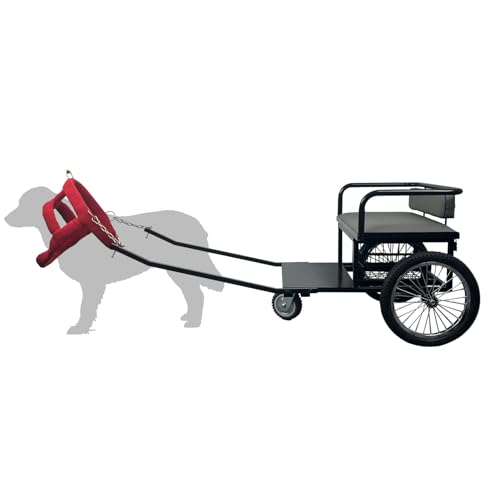
The wide seat sets this passenger cart apart: the maker says its 16-by-26-inch seat can fit two children, and it includes a metal foot deck. The specifications give a 330-pound capacity and 16-inch wheels. Its metal construction and roomy seating point to family outings rather than carrying trail supplies. Consider it only if passenger seating is the goal and your dog can safely pull the assembled cart. The cart is listed as 28 inches wide overall, which can limit access on narrow paths or through tight gates.
Bottom line: Choose this for a broad passenger seat and foot deck.
Four-Wheel Passenger Cart

Four wheels and a bicycle-style steering handle distinguish this passenger cart from the two-wheel options. The maker describes a handbrake, leather liner, and a 100-kilogram load capacity; it also gives a dog weight range of 30 to 60 kilograms. Those figures make it a passenger-focused choice for buyers who want steering control rather than a simple cargo basket. It is much larger than a utility wagon, with dimensions of 60 by 28 by 36 inches. Verify that the intended dog fits the harness and body-size range before use.
Bottom line: Pick this for steerable passenger carrying within its dog range.
JIYCD Detachable Passenger Cart

Adjustable rod spacing and a 23.6-inch seat width are the defining features of this passenger cart. The maker describes a high-precision axle-steel frame, stainless-steel welding, and a 100-kilogram load capacity; the rear wheels are about 13.7 inches in diameter. Its dog size range is 22 to 88 pounds, so it targets a broad span of dog weights while carrying a passenger. The cart size is described as the same across dog sizes, so check whether that fixed cart footprint suits your storage and route before choosing it.
Bottom line: Choose this when adjustable rods and its dog range fit.
How to Choose a Dog-Pulling Cart
Choose by load purpose first: a basket cart carries gear, while a passenger cart needs a seat, brakes, and room for the rider. The comparison here includes both types, so capacity alone does not tell you whether a cart suits your plan. Next match the harness and shafts to the dog’s body; an adjustable rod is useful only if it can be set without rubbing or restricting the dog’s stride. For a cargo route with grass or gravel, wheel size and tire design affect how easily the cart rolls. Start training with an empty cart on level ground, then add a small amount of weight only after the dog pulls calmly and turns and stops reliably.
| Need | Cart type | Check before use |
|---|---|---|
| Carry supplies | Two-wheel basket | Secure cargo and load limit |
| Carry a passenger | Seat cart | Brakes, rider restraint, dog fit |
| Vary dog fit | Adjustable shafts | Harness clearance and stride |
Passenger carts add a higher consequence if a dog stops or turns abruptly, so use only a setup with effective brakes and a securely seated rider.
Fit the Harness and Cart to the Dog
A pulling harness should spread force across the chest and shoulders rather than concentrate pressure on the neck; a standard walking collar is not a substitute for a pulling harness. The shafts should stay aligned beside the dog and allow free shoulder movement, with enough clearance to avoid contact during turns. Measure the dog’s chest and body length while standing, then compare those measurements with the harness adjustment range before attaching the cart. A cart that is too wide for a path can also force sharp turns that strain the dog or tip a passenger load. If the cart’s dimensions are unclear or conflict, verify the assembled footprint and harness fit before ordering.
Build Pulling Work Gradually and Safely
Start with short sessions on level, nonslip ground and an empty cart; increase either distance or load, not both at once. Stop if the dog is limping, repeatedly lagging, panting heavily, or resisting the harness, and let the dog recover before another session. Heat raises exertion risk, so schedule pulling for cooler parts of the day and bring water; avoid hot pavement, which can burn paw pads. Keep cargo secured low in the basket, since shifting weight can affect balance on turns. Do not use a dog cart for downhill braking: a dog cannot safely control a runaway load, and the handler must be able to stop the cart independently.
Frequently Asked Questions
Can any dog pull a cart safely?
No; a dog needs a comfortable harness fit, sound movement, and training that builds gradually. Start without added cargo, and stop if the dog limps, resists, or shows unusual fatigue.
How should I start cart-pulling training?
Begin with an empty cart on level ground for a short session, then increase distance or weight gradually. Change one at a time so you can tell whether the added demand is comfortable.
Is a walking harness suitable for pulling?
A pulling harness is designed to spread load across the chest and shoulders, while many walking harnesses are not. Check that the harness does not restrict shoulder movement or rub when the dog leans into the shafts.
Can dogs pull carts with children seated?
Only with a cart designed for passengers, effective brakes, and a securely seated rider; a cargo wagon is not a passenger cart. Train the dog with an empty cart first and never rely on the dog to stop a downhill load.
What should I check before taking a cart on gravel?
Check wheel suitability, cargo security, and whether the path is wide enough for the cart to turn without snagging. Start on a short, level stretch because loose gravel increases rolling resistance.