
Best Combs for Fine Hair: 4 Options Compared

The Kent 16T suits most fine-hair routines because it combines fine teeth for finishing with wider teeth for detangling in a 7.2-inch comb. Choose a wide-tooth-only comb if gentle wet-hair detangling is your main need, or a tail-comb set if you need parting and styling tools.
We earn a commission if you buy through links on this page. As an Amazon Associate I earn from qualifying purchases. Products are compared on manufacturer specifications, not hands-on testing.
- Best overall: Kent 16T Tortoise Comb – Its fine and wide tooth sections cover finishing and detangling in one 7.2-inch comb.
- Best for precise parting: 8.8-Inch Carbon Fiber Tail Comb – Its 8.8-inch tail comb has a stainless-steel pintail for parting and styling.
| Product | Best for | Tooth style | Length | Pieces | Shop |
|---|---|---|---|---|---|
| Kent 16T Tortoise Comb | Daily grooming | Fine and wide | 7.2 in | 1 | Check Price on Amazon |
| SALONSILK 4-Piece Comb Set | Multiple styling tasks | Wide, medium, fine, rat-tail | — | 4 | Check Price on Amazon |
| Kolavia 6-Piece Comb Set | Salon-style variety | Wide and fine tooth | 9 in | 6 | Check Price on Amazon |
| 8.8-Inch Carbon Fiber Tail Comb | Precise parting | Fine tooth, metal tail | 8.8 in | 1 | Check Price on Amazon |
Combs for Fine Hair Compared
Compare tooth styles and set contents to match the comb to your fine-hair routine.
Kent 16T Tortoise Comb

The Kent 16T combines fine and wide teeth, unlike the single-purpose wide-tooth and tail combs here. Its 7.2-inch saw-cut comb is hand-polished and has rounded teeth; the maker says the teeth are designed to glide through wet or dry hair. The fine section suits smoothing and finishing, while the wider section handles looser tangles. This is a practical choice if you want one comb for both steps. Its limitation is the dual-purpose layout: choose a wide-tooth-only comb if you mainly need room between teeth for working through damp tangles.
Bottom line: Choose this if you want fine and wide teeth in one daily comb.
SALONSILK 4-Piece Comb Set

The SALONSILK set stands out for providing four distinct comb styles instead of a single comb: wide-tooth, medium-tooth, fine-tooth rat tail, and braiding comb. The maker describes the carbon-fabric combs as heat-resistant and anti-static, and says the set is intended for daily use, hair cutting, styling, and drying. That variety suits someone who wants separate tools for detangling, parting, and close styling. The tradeoff is that the set takes more space than a single comb, and the measurements do not give a useful length for comparing its individual pieces.
Bottom line: Choose this if you want several tooth styles and a rat-tail comb.
Kolavia 6-Piece Comb Set
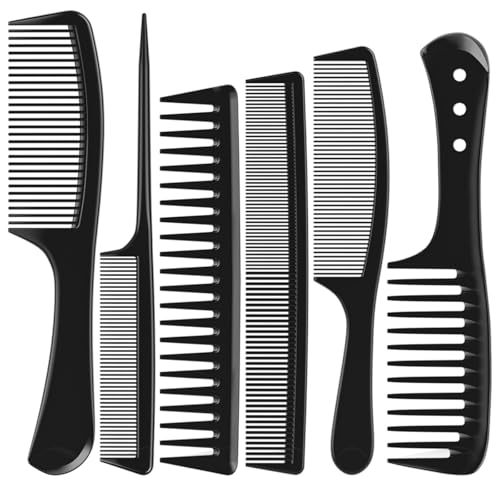
The Kolavia set has six combs, more pieces than the four-comb SALONSILK set, and is positioned for detangling, parting, teasing, styling, and cutting. Its features name both wide- and fine-tooth combs, along with rat-tail combs, so it can cover more than one kind of styling task. The maker says the carbon-fiber combs are designed to glide smoothly. This set suits someone who wants multiple tools rather than a single everyday comb. The limitation is that the set contents are not broken down by individual comb type, so it is harder to match a particular piece to a specific task.
Bottom line: Pick this if you want a six-piece styling set with wide and fine teeth.
8.8-Inch Carbon Fiber Tail Comb

The 8.8-inch tail comb is the most specialized choice here: its fine teeth pair with a stainless-steel pintail for parting, back-combing, and post-styling work. The maker says its carbon-fiber body is heat-resistant up to 356°F and anti-static. That combination suits a routine built around sectioning and close styling, rather than general-purpose detangling. Its narrow, fine-tooth format is less suitable as the only comb for working through larger tangles; choose a wide-tooth design for that task. It is a single comb, unlike the multi-piece sets.
Bottom line: Choose this for fine-tooth styling and precise sectioning.
How to choose a comb for fine hair
Choose tooth spacing according to the task: wider gaps help separate tangles, while closer teeth smooth and arrange hair. Fine strands can be easier to pull or snap when a comb catches, so start with loose tangles and work in small sections rather than dragging from scalp to ends. For one tool that does both jobs, a dual-tooth comb offers a wide section and a fine section; for distinct styling tasks, a set may include a rat-tail comb for parting. A measurable rule: if you need to detangle damp hair, start with a wide-tooth comb and switch to closer teeth only after the section moves freely. Fine-tooth designs work best for finishing, not forcing through knots.
Wide-tooth and fine-tooth combs compared
Wide-tooth combs prioritize separating hair, while fine-tooth combs prioritize close control and smoothing. A dual-tooth comb combines both spacing patterns; a tail comb adds a pointed handle for sectioning. Use this guide to match comb type to the job rather than assuming one tooth pattern handles every step.
| Need | Comb style | Why it fits |
|---|---|---|
| Detangle a loose knot | Wide tooth | More space between teeth to work through a section |
| Smooth or finish | Fine tooth | Closer teeth give more control over small sections |
| Part and style | Tail comb | Pointed handle separates sections |
| Switch between tasks | Dual-tooth or set | Offers more than one tooth style |
Detangling fine hair without pulling
Detangle from the ends upward, holding the section above a knot so the pull does not travel to the roots. Wet hair is more vulnerable to stretching and breakage than dry hair, so use gentle strokes and avoid forcing a comb through a snag. A wide-tooth comb is a sensible starting point for damp hair; stop if the teeth catch, separate the knot with your fingers, then continue in smaller sections. Once hair is free of knots, a fine-tooth comb can help with finishing or arranging a part. The comb alone cannot prevent breakage if the hair is pulled hard, so pressure and technique matter as much as tooth spacing.
When a tail comb or comb set makes sense
A tail comb is useful when sectioning matters more than general detangling: its pointed end helps create parts, while fine teeth can smooth small sections. A set is useful when you regularly alternate between detangling, braiding, and close styling, but a multi-piece kit adds tools you may not use. Carbon-fiber and carbon-fabric combs in this group are described by their makers as heat-resistant; only one gives a specific limit, 356°F. Do not assume every comb in a set has the same heat limit. If using a heated tool near a comb, verify the individual comb’s heat rating before exposing it to heat.
Frequently Asked Questions
Should I use a wide-tooth comb on fine hair?
A wide-tooth comb is a useful starting point for detangling, especially when hair is damp. Work through small sections from the ends upward, and stop if the teeth catch.
Is it better to comb fine hair wet or dry?
Fine hair is more vulnerable to stretching and breakage when wet, so use extra care on damp strands. A wide-tooth comb and gentle, end-first strokes reduce the need to pull through knots.
What does a rat-tail comb do?
A rat-tail comb uses its pointed handle to separate sections and make parts. Fine teeth can then smooth or arrange those sections for styling.
Can I use a fine-tooth comb to detangle knots?
Use a fine-tooth comb for finishing once larger tangles are out, not to force through a knot. Start with fingers or a wide-tooth comb and work upward from the ends.
Are carbon-fiber combs safe with hot tools?
Heat tolerance depends on the specific comb. One comb in this comparison gives a maker-stated limit of 356°F, so verify the individual comb’s rating before using it near heat.