
Heat Shrink Self Solder Connectors: 4 Kits Compared

For a broad range of wire sizes in one kit, 455-Piece 5-Size Kit is the most versatile pick, with 455 connectors across five sizes for 26–10 AWG wire. Choose a smaller assortment if you need fewer pieces, or a kit with gauge markings if quick identification matters.
Heat shrink self-solder connectors are sleeves with a solder ring and heat-activated adhesive that join and seal butt-spliced wires when heated with a heat gun.
We earn a commission if you buy through links on this page. As an Amazon Associate I earn from qualifying purchases. Products are compared on manufacturer specifications, not hands-on testing.
- Best overall: 455-Piece 5-Size Kit – It has 455 pieces across five sizes for 26–10 AWG wire.
- Best for marked sizes: haisstronica 340-Piece Kit – Its kit includes wire gauge markings and five sizes.
- Best for compact kit: Kuject 120-Piece Kit – Its 120-piece kit covers 26–10 AWG wire.
| Product | Best for | Kit count | Wire range | Color assortment | Shop |
|---|---|---|---|---|---|
| 455-Piece 5-Size Kit | Broad assortments | 455 pieces | 26–10 AWG | 5 colors | Check Price on Amazon |
| haisstronica 340-Piece Kit | Gauge identification | 340 pieces | 26–10 AWG | 5 colors | Check Price on Amazon |
| TICONN 150-Piece Kit | Smaller assortments | 150 pieces | Mixed AWG sizes | 4 colors | Check Price on Amazon |
| Kuject 120-Piece Kit | Compact assortments | 120 pieces | 26–10 AWG | 4 colors | Check Price on Amazon |
Heat Shrink Self Solder Connectors Compared
Compare these kits by their piece counts, wire coverage and color assortment before matching a connector to your wire.
455-Piece 5-Size Kit

With 455 pieces across five sizes, this kit offers the largest assortment here for 26–10 AWG wire. The maker describes a one-step process using a heat gun, with a solder sleeve, shrink tubing and hot-melt adhesive rings; the tubing is polyolefin. Five color-coded sizes can help sort connectors by fit. This is a practical choice for projects that use several wire gauges. Its large count may be more than needed for a small repair, and the maker’s claims of pull strength and moisture resistance do not replace checking that a finished splice is sound and suited to its environment.
Bottom line: Choose this kit if your projects use multiple gauges and you want the largest assortment.
haisstronica 340-Piece Kit
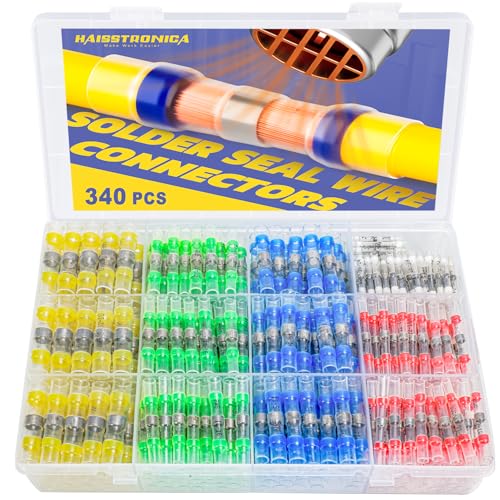
Wire gauge markings and clear sleeves distinguish this 340-piece kit from the other assortments. The five color groups are listed as 90 red, 70 blue, 70 green, 70 white and 40 yellow connectors, covering 26–10 AWG. Its compartment storage is useful when keeping several connector sizes organized, and the maker describes abrasion protection and hot-melt adhesive rings. This kit suits buyers who value marked sizes and organized storage. It has fewer total pieces than the 455-piece assortment, so it may be a less suitable choice for repeated jobs across many wires.
Bottom line: Pick this kit when marked gauges and compartment storage are useful.
TICONN 150-Piece Kit

The 150-piece TICONN assortment is the smaller mixed kit here, making it a fit for occasional wiring work rather than stocking a large supply. Its dual-wall design pairs outer polyolefin tubing with an inner solder ring and hot-melt adhesive, and the maker says a heat gun is the only tool needed for joining. The product includes white, red, blue and yellow connectors; the maker also offers specific single-gauge options. This assortment suits buyers seeking a lower piece count, but its mixed sizes require matching each connector to the wire before heating.
Bottom line: Choose this smaller mixed kit for occasional splices and a four-color assortment.
Kuject 120-Piece Kit

Kuject has the fewest pieces among these broad-range kits, with 120 connectors in red, blue, yellow and white for 26–10 AWG wire. Each butt connector has two hot-melt adhesive rings, and the maker says the connectors can be bent after joining for work in confined spaces. The maker also says a heat gun completes the solderless, crimpless joint. This kit may suit a small repair where access is tight, but the compact count is less suited to ongoing work that needs many connectors or several sizes on hand.
Bottom line: Select this kit for a small job where limited workspace and a compact count matter.
How to choose a heat shrink self solder connector
Start with the wire gauge and connector size, not the kit count. Wire gauge numbers run in reverse: 10 AWG wire is thicker than 26 AWG wire, so a connector must fit the conductor size to be joined. These kits span 26–10 AWG, but color conventions can vary between assortments; use the size marking or packaging rather than color alone. A kit with several sizes is useful when a project includes different wire gauges, while a single-gauge option avoids sorting mixed pieces. Choose a dual-wall sleeve with adhesive when moisture sealing is needed, and do not assume a sealed splice is suitable for every underwater or high-heat application.
How to heat and inspect a solder seal splice
A heat gun is the tool specified for these connectors; an open flame concentrates heat and can damage the tubing or nearby insulation. Strip enough insulation for the exposed conductors to meet beneath the solder ring, without leaving bare copper outside the sleeve. Center the solder ring over the joint, then heat evenly around the sleeve until the solder melts and the tubing shrinks. The exact heat and time depend on the connector and tool, so avoid overheating adjacent wire insulation. After the joint cools, check that the conductors remain aligned, the solder has flowed across the joint and the adhesive has sealed the sleeve ends. Disconnect power before making a splice.
When a solder seal connector is the wrong choice
A solder seal connector is intended for a butt splice between compatible wires; it is not a substitute for a terminal, junction box or strain relief. For wiring that moves repeatedly, carries a critical load or is exposed to immersion, verify that the connector and installation method are rated for that use before relying on the joint. A mechanically crimped connector may be more appropriate where the manufacturer or equipment instructions call for a specific crimp terminal. Keep the wire gauge within the connector’s range, and do not force oversized conductors into a sleeve. Heat-shrink tubing can protect a correctly made splice, but it cannot correct a poor conductor connection.
Connector kit sizes at a glance
Piece count tells you how much assortment a kit provides, but wire coverage and identification features decide whether it fits a project. Use the table to compare the kit options, then match the individual connector size to the wire rather than relying on the number of colors.
| Need | Kit choice |
|---|---|
| Most pieces and five sizes | 455-piece assortment |
| Marked gauges and compartments | haisstronica 340-piece kit |
| Smaller mixed assortment | TICONN 150-piece kit |
| Compact 120-piece assortment | Kuject kit |
Frequently Asked Questions
Can heat shrink solder connectors be used with a heat gun?
Yes, the kits here specify a heat gun for shrinking the sleeve and melting its solder ring. Apply heat evenly and avoid an open flame, which can damage insulation or tubing.
How do I choose the right connector size?
Match the connector size to the wire gauge, because 10 AWG wire is thicker than 26 AWG wire. For a mixed-wire job, choose a kit with multiple sizes and confirm each fit before heating.
Are solder seal connectors waterproof?
Adhesive-lined tubing is designed to seal against moisture, but that does not establish suitability for every wet or submerged installation. Check the connector and equipment requirements before using a splice where immersion or serious water exposure is possible.
Can I use a lighter instead of a heat gun?
A heat gun is the specified heating tool for these kits. A lighter or torch can create concentrated heat that damages the sleeve, adhesive or nearby wire insulation.
Should wiring be powered during connector installation?
No, disconnect power before stripping wire or making a splice. Once the connector has cooled, inspect the joint and restore power only when the circuit is safely reassembled.