
DHS Ping Pong Racket: 3 Models Compared by Setup

For an offensive DHS ping pong racket with a 5-ply wood blade and Hurricane 8/TinArc rubbers, DHS Performance-Level 5-Ply is the clearest fit; its rubber pairing is the deciding difference. Choose DHS 7-Ply Wood with Cover for a 7-ply wood blade and included fabric cover, or DHS H9002 9-Star Set if you want an Arylate Carbon blade and a two-player set.
We earn a commission if you buy through links on this page. As an Amazon Associate I earn from qualifying purchases. Products are compared on manufacturer specifications, not hands-on testing.
- Best overall: DHS Performance-Level 5-Ply – Pairs a 5-ply wood blade with Hurricane 8 and TinArc rubbers for an offensive setup.
- Best for a covered racket: DHS 7-Ply Wood with Cover – Includes a fabric cover and uses a 7-ply wood blade with sticky rubber.
- Best for carbon construction: DHS H9002 9-Star Set – Combines a 5+2 Arylate Carbon blade with Hurricane 8 and Hurricane 3 rubbers.
| Product | Best for | Blade construction | Rubber setup | Included extras | Shop |
|---|---|---|---|---|---|
| DHS Performance-Level 5-Ply | Offensive looping | 5-ply wood | Hurricane 8 / TinArc | — | Check Price on Amazon |
| DHS 7-Ply Wood with Cover | Covered storage | 7-ply wood | Sticky rubber | Fabric cover | Check Price on Amazon |
| DHS H9002 9-Star Set | Carbon blade set | 5+2 Arylate Carbon | Hurricane 8 / Hurricane 3 | 2 rackets, 6 balls | Check Price on Amazon |
DHS ping pong racket options
Compare blade construction, rubber pairing and included accessories before choosing a racket setup.
DHS Performance-Level 5-Ply
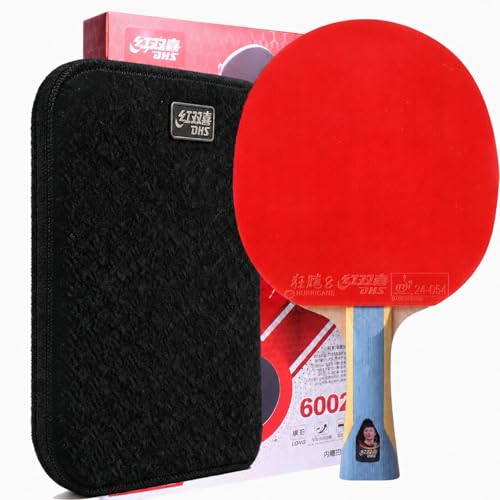
DHS Performance-Level 5-Ply stands out for its distinct rubber pairing: Hurricane 8 on the forehand and TinArc on the backhand, over a 5-ply wood blade. The maker says the tacky forehand rubber is designed for heavy topspin loops, while the backhand rubber supports blocks and flick attacks. Its 3 15/16-inch size is useful to compare against the grip you prefer. This setup suits players who want an offensive racket with different rubber characteristics on each side. The limitation is that it is built around that attacking style, so it may be a poor match for someone prioritizing a simple, uniform setup.
Bottom line: Choose this for an offensive game built around forehand loops and quick backhand attacks.
DHS 7-Ply Wood with Cover

DHS 7-Ply Wood with Cover is the only option here that pairs a 7-ply wood blade with a fabric paddle cover. It weighs 0.8 pounds and measures 3 15/16 inches; its maker describes the rubber as sticky and intended to support spin and control. The cover is a practical extra for players who want a case included with the racket. This choice suits someone seeking a wood-only, 7-ply construction rather than a carbon layer. Its limitation is the less specific rubber pairing: players who want named forehand and backhand rubbers should compare it with the more clearly identified combinations on DHS Performance-Level 5-Ply and DHS H9002 9-Star Set.
Bottom line: Choose this if a 7-ply wood blade and included fabric cover are your priorities.
DHS H9002 9-Star Set

DHS H9002 9-Star Set differs from the single-racket options by including a two-player set and six WTT 3-star balls, along with its 5+2 Arylate Carbon blade. The maker says this construction is intended for high-level offensive play, with speed, stability and control as goals. Hurricane 8 and Hurricane 3 are the named rubbers, and the racket has an ebony outer ply. This option suits advanced players who want carbon construction and a two-racket set for a partner. Its limitation is that the set format may be unnecessary for someone seeking only one racket or who prefers a classic all-wood blade.
Bottom line: Choose this for a carbon-blade setup that comes with a two-racket set and balls.
How to choose a DHS ping pong racket
Start with the blade construction and rubber pairing, because those are the clearest differences among these DHS options. A 5-ply wood blade appears in DHS Performance-Level 5-Ply, while DHS 7-Ply Wood with Cover uses 7-ply wood and DHS H9002 9-Star Set uses 5+2 Arylate Carbon. More layers or a carbon layer do not, by themselves, tell you whether a racket suits your technique; the maker’s descriptions point to these choices as offensive setups. For developing control, prioritize a comfortable grip and a predictable response over a speed-focused description. A measurable rule: if you specifically want a wood-only blade, compare the 5-ply and 7-ply options and exclude the carbon construction. Also choose by rubber: named forehand/backhand combinations make side-specific setups easier to distinguish.
Blade and rubber differences to compare
Table tennis rackets combine a blade with coverings on both sides, and the blade material and rubber surface affect the feel of the setup. The DHS options range from 5-ply and 7-ply wood to 5+2 Arylate Carbon; the “+2” identifies two added carbon layers in the named construction. A racket covering must be authorized for competition use under ITTF rules, and players should check current approved-equipment requirements if they plan to compete. The rubber choices also differ: two rackets name separate forehand and backhand rubbers, while the 7-ply option describes sticky rubber without naming a pairing. Use the table to narrow by construction and accessories, then decide whether the specified rubber combination matches your strokes.
| Setup | Blade | Best fit |
|---|---|---|
| Wood with named rubber pair | 5-ply wood | Side-specific offensive setup |
| Wood with cover | 7-ply wood | Covered storage preference |
| Carbon set | 5+2 Arylate Carbon | Two-player set need |
Choosing rubber for your playing style
Rubber surface and sponge design shape how a racket responds to spin and impact, but the product names alone cannot guarantee a particular result for every player. DHS Performance-Level 5-Ply names Hurricane 8 for the forehand and TinArc for the backhand; DHS H9002 9-Star Set names Hurricane 8 and Hurricane 3. DHS 7-Ply Wood with Cover instead emphasizes sticky rubber without identifying two distinct sides. Players who loop heavily on the forehand may value a tacky surface, while players who rely on quick blocks may want to compare the named backhand rubber and the maker’s intended use. If you are not sure which style fits, select based on your most frequent stroke rather than choosing solely by a “professional” label.
Racket care and competition checks
Keep table tennis rubber clean and covered between sessions; dust and surface residue can reduce grip. A case, such as the fabric cover included with DHS 7-Ply Wood with Cover, helps keep the racket protected during storage, but it does not replace gentle cleaning with a damp cloth. Allow the surface to dry before putting the racket away. For tournament play, the ITTF rules require approved racket coverings and different colors on the two sides; check the current rules and approved coverings before entering an event. This matters especially when a product uses branded rubber names but does not establish competition approval for every component. Avoid abrasive cleaners and do not leave the racket in prolonged direct sunlight, which can damage rubber.
Frequently Asked Questions
What does a 5+2 table tennis blade mean?
A 5+2 blade has five wood plies and two added plies of another material, such as the Arylate Carbon named for DHS H9002 9-Star Set. The construction alone does not establish whether it will suit your stroke or control preference.
How often should I replace table tennis rubber?
There is no single replacement interval because wear depends on how often you play, how you store the racket and how the surface is maintained. Replace a covering when it has lost grip or has visible damage; keep it clean and covered between sessions to limit dust buildup.
Can I use these DHS rackets in a tournament?
Tournament equipment must meet the current ITTF rules, including using authorized racket coverings and different colors on the two sides. Verify the current approval status of the specific coverings before competing; a product’s promotional description alone is not a substitute for that check.
What is the difference between a 5-ply and 7-ply blade?
The ply count refers to the blade’s layers, with 5-ply meaning five and 7-ply meaning seven. DHS Performance-Level 5-Ply has a 5-ply wood blade and DHS 7-Ply Wood with Cover a 7-ply wood blade, but layer count alone does not predict which will feel better for an individual player.
How should I store a table tennis racket?
Store the racket clean, dry and protected from dust, ideally in a cover between sessions. Keep it away from prolonged direct sun and heat, which can damage the rubber surface.