
Hand Crank Anchor Winch: 4 Manual Systems Compared

For a hand crank anchor winch, the Hazztoll system is the clearest match because it specifies a manual crank and a 35-pound capacity. Choose a different option if you need a kayak-specific crank, a 100-foot rope capacity, or a lift-and-lock pulley system instead.
We earn a commission if you buy through links on this page. As an Amazon Associate I earn from qualifying purchases. Products are compared on manufacturer specifications, not hands-on testing.
- Best overall: Hazztoll 35-lb Hand Crank Anchor Lift – It specifies a manual hand crank and a 35-pound anchor capacity.
- Best for kayaks: Anchor Wizard Low Profile Kayak Crank – It is a low profile kayak anchor crank sold without the full system.
- Best for long rope: Attwood Anchor Lift System 13710-4 – It supports up to 100 feet of 3/16-inch anchor line.
| Product | Best for | Operation | Anchor capacity | Rope fit | Shop |
|---|---|---|---|---|---|
| Hazztoll 35-lb Hand Crank Anchor Lift | Manual crank use | Manual hand crank | 35 lb | — | Check Price on Amazon |
| Anchor Wizard Low Profile Kayak Crank | Kayak anchoring | Kayak crank only | — | — | Check Price on Amazon |
| Attwood Anchor Lift System 13710-4 | Long line capacity | Anchor lift / roller | — | 100 ft, 3/16 in | Check Price on Amazon |
| Attwood Lift ‘N Lock 13700-7 | Locking lift control | Lift-and-lock pulley | 20 lb | 1/4–7/16 in | Check Price on Amazon |
Hand Crank Anchor Winch Options
Compare the operating style, load rating and line compatibility before choosing a manual anchor system.
Hazztoll 35-lb Hand Crank Anchor Lift

The Hazztoll is the only option here that explicitly identifies a manual hand crank and a 35-pound anchor capacity. Its thickened steel mounting plates and electroplated rope reel are intended for marine use, and the product features describe a secure lock and smooth axle rotation. It suits buyers who want a crank-operated system for a small boat or kayak.
Bottom line: Choose this when a manual crank and a 35-pound load limit are priorities.
Anchor Wizard Low Profile Kayak Crank

The Anchor Wizard is a low profile kayak crank sold on its own, rather than a complete anchor system. Its purpose makes it the specialized choice for kayak anglers or paddlers who already have compatible anchoring components and want a crank mechanism. That makes compatibility the key limitation: verify that the crank works with your anchor, line and kayak mounting arrangement before relying on it.
Bottom line: Pick this if you need a kayak-specific crank and already have compatible anchor gear.
Attwood Anchor Lift System 13710-4
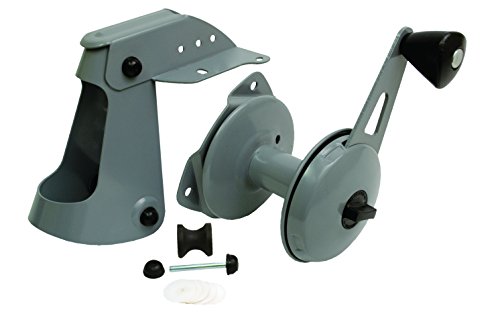
The Attwood Anchor Lift System stands out for its 100-foot capacity of 3/16-inch anchor line and bow- or stern-corner mounting. Powder-coated steel components and self-lubricating nylon rollers are specified, making this a roller-style anchor hoist rather than a clearly identified hand crank. It can suit recreational boaters who want to guide and stow line at a corner of the boat.
Bottom line: Choose this for corner mounting and a 100-foot line capacity, not for a specified crank.
Attwood Lift ‘N Lock 13700-7

The Attwood Lift ‘N Lock uses a lift-and-lock mechanism with a steel sheave, so it offers manual anchor control without being identified as a hand-cranked winch. Its limit is 20 pounds, and it accepts rope from 1/4 to 7/16 inch; the rope is sold separately. Zinc-plated steel and nylon pulleys distinguish it from the powder-coated roller hoist. This is a reasonable alternative when controlled lift positioning matters more than a crank handle, but the 20-pound limit rules it out for heavier anchors.
Bottom line: Pick this for a lift-and-lock pulley setup with an anchor at or below 20 pounds.
How to choose a hand crank anchor winch
Start with the anchor weight and the winch’s capacity; a 35-pound rating and a 20-pound rating are not interchangeable. Then match the mechanism to your setup: a crank reels line mechanically, while a roller or lift-and-lock pulley guides and controls line without a crank. Rope diameter and reel capacity also matter because line that will not fit the spool or guides cannot be used as intended.
Anchoring scope is the length of rode relative to the distance from the bow to the bottom. A common starting point is at least 5:1 in sheltered conditions, with more rode needed in wind, current or rough conditions. For example, 10 feet from bow to bottom calls for about 50 feet of rode at 5:1. A winch’s rope capacity does not by itself establish that the anchor is suitable for your boat or conditions.
Rope fit and anchor capacity
Choose by both line diameter and working load, not by the winch’s physical size. The compatibility range of 1/4 to 7/16 inch is wider than a single fixed-size line, while 3/16-inch line belongs only in equipment that accepts that diameter. Capacity figures in pounds refer to anchor weight here; they do not tell you how much holding force the anchor develops in a particular bottom.
Use this quick match to separate the options by their mechanical fit.
| Need | Best match | Key constraint |
|---|---|---|
| Manual crank and rated load | Hazztoll | 35 lb; rope fit should be verified |
| Kayak crank mechanism | Anchor Wizard | Crank only; check compatibility |
| Long 3/16-inch line | Attwood 13710-4 | 100 ft; no anchor rating given |
| Lift-and-lock pulley | Attwood 13700-7 | 20 lb; 1/4–7/16-inch rope |
Safe anchoring and common mistakes
A winch retrieves and manages rode; it does not replace a properly sized anchor, suitable scope or secure attachment point. Keep fingers clear of rollers, sheaves and moving line while lowering or raising an anchor, and secure the rode to a cleat or dedicated strong point after setting the anchor rather than leaving the winch to carry the boat’s load. Never exceed an anchor capacity.
A common mistake is choosing a winch by anchor weight alone and overlooking rope diameter or available rode length. Another is assuming a kayak-specific crank will fit a different boat or an existing anchor setup. Before ordering, check the line path and mounting space against your boat, and confirm compatibility wherever the crank or rope dimensions are not provided.
Frequently Asked Questions
How much anchor rode should I let out?
A common starting scope is 5:1 in sheltered conditions, meaning 50 feet of rode for 10 feet from bow to bottom. Wind, current and rough water can call for more scope, so a 100-foot line capacity is not automatically enough for every anchoring depth.
Can an anchor winch hold the boat in place?
The winch manages anchor line, but the rode should be secured to a cleat or dedicated strong point after setting the anchor. Do not treat the winch’s anchor-weight rating as a boat-holding-force rating.
What rope diameter should an anchor winch use?
Use only a diameter the line path and reel accept; one system here specifies 3/16-inch line, while another accepts 1/4 to 7/16 inch. A line that is too large may not pass through guides, and one that is too small may not wind reliably.
How do I size an anchor for my boat?
Anchor sizing depends on the boat and conditions, including wind, current and bottom type, not only the winch rating. Use the anchor maker’s boat-size guidance and keep the winch’s load limit at or above the anchor’s weight.
Is a kayak anchor crank compatible with a small boat?
Not necessarily; a kayak-specific crank may depend on its mounting layout and compatible anchor components. Confirm the mounting footprint, rope path and anchor setup for your boat before using it.