
Baking Pans for French Bread: 5 Baguette Pans Compared

For baking several French loaves at once, choose Pavsrmy 4-Loaf Baguette Pan: its four channels have room for the largest batch among these pans. Bakers with less oven space or smaller batches should consider a two- or three-loaf tray instead; pan width and the number of channels determine how much room the pan needs.
Baguette pans are grooved trays that support shaped dough while it bakes; perforations let heat and airflow reach the loaf surface.
We earn a commission if you buy through links on this page. As an Amazon Associate I earn from qualifying purchases. Products are compared on manufacturer specifications, not hands-on testing.
- Best overall: Pavsrmy 4-Loaf Baguette Pan – Four channels let you bake the largest batch at once; the pan measures 15 by 13 inches.
- Best for two loaves: Yupjlia 2-Loaf Baguette Pan – Its two channels fit a 15 by 6.3-inch footprint.
- Best for three loaves: 15 × 11-Inch Carbon-Steel 3-Loaf Pan – Three channels split the difference between a two- and four-loaf batch.
| Product | Best for | Loaves | Pan size | Construction | Shop |
|---|---|---|---|---|---|
| Pavsrmy 4-Loaf Baguette Pan | Large batches | 4 | 15 × 13 in | Nonstick coating | Check Price on Amazon |
| Yupjlia 2-Loaf Baguette Pan | Narrow ovens | 2 | 15 × 6.3 in | Nonstick coating | Check Price on Amazon |
| 15 × 11-Inch Carbon-Steel 3-Loaf Pan | Three-loaf batches | 3 | 15 × 11 in | Carbon steel, silicone coating | Check Price on Amazon |
| KITESSENSU 2-Loaf Baguette Pan | Two-loaf baking | 2 | 15 × 6.3 in | Nonstick coating | Check Price on Amazon |
| Gicyiit 3-Loaf Baguette Pan | Medium batches | 3 | 15 × 9.5 in | Nonstick coating | Check Price on Amazon |
Baking Pans for French Bread Compared
Compare channel count, footprint and pan construction to match your batch size and oven space.
Pavsrmy 4-Loaf Baguette Pan

With four channels and a 15 × 13-inch footprint, this pan accommodates the biggest batch in this group. Pavsrmy says its perforated, BPA-free nonstick surface promotes airflow and helps baguettes develop a crisp crust; the brand recommends hand washing. The wider tray suits bakers who want multiple loaves in one bake and have room for it in the oven. Its 13-inch width is the tradeoff: measure the usable rack space before choosing it, especially if your oven is compact.
Bottom line: Choose this if you want four channels and have 13 inches of oven width.
Yupjlia 2-Loaf Baguette Pan

This two-channel tray has the narrowest footprint here at 15 × 6.3 inches, making it a practical pick when a broader pan would take too much rack space. The maker says the perforated design encourages airflow for a crisp crust and airy interior; it also recommends hand washing. The BPA-free nonstick coating is intended to help release baked loaves. Its limitation is capacity: choose another pan if you regularly want three or four baguettes in one batch.
Bottom line: Pick this for two loaves when oven width is limited.
15 × 11-Inch Carbon-Steel 3-Loaf Pan

This pan offers three channels, a middle ground for batch size, and a 15 × 11-inch stated footprint. Its 0.8 mm carbon steel construction and silicone coating distinguish it from the other nonstick trays. The maker gives a maximum temperature of 446°F and says the pan is dishwasher safe; the coating is described as non-Teflon. That stated heat ceiling matters if your recipe calls for a hotter oven, so choose a different pan for baking above 446°F.
Bottom line: Choose this for three loaves if your recipe stays at or below 446°F.
KITESSENSU 2-Loaf Baguette Pan
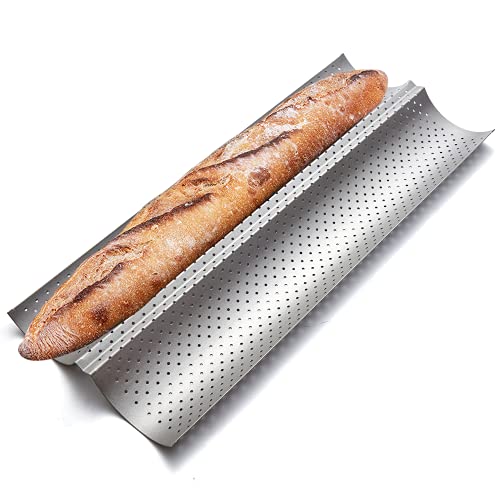
This two-loaf pan shares a 15 × 6.3-inch footprint with another option, but KITESSENSU emphasizes curved grooves intended to shape the loaf bottoms. Its perforated, nonstick surface is designed to support the dough through fermentation and baking, according to the maker, which says the tray can reduce the need for separate proofing cloths or parchment. The pan suits bakers who want a tray for shaping and baking. Its two channels limit each batch to two baguettes.
Bottom line: Pick this if you want curved grooves for shaping and baking two loaves.
Gicyiit 3-Loaf Baguette Pan
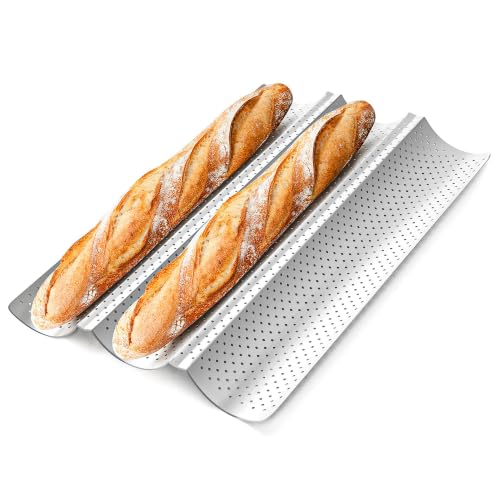
At 15 × 9.5 inches, this three-channel pan is narrower than the other three-loaf option, while still supporting three baguettes at once. The maker says its perforations promote airflow and its BPA-free nonstick surface helps release loaves; the pan is promoted for baguettes, sourdough and sub rolls. It suits bakers who want more capacity than a two-channel tray without stepping up to a four-loaf pan. The 9.5-inch width is still broader than the two-loaf trays, so check rack clearance.
Bottom line: Choose this for three loaves with a narrower footprint than an 11-inch pan.
How to choose a French bread pan
Choose a baguette pan by channel count, oven clearance and the loaf size you intend to bake. Two channels suit a small batch, while three or four make sense when you want several loaves in one bake. The pans here are all 15 inches long, but their widths range from 6.3 to 13 inches, so width may determine fit before capacity does. Measure the flat usable rack area, not just the oven opening; allow room to slide the pan in without catching the sides. Perforations help expose more of the dough surface to circulating oven heat, but they do not replace proper shaping or proofing.
For a rack with under 10 inches of usable width, consider a 6.3- or 9.5-inch tray; confirm the lift range before ordering if you are uncertain the pan can clear your oven opening.
Use this comparison to match the batch to the pan footprint.
| Batch need | Pan width | Example fit |
|---|---|---|
| Two loaves | 6.3 in | Narrow tray |
| Three loaves | 9.5–11 in | Medium batch |
| Four loaves | 13 in | Largest batch |
What perforations do for baguettes
Perforations let hot air circulate around more of a loaf’s surface than a solid tray does, which is why baguette pans commonly use holes beneath their curved channels. The channels support the long shape as dough rises and bakes, while the holes allow moisture to escape from the base. A pan cannot make every loaf uniform on its own: evenly portioned dough and consistent shaping still matter. Avoid covering the holes with a solid liner if you want air to reach the underside. Dough may also stick despite a nonstick surface, so follow the pan maker’s preparation and cleaning directions rather than assuming the coating needs no care.
How pan size and loaf capacity affect fit
Pan width changes substantially even when length and capacity seem similar. A 15 × 6.3-inch tray needs less rack width than a 15 × 11-inch tray, while a four-channel model reaches 13 inches wide. Measure your oven rack’s usable width and depth with obstructions such as side rails in mind; leave enough clearance to move the tray safely. A larger channel count is useful only if the pan fits and you can lift it steadily. One maker specifically advises using both hands when its four-loaf pan is full. Do not infer a baguette’s finished length from the tray measurement alone, since loaf length and dough expansion depend on shaping and recipe.
Care and temperature limits for baguette pans
Care depends on the pan’s construction and coating. One carbon-steel pan is specified as dishwasher safe and has a maximum temperature of 446°F; the nonstick-coated alternatives recommend hand washing. That temperature ceiling is the clearest decision rule: if your oven setting exceeds 446°F, avoid that pan. For coated trays, use gentle cleaning rather than abrasive scouring that can damage a release surface, and avoid cutting bread directly in the pan. Let a hot metal tray cool on a heat-safe surface before washing; sudden temperature changes can stress cookware. Always use oven mitts when moving a hot pan, and support the tray evenly when it carries multiple loaves.
Frequently Asked Questions
Do perforated baguette pans need parchment paper?
Perforated pans are designed to let air reach the dough, so a solid parchment layer can block some of that airflow. Whether to use a liner depends on the pan’s directions and dough release; avoid covering the holes if crisping the underside is a priority.
How wide should a baguette pan be for my oven?
Measure the usable rack width and compare it with the pan’s width, leaving clearance to insert and remove it. These options range from 6.3 to 13 inches wide, so choose a narrower pan if your rack has under 10 inches of clear space.
Can I bake sourdough in a baguette pan?
Yes, baguette-shaped sourdough can be baked in a grooved baguette tray when the dough is shaped to fit its channels. Leave room for the dough to expand during proofing and baking, since oversized loaves may spill beyond the grooves.
What oven temperature can baguette pans handle?
The carbon-steel pan in this group has a maximum of 446°F. For the other pans, check their temperature guidance before baking at a high setting; never exceed a pan’s heat limit.
How do I clean a nonstick baguette pan?
Hand washing is recommended for the nonstick-coated trays from two makers in this group, while the carbon-steel option is described as dishwasher safe. Use a soft sponge on coated surfaces and wait until a hot tray has cooled before washing.