
Best Dog Harness for Basset Hounds: 5 Picks by Fit

Ruffwear Front Range Medium is the strongest starting point for most basset hounds because its four adjustment points and two leash attachments let you tailor the fit and choose where to clip the leash.
Measure your dog’s chest before choosing a size; the sizes here do not establish a fit for every basset hound. Choose a different harness if you need a step-in style, or prefer a design that does not go over the head.
We earn a commission if you buy through links on this page. As an Amazon Associate I earn from qualifying purchases. Products are compared on manufacturer specifications, not hands-on testing.
- Best overall: Ruffwear Front Range Medium – Four adjustment points and chest-and-belly foam padding allow a more tailored fit.
- Best for head-shy dogs: PHOEPET No-Pull Medium – Three buckles let you put it on without passing it over the dog’s head.
- Best for stated chest sizing: 2 Hounds Freedom Medium – Its medium size specifies a 24- to 28-inch chest range.
| Product | Best for | Adjustment | Shop |
|---|---|---|---|
| Ruffwear Front Range Medium | Tailored everyday fit | 4 points | Check Price on Amazon |
| PHOEPET No-Pull Medium | Head-shy dogs | Adjustable | Check Price on Amazon |
| 2 Hounds Freedom Medium | Known chest range | 4 points | Check Price on Amazon |
| Funfox Medium Vest | Reflective walks | 4 points | Check Price on Amazon |
| rabbitgoo Large Vest | Large-size option | 4 straps | Check Price on Amazon |
Dog Harnesses for Basset Hounds
Compare the adjustment, leash connection and sizing information before choosing a harness for your dog’s build.
Ruffwear Front Range Medium

Four adjustment points distinguish this harness, giving basset-hound owners more ways to shape the fit around the chest and body. The maker describes closed-cell foam padding at the chest and belly, plus a back aluminum V-ring and reinforced chest webbing for leash attachment. Reflective trim and an ID pocket are also included. The medium size alone does not confirm a fit for an individual dog, so measure the chest and compare it with the maker’s sizing guidance. This is a useful option when adjustability matters more than a head-free putting-on process.
Bottom line: Choose this if you want multiple adjustment points and both front and back leash attachments.
PHOEPET No-Pull Medium
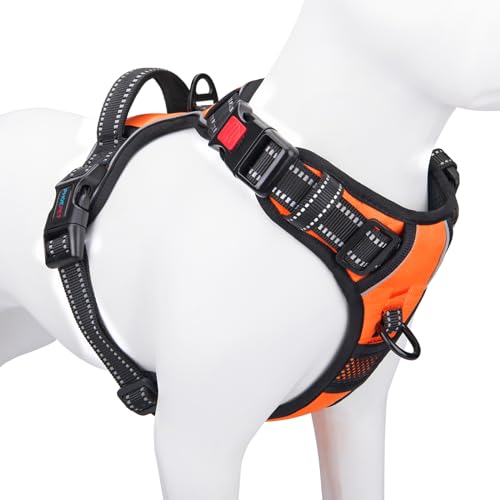
Unlike the over-the-head style, this harness opens at the neck and chest, which can help when a dog resists having gear pulled over its head. It has three buckles, a lockable neck buckle, two metal leash attachment loops and reflective material. The maker says the front attachment can reduce pulling; the back loop is another option for ordinary walks. Measure before choosing, especially for a broad-chested dog.
Bottom line: Pick this when avoiding a head-through opening is your main priority.
2 Hounds Freedom Medium

This medium harness is the only option here with an explicit chest range: 24 to 28 inches. That makes it easier to assess against a measured dog, though the range still needs to match the individual basset hound. Its four adjustment points, front O-ring and second leash connection provide options for guiding a dog that pulls; the maker describes Swiss Velvet lining. The 1-inch medium designation is not a breed-specific fit guarantee. Check that the chest measurement falls within the range and that the harness can be adjusted securely without restricting movement.
Bottom line: Choose this when your dog’s measured chest is within its 24- to 28-inch range.
Funfox Medium Vest
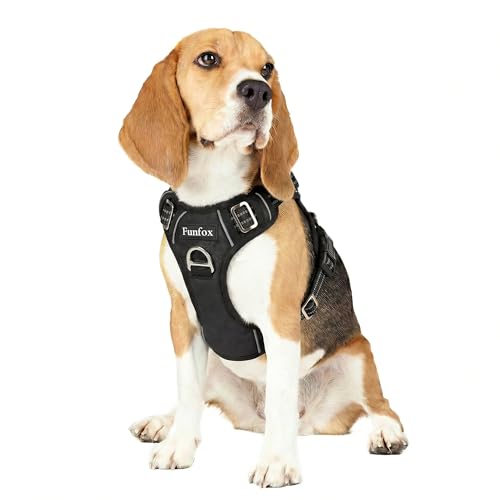
A vertical handle sets this vest apart for handlers who want a handhold alongside leash control. It includes two leash rings, four adjustment points, reflective material and a breathable mesh lining with chest and belly padding. The maker describes the fabric as waterproof polyester and Oxford fabric, and says the padding distributes pressure. Measure the chest and compare it with the size chart before selecting this option for night walks.
Bottom line: Consider this if a top handle and reflective material are priorities.
rabbitgoo Large Vest

This is the only large-size option among these harnesses, but “large” does not by itself mean it will fit a basset hound. It uses four adjustable straps, quick-release buckles and two leash clips, with breathable mesh and soft padding. The maker says the front clip provides redirection and the back clip suits casual walks with well-behaved dogs. Its over-the-head design may not suit dogs that dislike that process. Since no chest range is included here, compare your dog’s measurement with the maker’s sizing chart instead of relying on breed or weight assumptions.
Bottom line: Choose this only if the measured dog matches its large-size chart and accepts an over-head fit.
How to choose a harness for a basset hound
Fit around the chest matters more than the breed label, because harness sizing varies by maker and design. Measure the widest part of the rib cage just behind the front legs, keeping the tape snug without compressing the coat. A harness should stay secure when the dog backs up, while allowing normal shoulder movement and breathing. For a dog that pulls, a front leash attachment can redirect the chest; a back attachment is often simpler for relaxed walking. Choose a harness with several adjustment points when your dog falls between sizes, and avoid tightening straps enough to rub the skin or restrict movement.
For a long-backed, short-legged dog, check that the harness does not press into the armpits or ride onto the throat when the leash tightens.
Harness styles and leash clips compared
Front-clip, back-clip and dual-clip harnesses serve different walking needs. A front attachment changes the direction of leash pressure and can aid redirection, while a back attachment keeps the leash behind the dog. A dual-clip harness offers both choices; it does not replace good leash handling or a secure fit. Head-through vests can be quick to buckle but may bother dogs that dislike gear passing over the face. Buckle-open designs can avoid that step. Use the table to match the style to your main concern.
| Need | Useful feature | Tradeoff |
|---|---|---|
| Redirect pulling | Front leash attachment | Requires leash handling and training |
| Simple casual walks | Back leash attachment | Less directional redirection |
| Avoid head-through dressing | Neck-opening buckles | May take more steps to fasten |
| Fine-tune fit | Multiple adjustment points | Straps need careful adjustment |
How to measure and check the fit
Measure the chest at its broadest point behind the front legs, then use the specific maker’s size chart rather than converting a breed name into a size. The 2 Hounds medium harness here is for a 24- to 28-inch chest; the other medium labels do not provide a usable chest range in the specifications. After fastening, check that the harness stays in place when gently pulled and that the dog can walk and turn without rubbing at the armpits. Leave enough room for comfortable movement, but do not accept looseness that lets the dog back out. Recheck fit as the dog’s body or coat changes.
Walking safety and common fit mistakes
A harness is only as secure as its adjustment and leash connection. Before each walk, check buckles, stitching and leash rings for damage, then confirm the straps have not shifted. Reflective material can help make a dog more visible in low light, but it does not replace a leash, supervision or a light source. Do not attach a leash to a handle unless the maker identifies that handle for leash use; the handle is a separate feature on the Funfox harness. Avoid choosing by weight or the word “large” alone, since chest shape and strap placement determine whether a harness stays secure.
Frequently Asked Questions
Where should I measure a basset hound for a harness?
Measure around the widest part of the rib cage, just behind the front legs. Keep the tape snug without compressing the coat, then compare the measurement with the maker’s size chart.
Should a dog harness have a front or back clip?
A front clip can redirect a dog that pulls by changing leash direction, while a back clip suits many relaxed walks. A dual-clip harness gives both options, but fit and leash handling still matter.
How tight should a dog harness fit?
A harness should stay secure without restricting breathing or shoulder movement. Check that it does not rub behind the front legs and that the dog cannot back out when the leash is gently tensioned.
Can a harness stop a basset hound from pulling?
A front attachment can help redirect pulling, but it does not train a dog by itself. Pair it with consistent leash training and make sure the harness remains secure during movement.
Are reflective dog harnesses enough for night walks?
Reflective material can improve visibility when light reaches it, but it is not a light source. Use a leash and consider an active light for visibility in dark conditions.