
Crimson Trace Red Dots: 3 Models Compared by Fit

The Crimson Trace RAD Micro Pro suits most handgun buyers seeking a compact reflex sight, with a 3 MOA dot, motion activation and compatibility with Shield RMS and Jpoint footprints. Choose the CTS-25 instead for a rifle or long gun; the RAD Open fits a different handgun footprint.
A red dot sight projects an illuminated aiming point onto a lens. Confirm the sight’s footprint matches your firearm or mounting plate before ordering.
We earn a commission if you buy through links on this page. As an Amazon Associate I earn from qualifying purchases. Products are compared on manufacturer specifications, not hands-on testing.
- Best overall: Crimson Trace RAD Micro Pro – Compact 1-ounce design, motion activation and Shield RMS/Jpoint compatibility make it the most adaptable handgun option here.
- Best for rifles: Crimson Trace CTS-25 Compact Sight – The 4 MOA dot and 1x magnification are specified for rifles and long guns.
- Best for Docter footprint: Crimson Trace RAD Open Reflex – The 3 MOA pistol optic is compatible with the Docter footprint.
| Product | Best for | Platform / footprint | Dot size | Water resistance | Shop |
|---|---|---|---|---|---|
| Crimson Trace RAD Micro Pro | Compact handguns | Compact handguns; Shield RMS/Jpoint | 3 MOA | IPX4 | Check Price on Amazon |
| Crimson Trace RAD Open Reflex | Docter-footprint pistols | Full-size handguns; Docter | 3 MOA | IPX7 | Check Price on Amazon |
| Crimson Trace CTS-25 Compact Sight | Rifles and long guns | Rifles and long guns | 4 MOA | Water resistant | Check Price on Amazon |
Crimson Trace red dot sights compared
Match the sight’s platform and mounting footprint first, then compare dot size and controls.
Crimson Trace RAD Micro Pro

The RAD Micro Pro stands out for motion activation and an ambient-light sensor, features not specified for the other red dots here. Its 1-ounce aluminum body measures 1.57 by 1 by 0.9 inches and uses a CR1632 battery. Crimson Trace says the battery runtime is 20,000 hours. The maker also specifies a co-witness notch and an IPX4 water-resistance rating. This is the best fit for a compact or subcompact handgun using a Shield RMS or Jpoint footprint. Its footprint compatibility is narrower than a universal fit, so confirm your slide or plate matches before choosing it.
Bottom line: Choose this for a compact handgun with a compatible Shield RMS or Jpoint mount.
Crimson Trace RAD Open Reflex

The RAD Open is the option here with an IPX7 water-resistance rating and Docter-footprint compatibility. Its 3 MOA dot, recessed lens and aerospace-grade aluminum construction are specified for full-size handguns. The optic measures 1.81 by 1.13 by 1 inch and weighs 1 ounce. Crimson Trace says its CR1632 battery runs for 20,000 hours; the sight also has manual controls and an automatic shutoff function. Choose it when your full-size handgun uses the Docter footprint. It is not the right match for a Shield RMS or Jpoint mounting system.
Bottom line: Pick this for a full-size handgun using a Docter footprint, especially when its IPX7 rating matters.
Crimson Trace CTS-25 Compact Sight
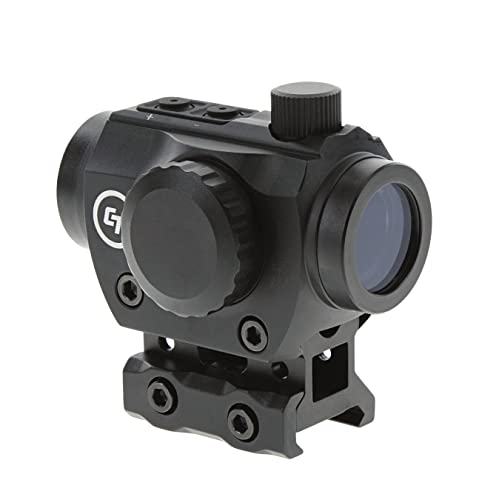
The CTS-25 is the only red dot in this group specified for rifles and long guns; the other two are pistol sights. It combines 1x magnification with a 4 MOA dot and a 25 mm lens. The sight measures 2.7 inches long and weighs 4.8 ounces. Crimson Trace says its included CR2032 battery lasts one year, and the side-accessible compartment allows battery changes without removing the sight. Its larger form and rifle-oriented use make it a poor fit for buyers seeking a compact pistol optic. The maker describes it as shock, impact, fog, water and vibration resistant.
Bottom line: Choose this for a rifle or long gun when a larger 4 MOA dot suits your use.
How to choose a Crimson Trace red dot
Start with the firearm platform and mounting footprint, because a pistol optic will not automatically fit every slide or plate. A footprint is the pattern of screw holes and recoil slots that joins the optic to its mount; Shield RMS, Jpoint and Docter are different patterns. A 3 MOA dot covers about 3 inches at 100 yards, while a 4 MOA dot covers about 4 inches at that distance. Smaller dots cover less of a distant target, while larger dots can be easier to see quickly. Decide whether auto activation or a side-accessible battery compartment matters for your setup, then verify the sight’s dimensions and mounting compatibility.
Red dot fit by firearm and footprint
Choose an optic made for your firearm type and verify its footprint against the slide or adapter plate. A direct fit avoids adding a plate, while a plate can add height and may affect the relationship between the optic and iron sights. Co-witnessing means the iron sights remain visible through or alongside the optic window; the usable alignment depends on sight height and mounting geometry. Keep the firearm unloaded while installing or adjusting an optic, and confirm the chamber and magazine well are clear before handling. This table separates the platform and footprint matches in this group.
| Use | Match to verify | Dot |
|---|---|---|
| Compact or subcompact handgun | Shield RMS or Jpoint | 3 MOA |
| Full-size handgun | Docter | 3 MOA |
| Rifle or long gun | Confirm mount compatibility | 4 MOA |
What MOA means for a red dot
MOA describes angular size: a 1 MOA dot covers about 1 inch at 100 yards, so 3 and 4 MOA dots cover approximately 3 and 4 inches at that distance. At 50 yards, those apparent spans are roughly half as large. A smaller dot can obscure less detail at distance, while a larger dot may be easier to pick up quickly; brightness and vision also affect how the dot appears. With a 3 MOA handgun optic, use the dot size as one factor rather than a promise of accuracy. Sight the optic at a safe range using a secure rest, and make adjustments according to the firearm and optic manuals.
Battery and water-resistance considerations
Battery runtime varies with power settings, activation behavior and storage, so the manufacturer’s runtime figure is not a guarantee of the same service life in every setup. The two pistol optics use CR1632 batteries, while the rifle sight uses a CR2032; these cells are not interchangeable. Motion activation can reduce unnecessary illumination, while a side-access battery compartment can simplify replacement without removing a mounted sight. IPX4 indicates protection against splashing water, whereas IPX7 covers temporary immersion under specified test conditions; neither rating means the optic is indestructible. Keep spare cells of the correct type and check the optic’s battery before relying on it.
Frequently Asked Questions
How large is a 3 MOA red dot at 100 yards?
A 3 MOA dot covers about 3 inches at 100 yards. At 50 yards, it covers roughly 1.5 inches, though the apparent dot can vary with brightness and vision.
Can a Shield RMS optic fit a Docter footprint?
No, Shield RMS and Docter are different mounting footprints. Check the slide or plate pattern before selecting an optic, and use only a compatible mounting solution.
What does co-witness mean on a pistol red dot?
Co-witness means the iron sights remain usable in the optic’s window or sight picture. Whether they align depends on the optic’s mounting height and the firearm’s iron sights.
Can a red dot sight stay on a firearm in the rain?
Water resistance depends on the optic’s rating; IPX4 covers splashing water, while IPX7 covers temporary immersion under defined test conditions. Keep the lens and battery compartment cared for according to the maker’s instructions.
How often should a red dot battery be replaced?
Replace a battery before its expected runtime ends and check it regularly, especially before relying on the firearm. Runtime depends on brightness, activation features and storage, so carry the correct replacement cell for the sight.