
Best Floss for Bridges: 3 Options Compared

Oral-B Super Floss suits most people with a bridge because its stiffened end threads under appliances and its spongy fiber cleans around them. Choose a different option if you want 160 strands per pack or an unflavored, three-section design.
Bridge floss is made to pass beneath the replacement tooth and clean around the supporting teeth, where ordinary floss may be difficult to position.
We earn a commission if you buy through links on this page. As an Amazon Associate I earn from qualifying purchases. Products are compared on manufacturer specifications, not hands-on testing.
- Best overall: Oral-B Super Floss – Its stiffened end and spongy fiber are designed for flossing around bridges.
- Best for three sections: VINSULLA 3-in-1 Orthodontic Floss – Each strand combines a stiffened end, spongy mesh, and regular floss.
- Best for 160 strands: RioRand 3-in-1 Orthodontic Floss – The pack contains 160 pre-cut strands with a stiffened end and spongy floss.
| Product | Best for | Design | Strand count | Flavor | Shop |
|---|---|---|---|---|---|
| Oral-B Super Floss | Bridge cleaning | Stiff end, spongy fiber | 100 strands | Mint | Check Price on Amazon |
| VINSULLA 3-in-1 Orthodontic Floss | Three-section design | Threader, spongy, regular | 160 strands | Unflavored | Check Price on Amazon |
| RioRand 3-in-1 Orthodontic Floss | Higher strand count | Threader, spongy floss | 160 strands | Unflavored | Check Price on Amazon |
Floss for Bridges
Compare the strand designs and pack counts to find an option that fits your bridge-cleaning routine.
Oral-B Super Floss
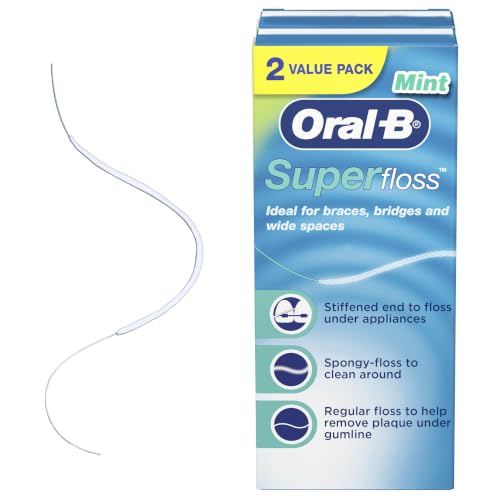
Oral-B Super Floss pairs a stiffened end with spongy fiber, giving it a bridge-focused design without requiring a separate threader. The pack contains 100 pre-cut strands and the floss is mint flavored. Oral-B says regular use helps prevent plaque buildup. This option suits someone who wants a purpose-made strand for passing beneath a bridge and cleaning around an appliance. The spongy section may be less convenient than ordinary floss for cleaning tight contacts between natural teeth, so keep regular floss available if you need both styles.
Bottom line: Choose this if you want pre-cut strands designed to thread under a bridge.
VINSULLA 3-in-1 Orthodontic Floss

VINSULLA 3-in-1 Orthodontic Floss stands out for its three distinct sections: a stiffened end, spongy mesh, and regular floss. That arrangement is intended to thread beneath a bridge, sweep wider gaps, and clean along tighter gumline spaces with one strand. The two-pack contains 160 pre-cut strands and is unflavored. It may suit someone who wants both a bulky cleaning section and a regular-floss section in the same strand. The specifications does not establish how thick the spongy section is, so confirm that it can fit your bridge gap without forcing it.
Bottom line: Choose this if you want three cleaning sections in each pre-cut strand.
RioRand 3-in-1 Orthodontic Floss

RioRand 3-in-1 Orthodontic Floss offers 160 pre-cut strands in a two-pack, with a stiffened end for threading and spongy floss for wider spaces. Its unflavored design and lack of a separate threader may appeal if you prefer an all-in-one strand. The maker describes it as suitable for bridges, braces, and implants. This option suits buyers who want a larger count than the 100-strand pack and a spongy section for cleaning around bridgework. The maker does not specify a distinct regular-floss section, so it may be less versatile for tight contacts than a strand that includes one.
Bottom line: Choose this if a 160-strand pack and built-in threader matter most.
How to Choose Floss for Bridges
Choose floss that can pass beneath the replacement tooth and clean the gumline around the supporting teeth. A stiffened tip helps guide a strand under bridgework, while a spongy section is designed to contact broader spaces around appliances. Regular floss remains useful for tight contacts between teeth; a three-section strand combines these tasks but may feel bulky in narrow gaps. A practical rule is to use the spongy portion only where it passes without force, and use a slimmer floss for tight contacts. Clean between teeth daily, since brushing alone does not reach every surface between teeth.
How to Thread Floss Beneath a Bridge
Pass the stiffened end gently under the bridge, then move the cleaning section back and forth beneath the replacement tooth and along the supporting teeth. Avoid snapping floss down onto the gum; controlled movement helps prevent irritating delicate tissue. A bridge has surfaces beneath the replacement tooth that a toothbrush cannot reach easily, so include that underside in daily cleaning. If the floss catches, shreds, or cannot pass without pressure, stop rather than forcing it and ask a dental professional to check the fit or recommend another tool. A floss threader can carry ordinary floss beneath a bridge when a built-in threader is not part of the strand.
Bridge Floss Versus a Separate Threader
Integrated bridge floss combines a stiffened tip with a cleaning strand, while a separate threader is a reusable-style guide for drawing compatible floss beneath an appliance. The products in this comparison that are floss include spongy sections; a threader alone is not floss and does not clean by itself. The choice depends on whether you want a ready-to-use pre-cut strand or prefer to thread your own floss. Use this guide to match the tool to the task:
| Need | Choose |
|---|---|
| Ready-to-use bridge strand | Floss with a stiffened end |
| Cleaning a wider space around an appliance | Floss with a spongy section |
| Using ordinary floss beneath bridgework | A separate floss threader |
For a tight contact, avoid forcing a thick strand through; ask your dental professional whether a slimmer floss or a specific threader is appropriate.
Daily Care Around a Dental Bridge
Clean around a bridge every day and brush twice daily for two minutes with fluoride toothpaste, as standard oral-care guidance recommends. Flossing beneath the replacement tooth complements brushing rather than replacing it. Move carefully along the supporting teeth and under the bridge; bleeding or soreness that continues despite gentle cleaning deserves attention from a dentist. Bridge design and gum-space size differ, so a professional can show the right thread path and whether an interdental brush can fit safely. Do not force a brush or floss into a gap: a tool should pass without painful pressure, and the correct size can be checked chairside.
Frequently Asked Questions
How often should I floss under a bridge?
Clean beneath a bridge daily as part of cleaning between your teeth. Brush for two minutes twice a day as well; floss reaches surfaces that brushing may miss.
Can regular floss clean beneath a bridge?
Yes, if you can guide it under the bridge with a floss threader. Use a stiffened-end strand or threader to pass beneath the replacement tooth, and do not force floss through a tight space.
What does spongy floss do around a bridge?
Spongy floss is designed to clean wider spaces around appliances and bridgework. Use it only where it passes gently; a bulky section may not fit a tight tooth contact.
Can I use an interdental brush under a bridge?
An interdental brush can clean a gap if the brush fits without being forced. Ask a dental professional to help choose the right brush size, since bridge clearances vary.
What should I do if floss shreds under my bridge?
Stop and avoid pulling hard if floss repeatedly shreds or catches. A dentist can check the bridge surface and show a suitable threader or cleaning tool.