
Digital Speedometers for Yacht: 5 GPS Gauges Compared

For a digital speedometer for a yacht, choose MOTOR METER RACING Pro Series 52 mm GPS Speedometer if you want a 0–120 mph scale in a 52 mm gauge; its wide range is the deciding feature. Choose another model if your panel opening or electrical system does not match, or if you need a lower speed range.
GPS speedometers calculate speed from satellite signals rather than a hull-mounted paddlewheel, so antenna placement and a clear sky view matter.
We earn a commission if you buy through links on this page. As an Amazon Associate I earn from qualifying purchases. Products are compared on manufacturer specifications, not hands-on testing.
- Best overall: MOTOR METER RACING Pro Series 52 mm GPS Speedometer – Its 0–120 mph scale and 52 mm gauge suit buyers seeking a wide display range in a compact opening.
- Best for compact panels: ELING 52 mm Universal GPS Speedometer – The 52 mm gauge uses a specified 52 mm panel opening and needs 70 mm of clearance behind it.
- Best for low speed range: 85 mm Marine GPS Speedometer, 0–30 mph – Its 0–30 mph scale is the narrowest range among these options.
| Product | Best for | Speed range | Gauge size | Operating voltage | Shop |
|---|---|---|---|---|---|
| MOTOR METER RACING Pro Series 52 mm GPS Speedometer | Wide speed range | 0–120 mph | 52 mm (2 1/16 in) | 12/24V negative ground | Check Price on Amazon |
| ELING 52 mm Universal GPS Speedometer | Small panel opening | — | 52 mm | 12/24V | Check Price on Amazon |
| 85 mm Marine GPS Speedometer, 0–30 mph | Low speed scale | 0–30 mph | 85 mm | 9–32V DC | Check Price on Amazon |
| Geloo 85 mm Boat GPS Speedometer, 0–80 mph | Midrange scale | 0–80 mph | 85 mm | 9–32V | Check Price on Amazon |
| ELING 85 mm Digital GPS Speedometer | Trip display | — | 85 mm (name) | 12/24V (name) | Check Price on Amazon |
Digital speedometers for yacht use
Compare the GPS gauges by scale, panel fit and electrical requirements before choosing one for your helm.
MOTOR METER RACING Pro Series 52 mm GPS Speedometer

MOTOR METER RACING Pro Series 52 mm GPS Speedometer has the widest scale in this group, covering 0–120 mph in a 52 mm gauge. The unit has an IP67 rating, a 316 stainless steel bezel, ABS housing and white LED illumination. Its odometer records up to 99,999.9 miles, while the trip meter records up to 999.9 miles and can be reset by grounding the blue wire. The maker says the gauge suits 12/24V negative-ground systems. Pick it when broad speed coverage matters; its negative-ground requirement makes electrical compatibility a must-check for other systems.
Bottom line: Choose this gauge if you want a 0–120 mph scale and your system is 12/24V negative ground.
ELING 52 mm Universal GPS Speedometer

ELING 52 mm Universal GPS Speedometer gives a precise installation target for compact helms: a 52 mm panel hole and 70 mm of rear clearance. The gauge includes a digital odometer and a separate GPS antenna; the antenna cable should not be cut, and the antenna should sit flat with its black side up where it can see the sky. The maker says initial signal acquisition takes about 30 seconds, with subsequent acquisition under 3 seconds. Choose it when fitting a 52 mm opening is more important than selecting a speed scale; its range is not identified here.
Bottom line: Choose this model when a 52 mm opening and 70 mm rear clearance fit your helm.
85 mm Marine GPS Speedometer, 0–30 mph
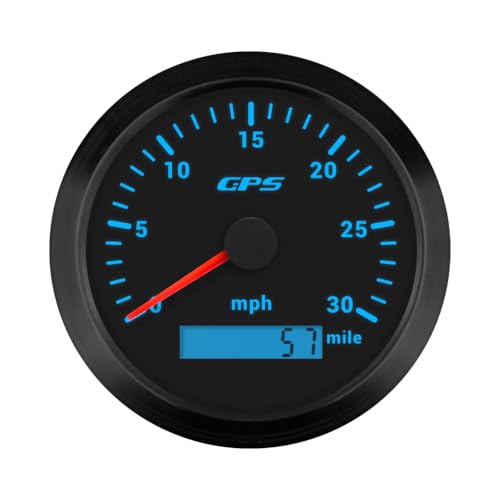
85 mm Marine GPS Speedometer, 0–30 mph is the only gauge here with a 0–30 mph scale, making its display range the key difference. The 85 mm face has seven selectable backlight colors, and the gauge is rated IP67 for water and dust resistance. It operates on 9–32V DC and comes with a 3 m GPS antenna cable that cannot be cut. The maker calls for a clear sky view for GPS reception. Choose it if your expected speed range fits within 30 mph; a higher-speed boat can exceed its display scale.
Bottom line: Choose this gauge if a 0–30 mph scale covers the speed range you need.
Geloo 85 mm Boat GPS Speedometer, 0–80 mph

Geloo 85 mm Boat GPS Speedometer, 0–80 mph uses a 0–80 mph scale, a middle ground between the 30 mph and 120 mph options. The gauge displays current speed and odometer readings, with a choice between trip and course over ground (COG) display. It supports 9–32V and has seven backlight colors. The maker describes the GPS receiver as the source for speed and mileage readings. Choose it when you want the trip-or-COG display choice and an 80 mph ceiling; verify that the display units match your preference, since the gauge also indicates a km/h range.
Bottom line: Choose this model if you need an 80 mph scale and want to switch between trip and COG.
ELING 85 mm Digital GPS Speedometer

ELING 85 mm Digital GPS Speedometer is an 85 mm ELING gauge identified for boat, marine and yacht use, with a digital odometer and trip function in its name. Before choosing it, confirm the required panel cutout and rear clearance with the seller or manufacturer. That mismatch matters most on a helm with an existing opening that cannot be enlarged or adapted.
Bottom line: Consider this option only after confirming its actual panel cutout and rear clearance.
How to choose a digital yacht speedometer
Match the display’s maximum speed to the boat’s expected speed, then check its voltage range and panel fit. The gauges here span 0–30, 0–80 and 0–120 mph, so a 30 mph scale is unsuitable if the boat may exceed that reading. Gauge diameters are 52 mm (2 1/16 in) or 85 mm (3 3/8 in); diameter alone does not confirm the cutout or rear clearance. Electrical compatibility also differs: some gauges require 12/24V negative ground, while others specify 9–32V DC. A GPS speedometer derives speed from satellite signals rather than a paddlewheel, but reception depends on antenna placement.
| Decision | What to match |
|---|---|
| Top speed | Display scale above the boat’s expected speed |
| Helm fit | Cutout diameter and rear clearance |
| Power | Voltage range and grounding requirement |
| Reception | Flat antenna placement with sky visibility |
GPS antenna placement and signal
A GPS antenna needs a clear view of the sky; mount it flat with the receiving side up and keep it away from obstructions where possible. One 52 mm gauge specifies a black side facing upward and suggests an outside location or the inside of a front windscreen. Another model provides a 3 m cable that cannot be cut, so plan the route before securing the antenna. Initial signal acquisition can take about 30 seconds on one gauge, with later acquisition under 3 seconds; a clear sky view supports reception. On a yacht, a hardtop or nearby structure can block part of the sky, so assess the intended mounting spot before fixing the antenna in place.
Panel size, cutout and rear clearance
Measure both the helm opening and the space behind it before choosing a gauge. A 52 mm body does not automatically mean every model uses the same cutout: one gauge’s instructions call for a 52 mm opening and 70 mm rear clearance, while another 85 mm gauge calls for an 85 mm opening and 55 mm depth. These figures differ enough to rule out assumptions based on the face diameter alone. Leave room to route the antenna lead and power harness without pinching or sharply bending cables. For the 85 mm ELING gauge, the installation text calls for a 52 mm opening, so confirm the actual cutout and depth before buying rather than relying on its face size.
Speed scale, odometer and marine display functions
Choose a speed scale that covers the boat’s operating range with room above its expected top speed. The options include 0–30, 0–80 and 0–120 mph, while a wider scale is not automatically easier to read at low speeds. Odometer and trip functions also differ: one unit records total mileage to 99,999.9 miles and trip mileage to 999.9 miles, while another allows a choice between trip and course over ground (COG). COG is the direction of travel over the earth, not the bow’s heading; current and wind can make the two differ. For marine use, also check whether the display uses mph or km/h and whether its backlight is visible at the helm’s typical lighting level.
Frequently Asked Questions
Does a yacht GPS speedometer need a paddlewheel?
No. A GPS speedometer calculates speed from satellite position changes, so it does not require a paddlewheel sensor. The GPS antenna still needs a clear sky view for reception.
Where should I mount a GPS speedometer antenna on a boat?
Mount the antenna flat with its receiving side upward, in a location with an unobstructed view of the sky. A hardtop, metal structure or other obstruction can interfere with satellite reception.
How much space does a 52 mm gauge need behind the panel?
The 52 mm ELING model calls for 70 mm of clearance behind the panel. Measure both the opening and rear depth before installation, since gauge diameter alone does not establish fit.
Can I cut a GPS speedometer antenna cable shorter?
Do not cut the antenna cable when the gauge instructions prohibit it. Some supplied GPS antenna cables are specified as non-cuttable, so plan routing around the original cable length.
What does COG mean on a marine speedometer?
COG means course over ground: the direction a boat travels across the earth’s surface. It differs from heading, which is the direction the bow points, especially when wind or current causes drift.