
Donut Pads for Feet: 5 Cushions Compared by Fit

For a defined pressure point, Skin-Color Felt Callus Cushions is the clearest fit because its felt cushion has a 0.6-inch center cutout and measures 1.4 inches across. Choose a different style if you want broader oval coverage, flexible foam, or a U-shaped pad instead.
Donut pads are adhesive cushions with an opening that leaves a tender spot inside the ring while padding around it; they reduce direct rubbing but do not treat the cause of foot discomfort.
We earn a commission if you buy through links on this page. As an Amazon Associate I earn from qualifying purchases. Products are compared on manufacturer specifications, not hands-on testing.
- Best overall: Skin-Color Felt Callus Cushions – Its 0.6-inch cutout makes the intended ring shape and opening size clear.
- Best for oval coverage: Welnove Oval Felt Callus Pads – The oval felt design has a hollow center and covers a broader area.
- Best for flexible coverage: ZenToes Soft Foam Cushions – Soft foam cushions are intended for the ball of the foot, heels, or toes.
- Best for U-shaped fit: ZenToes U-Shaped Felt Pads – The horseshoe-shaped felt pad can be trimmed to fit.
| Product | Best for | Shape | Opening | Count | Shop |
|---|---|---|---|---|---|
| Skin-Color Felt Callus Cushions | Defined small spot | Round | 0.6 in | 84 | Check Price on Amazon |
| Welnove Oval Felt Callus Pads | Oval felt coverage | Oval | Hollow center | 42 | Check Price on Amazon |
| ZenToes Soft Foam Cushions | Foam shoe cushioning | — | — | 24 | Check Price on Amazon |
| Dr. Scholl’s Corn Cushions | Corn pressure cushioning | — | — | 9 | Check Price on Amazon |
| ZenToes U-Shaped Felt Pads | Trim-to-fit felt | U-shaped | 0.6 in | 24 | Check Price on Amazon |
Donut Pads for Feet Compared
Compare the cutout style, material, and count to match a cushion to the spot and shoe coverage you need.
Skin-Color Felt Callus Cushions

The explicit 0.6-inch center opening makes this 1.4-inch felt cushion the most clearly sized ring in this group. The pack contains 84 self-adhesive pads in a skin-color finish, intended to add a buffer between a foot spot and shoe or sock friction. The maker says the pads can cushion corns, bunions, blisters, and calluses; cushioning is not a treatment for the cause. The small opening is a limitation if the sensitive area is wider than the cutout, so compare the spot with the opening before applying.
Bottom line: Choose this if a clearly measured, small center opening and a large pad count matter most.
Welnove Oval Felt Callus Pads

The oval outline sets this felt cushion apart from the round, measured ring: it is intended to cover a larger surrounding area while leaving a hollow center. The 42-piece pack uses a self-stick backing, and the maker describes its adhesive as water-resistant. Soft felt forms a barrier between the foot and shoe, while the oval shape may suit a spot that needs more lengthwise coverage than a compact ring.
Bottom line: Choose this for an oval felt cushion when broad surrounding coverage matters more than a measured opening.
ZenToes Soft Foam Cushions

Soft foam distinguishes these cushions from the felt ring and oval options, and the maker identifies the ball of the foot, heels, and toes as placement areas. Water-resistant adhesive is intended to keep the pads in place during daily activity, and the neutral low-profile design is meant to fit inside most shoes. This is a flexible general-purpose cushion rather than a clearly defined donut: neither its shape nor an opening measurement is supplied. Pick it when soft coverage across several foot areas matters more than centering a precisely sized hole around one spot.
Bottom line: Choose this for soft, low-profile cushioning across several foot areas rather than a measured donut opening.
Dr. Scholl’s Corn Cushions

These corn cushions focus on cushioning against shoe pressure and friction, rather than specifying a donut outline or center opening. The pack contains nine beige cushions, and the maker says they are designed to stay on all day. That stated purpose can suit someone looking for a corn cushion with a longer-wear design, but the shape and dimensions do not establish whether it will surround a spot like a ring. Choose it for its corn-focused cushioning intent only if the actual pad shape fits the area you want to protect.
Bottom line: Choose this for corn-focused cushioning when the pad’s shape suits the spot.
ZenToes U-Shaped Felt Pads
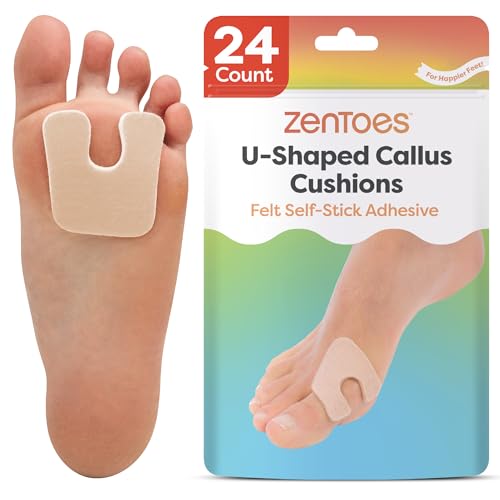
The U-shaped outline differs from a closed donut ring: its opening is accessible from one side, and the felt pad can be trimmed to fit. Each cushion is about 2 inches tall, 1.9 inches wide at the top, and 1.7 inches wide at the bottom; the interior width is about 0.6 inch. The maker describes the felt as medical grade and says it helps reduce rubbing around sensitive areas. This 24-count pack suits a spot that benefits from an open horseshoe surround, but it is not a closed ring.
Bottom line: Choose this when an adjustable, open-sided felt surround works better than a closed donut.
How to Choose Donut Pads for Feet
Match the opening to the sensitive spot and the outer pad to the area that rubs. A ring cushions around a central point; a U-shaped pad leaves one side open, while a broad cushion may cover the spot rather than surround it. Compare the opening and outer dimensions in inches where available, then check that the pad will not press against a neighboring toe or shoe seam. Adhesive cushions work best on clean, dry skin; lotion and moisture can weaken adhesion. If a pad shifts, bunches, or causes redness, remove it rather than adding layers that increase pressure inside a shoe.
Material affects feel and thickness: felt is a firmer barrier, while foam is softer and more compressible. Choose based on the space inside your footwear, not just the cushion’s comfort claim.
Donut, Oval, and U-Shaped Pad Coverage
A closed donut is the most direct choice when the target area should sit inside a hole; an oval can spread cushioning along a longer area, and a U-shaped pad offers an open side. The shape alone does not guarantee a fit: line up the opening with the sensitive area and ensure the surrounding cushion stays on flat skin. A pad that is too narrow can let the target touch footwear, while one that is too wide can crowd nearby toes or create a ridge.
The table shows the main practical difference between these styles. The actual opening and outside dimensions matter more than the shape name when a spot is close to a shoe edge or toe joint.
| Style | Coverage pattern | Choose when |
|---|---|---|
| Closed donut | Cushion surrounds a center opening | The target fits inside the opening |
| Oval | Longer surrounding coverage | The rubbing area extends lengthwise |
| U-shaped | Open-sided surround | You want to position or trim an open shape |
| General cushion | Coverage shape varies | You need cushioning without a confirmed ring opening |
Fitting Pads Inside Shoes
A foot pad should lie flat without folding or lifting at the edges. Place the opening over the area you want to keep from direct contact, then check the fit while standing; the foot spreads under load, so a pad that seems centered while seated may shift under pressure. Leave room around adjacent toes, and avoid placing a thick edge directly under a tight shoe seam. For a pad with dimensions, measure the target and the available shoe space in inches before use; for an unspecified shape, check the pad itself before committing it to a location.
Do not stack cushions to compensate for a poor fit: extra height can increase shoe pressure. If the shoe feels tighter or walking becomes uncomfortable, remove the pad and reassess the shape and placement.
Skin Safety and Pad Care
People with diabetes, poor circulation, or reduced foot sensation should ask a clinician before using adhesive foot pads, because pressure or skin irritation may go unnoticed. Do not apply a cushion over broken skin, and remove it if burning, redness, or worsening discomfort develops. These pads provide a friction barrier; they are not medicated corn removers and do not resolve a cause such as shoe fit.
Keep the skin clean and dry before applying a self-stick cushion, and replace it if it becomes dirty, loose, or damp. Water-resistant adhesive does not mean every pad will remain secure during every shower or activity. Check the skin when removing a pad, especially if the area is tender.
Frequently Asked Questions
How do donut pads for feet reduce shoe rubbing?
A donut pad places cushioning around a center opening, so the surrounding material takes some contact from footwear. Center the sensitive spot in the opening and make sure the pad lies flat; a shifted ring can rub instead.
Should a donut pad cover the sore spot?
A ring-style cushion is positioned around the spot, not over its center, so the opening should fit the area. If the opening is too small or the pad presses on the spot, choose a different shape or size.
Can I wear felt foot pads in tight shoes?
Only if the shoe still has room without squeezing the foot. Even a thin pad adds material, and stacking cushions can increase pressure; remove it if the fit feels tighter or causes discomfort.
How do I keep adhesive foot pads in place?
Apply the pad to clean, completely dry skin and press it flat without wrinkles. Moisture, lotion, or friction at a shoe edge can loosen adhesive, so remove and replace a pad that shifts.
Are donut pads safe for people with diabetes?
People with diabetes or reduced foot sensation should consult a clinician before using adhesive cushions. Pressure and skin irritation can be harder to notice, so do not rely on a pad to protect damaged skin.