
Faceting Machines for Gemstones: 5 Models Compared

For gemstone faceting, Mxmoonant Gem Faceting Machine stands out for its adjustable speed up to 2,980 RPM and 96-division index wheel. Choose another model if you need a disc size, higher stated motor power, or want controls suited to a different workflow.
A faceting machine holds and turns a stone at controlled angles against an abrasive lap, allowing the cutter to shape a pattern of flat facets.
We earn a commission if you buy through links on this page. As an Amazon Associate I earn from qualifying purchases. Products are compared on manufacturer specifications, not hands-on testing.
- Best overall: Mxmoonant Gem Faceting Machine – The 0–2,980 RPM control and 96-division index wheel provide specific speed and repeatable indexing adjustments.
- Best for broad adjustability: Faceting Machine Pro 4 – The product features describe adjustable angle, depth and speed controls for cutting, grinding and polishing.
- Best for a 6-inch disc: 180W Gem Faceting Machine with 6-Inch Disc – Its product features specify a 6-inch electroplated diamond grinding disc.
| Product | Best for | Maximum speed | Power | Shop |
|---|---|---|---|---|
| Mxmoonant Gem Faceting Machine | Controlled practice | 2,980 RPM | — | Check Price on Amazon |
| Faceting Machine Pro 4 | Control flexibility | — | — | Check Price on Amazon |
| VEVOR 180W Gem Faceting Machine | Power and drainage | 2,800 RPM | 180 W | Check Price on Amazon |
| 180W Adjustable-Height Faceting Machine | Height adjustment | 2,800 RPM | 180 W | Check Price on Amazon |
| 180W Gem Faceting Machine with 6-Inch Disc | Specified disc size | 2,800 RPM | 180 W | Check Price on Amazon |
Faceting Machines for Gemstones
Compare the controls and hardware, then choose a machine that matches the steps and stone sizes you plan to work on.
Mxmoonant Gem Faceting Machine
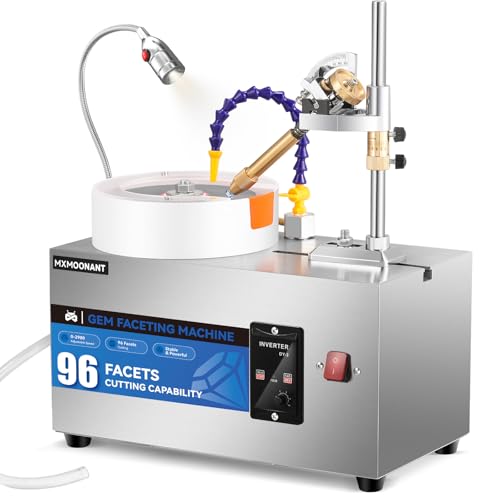
Mxmoonant Gem Faceting Machine is the only option here with a 96-division index wheel and 0–90° protractor. The maker says its 0–10 control panel adjusts speed from stopped to a maximum of 2,980 RPM, and the machine includes a splash guard and LED light. Those controls suit a beginner who wants to practice setting repeatable angles and index positions.
Bottom line: Choose this for its specified index wheel and adjustable speed.
Faceting Machine Pro 4
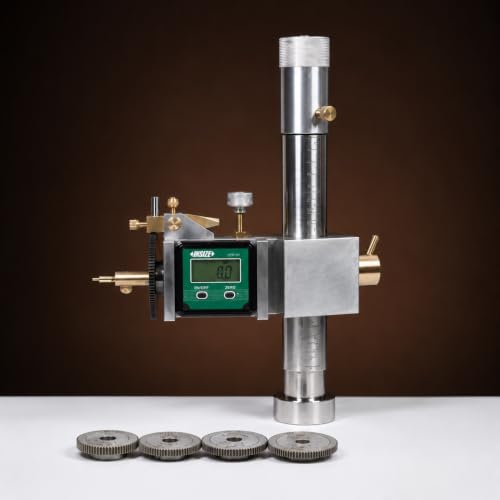
Faceting Machine Pro 4 is distinguished by the maker’s emphasis on angle, depth and speed adjustment, rather than a RPM limit or index-wheel division. Its described uses span cutting, grinding and polishing, with adjustable settings intended to accommodate different gemstone sizes and shapes. That broad control set may suit a cutter who wants one machine for several stages of work.
Bottom line: Choose this if adjustable angle, depth and speed are your priority.
VEVOR 180W Gem Faceting Machine

VEVOR 180W Gem Faceting Machine pairs a 180-watt motor with speed up to 2,800 RPM and a faceted manipulator that adjusts up and down. The maker also describes a drain pipe for water used during polishing and a protective cover. Those features make it a fit for buyers who want a powered polishing setup with drainage provisions.
Bottom line: Choose this for its motor power and drainage features.
180W Adjustable-Height Faceting Machine

180W Adjustable-Height Faceting Machine is described with adjustable scale, angle and height, plus a 180-watt copper-wire motor and 2,800 RPM in its product name. The maker also identifies a cast-iron body and anti-slip foot mats. Height adjustment is the differentiator for buyers who need to position the workpiece to suit their stance or bench arrangement.
Bottom line: Choose this if adjustable working height matters most.
180W Gem Faceting Machine with 6-Inch Disc
180W Gem Faceting Machine with 6-Inch Disc is the only product here whose features specify a 6-inch electroplated diamond grinding disc. The maker describes a cast-iron construction and adjustable scale, angle and height, alongside a 180-watt motor; its name gives a 2,800 RPM speed. The disc diameter gives buyers a concrete starting point for comparing lap size and workspace needs.
Bottom line: Choose this when a 6-inch disc is useful for planning.
How to choose a gemstone faceting machine
Start with the control system you need for the patterns you intend to cut. A 96-division index wheel divides a full rotation into 96 positions, or 3.75° per index step; a protractor sets the facet angle while the index selects the stone’s rotational position. RPM describes lap rotation speed, not how quickly a stone should be cut, so steady feed and suitable abrasives still matter. Match the machine’s controls to your workflow: Mxmoonant Gem Faceting Machine supplies an index count and protractor, while Faceting Machine Pro 4 emphasizes adjustable angle, depth and speed. If your patterns depend on a particular index count, choose only a machine whose wheel compatibility you can confirm.
Faceting laps, abrasives and polishing
Faceting generally separates shaping, pre-polishing and final polishing into stages, using progressively finer abrasives rather than one abrasive for every task. Diamond abrasives are common for cutting hard gemstones; polishing compounds and lap surfaces vary with the stone and finish goal. A 6-inch lap is specified for 180W Gem Faceting Machine with 6-Inch Disc, while the other machines here do not give a disc diameter, so do not assume lap sizes are interchangeable. Water is often used to carry away swarf and control heat during lapidary work; keep water away from electrical connections and use only a setup designed to manage it. Start with a compatible lap and abrasive system before cutting a valuable stone.
Setting angles and index positions
Use the faceting diagram as the source for each facet’s angle and index position, then secure the stone consistently before making a cut. A 96-index wheel has 96 positions around one turn, and patterns may call for repeated or skipped positions; an angle setting alone cannot reproduce the pattern. Keep the stone dop aligned as you move between facets, because small alignment changes can shift meet points where facets converge. For a pattern that requires a named index wheel, confirm the machine provides it or accepts a compatible one before buying. The product feature set for Mxmoonant Gem Faceting Machine is the one here that explicitly gives both a 96-division wheel and a 0–90° protractor.
Water, dust and safe bench setup
Keep the work area stable and manage water before switching on a lapidary machine. Wet grinding can limit airborne dust and carry away abrasive residue, but water and electricity create a shock hazard: keep plugs, switches and connections dry, and use ground-fault protection where required by local electrical rules. Secure the machine on a level bench, use eye protection, and keep hands clear of the rotating lap. A drain pipe and protective cover are described for VEVOR 180W Gem Faceting Machine, while Mxmoonant Gem Faceting Machine includes a splash guard; these features do not replace safe handling or a controlled water setup. Never assume a polishing machine is suitable for dry cutting unless its manufacturer explicitly permits that use.
Frequently Asked Questions
What does a 96-index wheel mean on a faceting machine?
A 96-index wheel provides 96 rotational positions around one full turn, with each position 3.75° apart. Facet patterns specify which positions to use along with each cutting angle.
What speed should I use when faceting a gemstone?
There is no single RPM for every stone, abrasive and cutting stage. Machines in this comparison state maxima of 2,800 or 2,980 RPM, so begin at a controlled low speed and adjust based on the lap and stone rather than treating maximum RPM as a target.
Why does lap diameter matter when choosing a machine?
Lap diameter determines the size of the rotating work surface and affects workspace and replacement-lap compatibility. One machine here specifies a 6-inch disc; confirm a machine’s supported diameter if you already own laps.
Do gemstone faceting machines need water?
Many lapidary cutting and polishing operations use water to carry away swarf and manage heat, but the appropriate setup depends on the machine and abrasive. Keep electrical connections dry and use a machine designed for wet operation.
What is the difference between cutting and polishing laps?
Cutting laps use abrasive action to remove material and form facets, while polishing laps and compounds refine the surface toward its final finish. The abrasive and lap combination should suit the gemstone, since a single setup does not work identically for every stone.