
Fiber Optic to Cat6 Converter Options Compared by Fit

For a fiber-to-Cat6 connection with two copper ports at each end, choose Dual RJ45 Single-Mode LC Pair Kit; its pair uses single-mode LC fiber and supports runs up to 20 km. Choose another option if you need multimode fiber, an SC connector, or a single copper port per converter.
A media converter changes Ethernet between fiber and copper; the fiber modules and fiber cable must match at both ends.
We earn a commission if you buy through links on this page. As an Amazon Associate I earn from qualifying purchases. Products are compared on manufacturer specifications, not hands-on testing.
- Best overall: Dual RJ45 Single-Mode LC Pair Kit – Each converter has two Cat6-compatible RJ45 ports and a fitted 20 km single-mode LC module.
- Best for 20 km single-mode links: Gigabit Single-Mode LC Pair, 20 km – The pair includes 1310 nm single-mode LX modules and supports runs up to 20 km.
- Best for multimode LC links: ipolex Multimode LC Pair, 550 m – The two-pack includes 850 nm SX modules for duplex multimode fiber runs up to 550 m.
| Product | Best for | Fiber type and reach | RJ45 ports per unit | Shop |
|---|---|---|---|---|
| Dual RJ45 Single-Mode LC Pair Kit | Two-device endpoints | Single-mode LC, 20 km | 2 | Check Price on Amazon |
| Gigabit Single-Mode LC Pair, 20 km | Long single-mode links | Single-mode LC, 20 km | 1 | Check Price on Amazon |
| ipolex Multimode LC Pair, 550 m | 550 m multimode links | Multimode LC, 550 m | 1 | Check Price on Amazon |
| 10Gtek Multimode LC Pair, 550 m | Two-unit multimode kit | Multimode LC, 550 m | 1 | Check Price on Amazon |
| StarTech Multimode SC Converter | SC fiber connections | Multimode SC, 550 m | 1 | Check Price on Amazon |
Fiber Optic to Cat6 Converter Options
Match the converter pair to your fiber mode, connector, reach and required number of copper ports.
Dual RJ45 Single-Mode LC Pair Kit
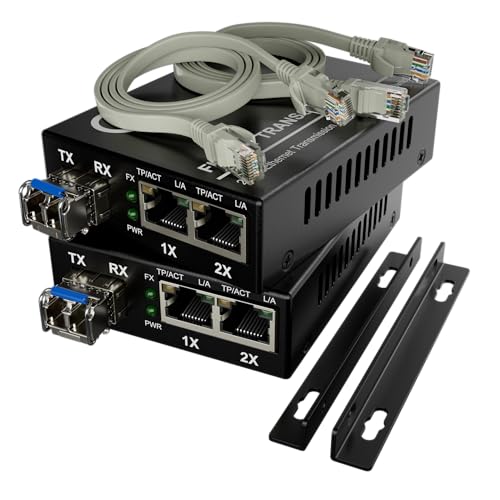
Two RJ45 ports per unit distinguish this pair from the single-port converters, letting two Ethernet devices connect at each end of one fiber link. Each unit has a fitted 1310 nm 1000BASE-LX SFP for duplex OS1 or OS2 single-mode LC fiber, and the copper ports support Cat5e or Cat6. The units auto-negotiate speed and duplex and support auto MDI/MDI-X. This is a fit for endpoints with a device and a local diagnostic laptop. Its 20 km reach is for single-mode fiber; it is not the choice for an existing multimode run.
Bottom line: Pick this when each endpoint needs two copper connections over a single-mode LC link.
Gigabit Single-Mode LC Pair, 20 km

A 20 km single-mode reach sets this pair apart from the multimode options. It includes two converters, two 1310 nm 1000BASE-LX SFP modules and external power supplies; each unit has one RJ45 port and supports 10/100/1000 Mbps Ethernet. The RJ45 ports support full- or half-duplex operation, auto MDI/MDI-X and jumbo frames up to 9 KB. Choose it for a long duplex LC single-mode link with one copper device at each endpoint. It does not provide the two RJ45 ports per unit found on Dual RJ45 Single-Mode LC Pair Kit.
Bottom line: Choose this for a 20 km single-mode LC connection with one Ethernet device at each end.
ipolex Multimode LC Pair, 550 m

This two-unit kit targets a shorter multimode LC run, with a reach of 550 m over OM3 or OM4 duplex fiber. Two 850 nm 1000BASE-SX SFP modules are included, and each converter has one 10/100/1000Base-T RJ45 port. The maker says setup is plug-and-play and the modules are hot-swappable. It suits a Gigabit link between nearby buildings or network areas that already have compatible multimode fiber. The 550 m reach and SX modules are not a match for a 20 km single-mode installation.
Bottom line: Pick this for a compatible duplex multimode LC run no longer than 550 m.
10Gtek Multimode LC Pair, 550 m

The included 850 nm multimode SFP transceivers and two-converter pack make this a ready-made option for a duplex LC fiber link up to 550 m. Each converter has one 10/100/1000 Mbps RJ45 port with auto-negotiation, auto MDI/MDIX and support for Cat5e UTP or STP cable. It suits a Gigabit endpoint pair where the installed fiber is multimode and the copper leg uses Cat5e. Unlike Dual RJ45 Single-Mode LC Pair Kit, each unit provides only one RJ45 port, and the Ethernet cable specification is Cat5e rather than Cat6.
Bottom line: Choose this for a two-endpoint multimode LC link with Cat5e copper cabling.
StarTech Multimode SC Converter

An SC fiber connector, rather than LC, is the key distinction of this standalone StarTech converter. It converts 10/100/1000 Mbps Ethernet to 850 nm multimode SC fiber over distances up to 550 m, and supports auto-negotiation, auto MDI/MDI-X, full-duplex flow control and jumbo frames up to 9 KB. The maker says it can install with little to no configuration and supports optional chassis mounting. It fits an existing SC multimode network, but it is supplied as a standalone converter, not the two-unit pair included with several alternatives.
Bottom line: Pick this when your existing multimode fiber uses SC connectors and you need a standalone unit.
How to choose a fiber optic to Cat6 converter
Match the fiber mode and connector before comparing reach or port count. 1000BASE-SX normally pairs with 850 nm multimode fiber, while 1000BASE-LX commonly uses 1310 nm single-mode fiber; the transceiver, fiber and connector must be compatible at both ends. Then count the copper devices each endpoint needs: a one-port converter serves one device, while a dual-port unit can serve two. Gigabit converters negotiate down to 10/100 Mbps when the connected device or cable requires it, but both ends still need compatible fiber interfaces. If your existing fiber’s mode or connector is unknown, identify it before ordering rather than assuming LC and SC are interchangeable.
Cat6 cable length and Ethernet speed
Cat6 supports a standard Ethernet channel of up to 100 meters, including the permanent link and patch cords, so keep the full copper path within that limit. For a typical structured-cabling channel, the permanent link is up to 90 meters with patch cords making up the remainder. A Gigabit media converter does not create a 10 Gigabit connection: these options provide up to 1,000 Mbps on their copper ports. Use Cat6 where the installation calls for it, but remember that the fiber-side reach is determined by the fiber mode and optical modules, not by the Cat6 cable. Avoid adding unmanaged intermediate couplers that push the copper channel past 100 meters.
Multimode and single-mode fiber compared
Multimode SX links suit shorter runs, while single-mode LX links suit longer distances when paired with compatible optics. In these choices, the multimode options reach up to 550 meters and the single-mode LC choices reach up to 20 kilometers. Connector shape alone does not identify fiber mode: LC can be used with either mode, so check the cable and SFP specifications together. Duplex fiber uses two strands, one for transmit and one for receive, and the polarity must allow each transmitter to reach the far-end receiver.
| Link need | Match | Example reach |
|---|---|---|
| Shorter LC multimode run | 850 nm 1000BASE-SX | Up to 550 m |
| Long LC single-mode run | 1310 nm 1000BASE-LX | Up to 20 km |
| Existing SC multimode run | 850 nm SC converter | Up to 550 m |
Do not connect unlike optical modes or assume that an LC connector means single-mode fiber.
Pairing converters and avoiding link problems
A fiber Ethernet link between two copper networks generally needs a media converter at each end, with compatible optical specifications on both sides. A pair kit simplifies matching, but the fiber itself still needs the correct mode, connector, strand count and polarity. Before powering the units, inspect the labels for SX or LX and verify the wavelength and reach against the installed cable. Connect each copper device with an Ethernet cable within the 100-meter channel limit. Fiber transceivers use laser light; never look into an exposed fiber end or SFP port, and disconnect power before handling optics. If the link light stays off, check power, fiber polarity, connector seating and matching transceiver types before changing network settings.
Frequently Asked Questions
Can a fiber media converter connect directly to a Cat6 switch?
Yes, a converter’s RJ45 Ethernet port can connect to a Cat6 cable and switch port. Keep the complete copper channel within 100 meters, and confirm that both network ports negotiate a compatible speed.
Do I need a converter at both ends of the fiber?
For a fiber connection between two copper Ethernet devices, use a converter at each end unless one device already has a compatible fiber port. Match the optical mode, wavelength, speed and connector across the link.
Can single-mode SFPs work on multimode fiber?
Use an optic designed for the fiber mode; the SX multimode and LX single-mode modules in these options are not interchangeable. Match the module wavelength and fiber type at both ends to avoid link failure.
How far can Cat6 run from a converter?
A standard Ethernet channel can run up to 100 meters over Cat6, including patch cords. Keep the permanent link to 90 meters or less when using the typical structured-cabling allowance for patch leads.
What does duplex LC fiber mean for installation?
Duplex LC uses two fiber strands, one transmitting and one receiving, so correct polarity matters. If the connection has no link, check that each end’s transmit strand reaches the other end’s receive strand.