
Fishing Glasses With Magnifiers: 3 Bifocal Picks

Fishoholic Polarized Bi-Focal Sunglasses suits most anglers who want to tie lures without switching glasses because it offers three bifocal powers and polarized lenses. Choose KastKing Estero Bifocal Sunglasses or KastKing Ellijay Bifocal Sunglasses instead if you prefer their oleophobic coating or specific frame style; a clip-on magnifier is a different tool for close work rather than sun protection.
We earn a commission if you buy through links on this page. As an Amazon Associate I earn from qualifying purchases. Products are compared on manufacturer specifications, not hands-on testing.
- Best overall: Fishoholic Polarized Bi-Focal Sunglasses – Offers 1.5x, 2.0x and 2.5x bifocal options with polarized lenses.
- Best for lens care: KastKing Estero Bifocal Sunglasses – Combines a 2.5x bifocal with an oleophobic coating designed to repel oil, saltwater and dirt.
- Best for wraparound fit: KastKing Ellijay Bifocal Sunglasses – Pairs a wrap-reader design with a 2.5x bifocal and Grilamid frame.
| Product | Best for | Magnification | Frame | Shop |
|---|---|---|---|---|
| Fishoholic Polarized Bi-Focal Sunglasses | Power choice | 1.5x, 2.0x, 2.5x | Polycarbonate | Check Price on Amazon |
| KastKing Estero Bifocal Sunglasses | Easy cleaning | 2.5x | Grilamid | Check Price on Amazon |
| KastKing Ellijay Bifocal Sunglasses | Wrap reader fit | 2.5x | Grilamid | Check Price on Amazon |
Fishing Glasses With Magnifiers
Compare bifocal strength and construction to find a pair that fits your close-vision needs on the water.
Fishoholic Polarized Bi-Focal Sunglasses
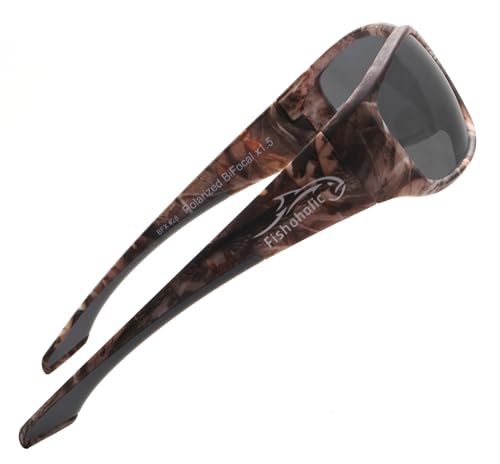
Fishoholic Polarized Bi-Focal Sunglasses stands out for offering three reader strengths, so anglers can choose between 1.5x, 2.0x and 2.5x rather than being limited to one power. Its polarized polycarbonate lenses include integrated bifocals, and the maker says the UV400 lenses provide 100% UV protection. Wide sides are intended to reduce side glare, and the set includes a hard case and cleaning pouch. This is a practical fit for anglers who want one pair for sun and close-up tasks such as tying on a lure. The selected magnification is important: the product comes in an X-Large size, but the specific power depends on the version chosen.
Bottom line: Choose this if you want to select among three bifocal strengths.
KastKing Estero Bifocal Sunglasses

KastKing Estero Bifocal Sunglasses is the choice for anglers who want a bifocal lens with an oleophobic coating and a Grilamid frame. Its 1.8 mm polarized polycarbonate lenses have integrated 2.5x magnifiers, and the maker says the coating repels saltwater, oil, dirt and dust. The feature set also includes impact-resistant lenses and protection from UVA and UVB rays. The reader area is integrated and flush with the lens, rather than a separate magnifier attachment. Anglers who need a different reading power should compare options carefully: the variant is +2.5, while this particular selection may not suit someone who needs a lower magnification.
Bottom line: Pick this for the coated lens and Grilamid frame with 2.5x readers.
KastKing Ellijay Bifocal Sunglasses

KastKing Ellijay Bifocal Sunglasses uses a wrap-reader format, distinguishing it from a standard bifocal style. It combines 2.0 mm polarized polycarbonate lenses with integrated 2.5x magnifiers, plus a Grilamid frame and an oleophobic coating. The maker says the lenses block 100% of UVA and UVB rays and that the coating repels saltwater, oil and chemicals. This suits anglers who prefer the wrap design and whose close-vision needs match +2.5 magnification. The color and size variant is Gloss Demi with a brown-chartreuse mirror finish. Since the chosen magnification is +2.50, anglers who need 1.5x or 2.0x should confirm the selected power before ordering.
Bottom line: Choose this if you want a wrap-reader design in 2.5x.
How to choose fishing bifocal sunglasses
Start with the reader power that lets you focus on a small hook or line without leaning in or holding it unusually close. Common over-the-counter reader strengths include +1.5, +2.0 and +2.5; stronger lenses magnify more but can make distant vision less comfortable when viewed through the reading segment. Polarized lenses reduce reflected glare from flat surfaces such as water, while magnification helps with close tasks. Those are separate functions, so check both when comparing glasses. If you tie knots frequently, choose a pair whose bifocal power matches your close-vision needs; if you only need occasional magnification, a separate clip-on tool may be more convenient. A prescription wearer should confirm compatibility with their vision correction before choosing non-prescription readers.
What bifocal magnification means
Bifocal fishing sunglasses combine a distant-view lens area with a magnifying segment for close work. Reader powers are measured in diopters, commonly marked +1.5, +2.0 or +2.5 on products of this type; a higher plus number provides stronger magnification at a shorter working distance. Use the lowest strength that gives a comfortable view of your knot-tying distance, rather than assuming the strongest option is best. A segment that is too strong can make the line or lure difficult to position naturally. Lens segment placement also matters: look through the magnifier while holding your hands at your usual tying position. Bifocal sunglasses are not a substitute for prescription eyewear when you need correction for distance or astigmatism.
Polarized lenses and water glare
Polarized sunglasses filter much of the horizontally reflected light that causes glare off water, helping make a bright fishing scene more comfortable to view. They do not make every underwater object visible, and changing water conditions, depth, surface chop and light angle affect what you can see. UV protection is a separate lens property from polarization: look for a UVA and UVB protection level, not just the word polarized. For long days outdoors, sunglasses should fit securely and cover the sides well enough for your usual fishing conditions. When boating, remember that polarized lenses can make some LCD displays harder to read; tilt your head or use another viewing angle if a screen appears dark.
Keep fishing glasses in good condition
Rinse lenses with clean fresh water after exposure to salt spray, then dry them with a clean microfiber cloth to reduce abrasive grit and salt residue. Avoid wiping a dusty lens dry, because particles can scratch a coating or lens surface. Store sunglasses in a hard case when they are not being worn, especially in a tackle bag where hooks and tools can contact the lenses. Oleophobic coatings can make oils and grime easier to remove, but they do not eliminate the need for cleaning. Do not use household window cleaner unless the lens maker says it is safe; ammonia and solvents can harm some coatings. Replace scratched or damaged lenses when the damage interferes with clear vision.
Frequently Asked Questions
What magnification is best for tying fishing knots?
A +1.5, +2.0 or +2.5 reader may work, depending on your comfortable viewing distance and close-vision needs. Choose the lowest power that lets you see the knot clearly while holding the line naturally.
Do polarized fishing glasses magnify the water?
No, polarization reduces reflected glare, while a bifocal segment magnifies close objects such as line and hooks. Water clarity, depth and surface conditions still affect what you can see beneath the surface.
Can I wear bifocal fishing sunglasses over prescription glasses?
Most integrated bifocal sunglasses are designed to be worn on their own, not over prescription glasses. If you need prescription correction, check whether the frame accepts prescription lenses or choose an appropriate over-glasses design.
How do I clean polarized fishing sunglasses?
Rinse away grit and salt with clean fresh water before wiping the lenses with a clean microfiber cloth. Dry wiping can drag abrasive particles across the lens and scratch it.
Are polarized lenses safe for reading boat screens?
Some LCD screens look dim or black through polarized lenses at certain angles. Rotate your head or change the screen angle if the display is difficult to read.