
Flipper Zero External Antenna: 5 Options Compared

For a Flipper Zero external antenna, External CC1101 12 dB Omni Antenna stands out for its included 12 dB omni antenna and maker-claimed 433 MHz operation; choose Hidden CC1101 Antenna Set instead if you want a silicone case and EVA carry case included. These are CC1101/Sub-GHz accessories rather than standalone Flipper Zero devices, so check the antenna connector and GPIO fit before ordering.
We earn a commission if you buy through links on this page. As an Amazon Associate I earn from qualifying purchases. Products are compared on manufacturer specifications, not hands-on testing.
- Best overall: External CC1101 12 dB Omni Antenna – Includes a 12 dB omni antenna, with claimed 433 MHz operation and maker-reported range figures.
- Best for included storage: Hidden CC1101 Antenna Set – Bundles a silicone case and EVA carrying case alongside its CC1101 antenna.
- Best for simple assembly: PINGEQUA 5Ghost Expansion Board – The maker describes tool-free assembly and includes a separate external antenna.
| Product | Best for | Antenna frequency | Claimed transmission range | Included accessories | Shop |
|---|---|---|---|---|---|
| External CC1101 12 dB Omni Antenna | Long-range claims | 433 MHz | 2,000+ ft | 12 dB antenna; stand | Check Price on Amazon |
| Hidden CC1101 Antenna Set | Portable storage | 433 MHz | 450+ ft | Silicone case; EVA case; stand | Check Price on Amazon |
| IotMug CC1101 External Antenna Module | Compact module | 433 MHz | 500 ft | High-gain antenna | Check Price on Amazon |
| PINGEQUA 5Ghost Expansion Board | Tool-free assembly | — | — | External antenna; board | Check Price on Amazon |
| CC1101 Devboard with Detachable Antenna | Detachable antenna | — | — | Expansion board; detachable antenna | Check Price on Amazon |
Flipper Zero External Antenna Options
Compare the antenna configuration and included pieces before choosing a GPIO-mounted CC1101 accessory.
External CC1101 12 dB Omni Antenna

The 12 dB omni antenna separates this module from the other choices, and the maker says it operates at 433 MHz. The package includes the CC1101 antenna and a portable stand; the maker reports transmission tests above 2,000 feet and reception above 80 feet. Those figures are maker claims, not a guarantee for a particular location or device. The GPIO design uses pins 1–8, and the module is powered at 5 V. Choose it if the antenna gain and stated range are central to your setup; its orange color may not suit buyers seeking a black accessory.
Bottom line: Choose this when the 12 dB omni antenna and its range are the priority.
Hidden CC1101 Antenna Set

The hidden-antenna version is the storage-focused choice: unlike the antenna-only kits, it includes a soft silicone Flipper Zero case and an EVA carrying case as well as a stand. The maker says the antenna is 433 MHz, powered at 5 V, and tested for transmission beyond 450 feet and reception beyond 15 feet. It uses GPIO pins 1–8, leaving pins 9–18 free according to the maker. This set suits someone who wants carrying protection bundled in; choose another option if you specifically want a detachable or 12 dB omni antenna.
Bottom line: Pick this set when a protective case and carrying case matter as much as the antenna.
IotMug CC1101 External Antenna Module
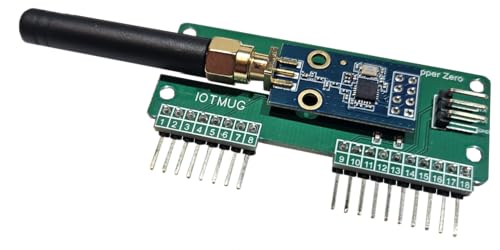
The IotMug module is the compact option with dimensions of 1.4 × 0.3 × 2.9 inches, unlike the bundles that emphasize a stand or carry case. Its maker describes a high-gain 433 MHz antenna and claims transmission testing up to 500 feet in open areas, with recording up to 10 feet in clear line of sight. The maker also gives a terrain-dependent range estimate of 70–150 meters.
Bottom line: Choose this if compact dimensions and the maker’s 433 MHz operation fit your setup.
PINGEQUA 5Ghost Expansion Board

The PINGEQUA 5Ghost is the board-oriented choice, with a separate external antenna included rather than the described 433 MHz antenna claims of several other options. The maker says it assembles without additional tools and includes one expansion board and one antenna; the Flipper Zero itself is not included. Its dimensions are 3.7 × 3.5 × 0.63 inches.
Bottom line: Pick this for the board-and-antenna package if tool-free assembly is your main concern.
CC1101 Devboard with Detachable Antenna

The detachable antenna is the distinguishing feature of this CC1101 devboard, while several competing options describe a fixed or hidden antenna arrangement. The package includes one expansion board and one detachable antenna, and the maker describes the design as plug and play for Flipper Zero. This is the relevant pick if removal of the antenna matters to your setup; confirm the intended band before purchasing.
Bottom line: Choose this if a detachable antenna matters more than a published frequency or range claim.
How to Choose a Flipper Zero External Antenna
Choose by operating frequency, GPIO connection, and what the kit includes; advertised distance alone is not a dependable selection rule. A CC1101 module is an add-on transceiver for Sub-GHz work, and the antenna must match the radio band and local rules. Several options here identify a 433 MHz antenna, while others do not give a frequency. A maker’s open-area range claim does not predict performance through walls, interference, antenna orientation, or receiver sensitivity. For example, choose External CC1101 12 dB Omni Antenna if a 12 dB omni antenna is the priority, or Hidden CC1101 Antenna Set if protective storage is more useful.
GPIO Fit and Power for CC1101 Modules
GPIO alignment and power are essential checks before attaching an external module. One of the sets says it uses GPIO pins 1–8 and is powered at 5 V; these are product-specific claims, not a universal description of every board. GPIO accessory layouts can differ, so compare the board’s pin mapping with the Flipper Zero header before applying power. The Flipper Zero is a low-voltage device, but a misaligned header or incompatible power arrangement can damage hardware. Never force a board onto the pins, and disconnect it before adjusting its position. Choose a module whose mounting and power requirements you can verify for your particular unit.
What Range Claims Mean for Sub-GHz Use
Line of sight and surroundings can change radio range substantially, so treat maker range figures as test conditions rather than expected everyday distances. The options report different ranges, including open-area transmission figures and separate receiving distances; those measurements are not directly comparable unless antenna, receiver, power, and environment match. Walls, metal structures, nearby radios, antenna placement, and regional transmission limits all affect results. Use the frequency only where it is permitted, and avoid transmitting on channels or power levels restricted in your region. When reliable reception matters, test in the actual environment and keep the antenna clear of metal and the user’s body.
External Antenna Kits Compared by Use
Kit contents can determine the best fit as much as the antenna claim. Use this guide to match a practical need to the included configuration rather than assuming every CC1101 board is interchangeable.
| Need | Suitable configuration | What to check |
|---|---|---|
| 12 dB omni antenna | External CC1101 12 dB Omni Antenna | 433 MHz band and connector fit |
| Protective carrying bundle | Hidden CC1101 Antenna Set | GPIO alignment and 5 V requirement |
| Removable antenna | CC1101 Devboard with Detachable Antenna | Supported frequency |
| Simple board assembly | PINGEQUA 5Ghost Expansion Board | Operating frequency |
A carrying case protects loose accessories, while a stand can help keep a transceiver supported; neither changes radio compatibility. If your priority is an exact frequency or connector specification, select only a kit whose specifications identify it, then verify its fit with the hardware you own.
Frequently Asked Questions
What does a CC1101 module add to Flipper Zero?
A CC1101 module is an external Sub-GHz transceiver accessory that pairs with a compatible host connection and antenna. Its usable band and capabilities depend on the module and the antenna fitted.
Does an external antenna guarantee longer range?
No, an external antenna does not guarantee a particular distance; walls, interference, antenna orientation, and receiver sensitivity can all reduce range. Maker-reported open-area figures should not be treated as indoor expectations.
Why do some antenna kits specify 433 MHz?
433 MHz identifies the operating band claimed for those particular antennas, not every external antenna accessory. Confirm that the band is appropriate for your region and intended device configuration before transmitting.
Can a GPIO board be attached while powered?
Disconnect the Flipper Zero before fitting or removing a GPIO board to reduce the risk of a short or pin damage. Check the pin alignment before reconnecting power, and do not force a misaligned header.
What affects a Sub-GHz antenna’s range most?
Obstructions and interference are major factors, and antenna height, orientation, and transmitter power also matter. A clear line of sight generally supports better propagation than a path through walls or metal.