
Fluval ProVac Powered Aquarium Gravel Cleaner Compared

The Fluval ProVac powered aquarium gravel cleaner suits routine substrate cleaning when a plug-in tool with two speeds, a pause feature, and a gravel guard is the priority. Choose an alternative if you need a pump flow rate, adjustable tube length, or multiple water-changing functions.
We earn a commission if you buy through links on this page. As an Amazon Associate I earn from qualifying purchases. Products are compared on manufacturer specifications, not hands-on testing.
- Best overall: Fluval 11077 ProVac – Two speeds, a pause feature, LED, and gravel guard focus the design on powered gravel cleaning.
- Best for pump flow: UPETTOOLS 28W Electric Cleaner – Its 28W pump is rated for a maximum flow of 1,700 L/H.
- Best for adjustable reach: hygger 360GPH Electric Cleaner – Four rigid tubes extend from 11.4 to 40.5 inches.
| Product | Best for | Power | Maximum flow | Adjustable reach | Shop |
|---|---|---|---|---|---|
| Fluval 11077 ProVac | Focused gravel cleaning | Plug-in; no batteries | — | Extender nozzle included | Check Price on Amazon |
| UPETTOOLS 28W Electric Cleaner | High-flow water changes | 28 W | 1,700 L/H max | — | Check Price on Amazon |
| hygger 360GPH Electric Cleaner | Adjustable tank reach | 15 W | 360 GPH max | 11.4–40.5 in | Check Price on Amazon |
| AKKEE 36W Electric Cleaner | Selectable motor power | 36 W; 27 W; 19 W | — | — | Check Price on Amazon |
| 16W Electric Cleaner with Filter | Filtered circulation | 16 W | — | Extension tube included | Check Price on Amazon |
Powered Aquarium Gravel Cleaners
Compare the Fluval ProVac with electric cleaners by power, flow, reach, and the functions that matter for your tank.
Fluval 11077 ProVac

The Fluval 11077 ProVac is the only cleaner here centered on powered gravel vacuuming, with two speeds and a pause feature to release trapped gravel. A built-in spotlight LED helps illuminate dark corners, while the extender nozzle reaches deeper aquariums. The dual-density filter pad traps larger and smaller waste particles, and a gravel guard helps prevent clogging. A quick-release filter cartridge and ergonomic handle round out the design. It is a strong fit for targeted substrate maintenance, but the water-change adapter requires a separately purchased hose, which matters if you want to drain water through it.
Bottom line: Choose it for focused powered gravel cleaning with a pause feature and LED.
UPETTOOLS 28W Electric Cleaner

The UPETTOOLS cleaner stands apart with a specified maximum pump flow of 1,700 liters per hour from its 28W motor. Its six functions include water changing, sand washing, debris removal, filtration, water showering, and flow control, so it is aimed at broader tank maintenance than gravel vacuuming alone. The maker says a 180-gallon tank can be drained in about 30 minutes under optimal conditions; actual drain time will depend on setup. This is a useful alternative when flow and multiple functions are priorities, but the maximum flow figure does not tell you the gentlest usable setting.
Bottom line: Pick it when stated pump flow and multiple maintenance functions matter.
hygger 360GPH Electric Cleaner
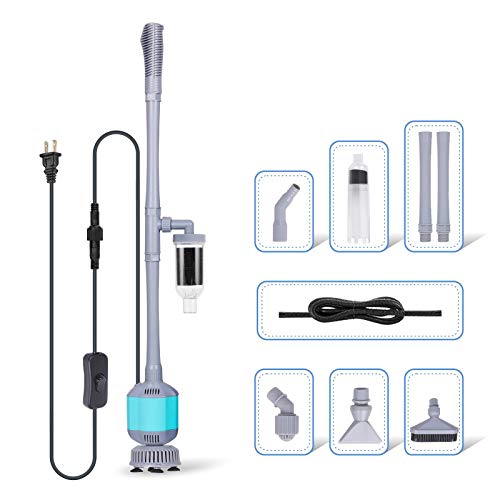
The hygger 360GPH cleaner has the clearest reach adjustment in this group: four rigid tubes extend from 11.4 to 40.5 inches. Brush heads and a duckbill suction port let it work in corners as well as along the substrate. Its water-changing pump is rated up to 360 gallons per hour, with a 4.92-foot head; the maker also gives a starting water level of 2 inches and pumping down to 0.3 inch. It suits tanks where reach is the deciding factor, but the 15W rating and listed flow are lower than the UPETTOOLS unit’s figures.
Bottom line: Choose it when extending the tube to different tank depths is essential.
AKKEE 36W Electric Cleaner

The AKKEE cleaner differentiates itself with three motor power levels—36W, 27W, and 19W—alongside functions for water changes, gravel cleaning, filtration and circulation, algae scraping, and timed shutdown. Its maker positions the lower settings as more suitable for smaller fish, while the selectable power lets owners adjust suction for the task. The unit is a broader maintenance tool rather than a gravel-only vacuum.
Bottom line: Pick it for selectable motor power and a wide range of cleaning tasks.
16W Electric Cleaner with Filter

The 16W electric cleaner is distinguished by its built-in cotton mesh filter, which captures visible particles and detritus as water circulates through the system. An extension tube helps reach different depths, and the cleaner includes a shower outlet. Its care guidance emphasizes keeping the intake just above the substrate, especially over fine sand, and rinsing the intake, tubing, filter media, and attachments after use. That makes it a practical option for filtration during maintenance, but the specifications do not give a flow rate or extension length, limiting comparisons for tank size and reach.
Bottom line: Choose it when a built-in cotton mesh filter during maintenance is useful.
How to choose a powered aquarium gravel cleaner
Start with the task: a gravel vacuum lifts debris from the substrate, while multi-function electric cleaners may also circulate or change water. For a focused gravel-cleaning routine, prioritize controlled suction and a guard or pause feature; for water changes, compare pump flow and any included drainage connection. Flow figures are not directly comparable unless they use the same unit, so convert liters per hour to gallons per hour before comparing. Fine sand needs a lighter touch than coarse gravel: hold an intake just above the surface and avoid burying it, which can pull substrate into the tube or clog the intake. Choose a model only after checking its reachable depth and whether its power setup works where the aquarium sits.
Matching reach and flow to your aquarium
Reach matters most when the tank is deep or the substrate is difficult to access; compare the usable tube or nozzle length with the water depth, not just the tank’s outside height. An extension tube can help reach the bottom, but a long tube does not by itself guarantee adequate suction. For a water-changing model, use the maximum flow as a ceiling rather than an expected everyday rate; head height, tubing, and bends affect pumping. A useful decision rule is to favor a model with an adjustable reach when the tank depth changes between aquariums; if you clean one fixed-depth tank, prioritize suction control and the intake shape instead.
Powered gravel vacuums versus multi-function cleaners
Powered gravel vacuums focus on suctioning debris from substrate, while multi-function cleaners add tasks such as water changing, filtration, showering, or algae scraping. Those additions can reduce the number of separate tools, but they do not guarantee better gravel cleaning. Use this comparison to match design to task rather than treating every feature as equally important.
| Need | Feature to compare | Practical choice |
|---|---|---|
| Targeted gravel cleaning | Pause or flow control; gravel guard | Prioritize controlled intake |
| Water changes | Flow rating; drain connection | Check both rate and hose needs |
| Variable tank depth | Tube or nozzle reach | Choose a model with extension |
| Fine sand | Adjustable suction and intake clearance | Keep the nozzle above the substrate |
Using and maintaining an electric aquarium cleaner
Keep the intake moving slowly above the substrate instead of pressing it into sand or gravel; pushing too deeply can pull grains in and impede flow. Start with a low or controlled setting when the cleaner offers one, especially around small fish or delicate substrate. Before cleaning, position the unit according to its operating instructions and keep electrical connections dry; unplug it before handling or rinsing any component. After use, remove trapped waste and rinse the intake, tubing, and filter media so debris does not remain in the wet path. Replaceable pads and cotton mesh need inspection as they collect detritus, since a clogged filter can restrict circulation. Check that any separate hose or adapter needed for draining is compatible before relying on a cleaner for water changes.
Frequently Asked Questions
Can a powered gravel vacuum clean fine sand?
Yes, but keep the intake just above the sand rather than burying it. Fine grains are more easily drawn into an intake and can clog the flow path, so use controlled suction where available.
How often should aquarium gravel be vacuumed?
A common starting routine is to vacuum part of the substrate during a weekly water change, rather than deep-cleaning the entire bed at once. Stocking, feeding, and visible waste determine how much of the bottom needs attention each session.
Can an electric gravel cleaner replace a siphon hose?
Only if it supports the water-changing task and has a compatible drain path. Some powered cleaners focus on filtration or substrate cleaning, and an adapter may require a separate hose.
Should the aquarium cleaner run while outside the water?
No, submersible aquarium pumps should be placed in water before they are switched on. Unplug the unit before rinsing it or clearing its intake, and keep plug connections away from splashes.
Does higher pump flow mean better gravel cleaning?
Not necessarily; maximum flow describes water movement, not how gently an intake lifts debris from the substrate. For fine sand or small fish, adjustable or controlled suction can matter more than peak flow.