
Grinding Wheels for Ceramic Tile: 3 Types Compared

For ceramic-tile surface grinding, 4-Inch 12-Segment Turbo Diamond Cup Wheel is the clearest fit because it is a diamond cup wheel rather than a thin cut-off disc.
A grinding wheel removes material from a tile face or edge, while a cut-off blade is designed primarily to make narrow cuts. Match the wheel style to the task before choosing by diameter.
We earn a commission if you buy through links on this page. As an Amazon Associate I earn from qualifying purchases. Products are compared on manufacturer specifications, not hands-on testing.
- Best overall: 4-Inch 12-Segment Turbo Diamond Cup Wheel – Its cup-wheel form is intended for grinding tile and other hard surfaces.
- Best for edge polishing: ONEGOTOOL 4.5-Inch Dual-Edge Diamond Disc – Its 30 mm diamond-sanded edges work on both sides for grinding and polishing.
- Best for mixed materials: FOXBC 4.5-Inch Multi-Material Diamond Disc – Its diamond rim is specified for grinding as well as cutting multiple materials.
| Product | Best for | Diameter | Thickness | Grinding feature | Shop |
|---|---|---|---|---|---|
| 4-Inch 12-Segment Turbo Diamond Cup Wheel | Surface grinding | 4 in | 0.1 in | 12-segment cup | Check Price on Amazon |
| ONEGOTOOL 4.5-Inch Dual-Edge Diamond Disc | Tile edge finishing | 4.5 in | 0.05 in | 30 mm dual-sided edges | Check Price on Amazon |
| FOXBC 4.5-Inch Multi-Material Diamond Disc | Mixed-material work | 4.5 in | 0.1 in | Cut-off and flat grinding | Check Price on Amazon |
Grinding wheels for ceramic tile
Choose a cup wheel for surface work or a thin diamond disc when cuts and edge finishing are part of the job.
4-Inch 12-Segment Turbo Diamond Cup Wheel
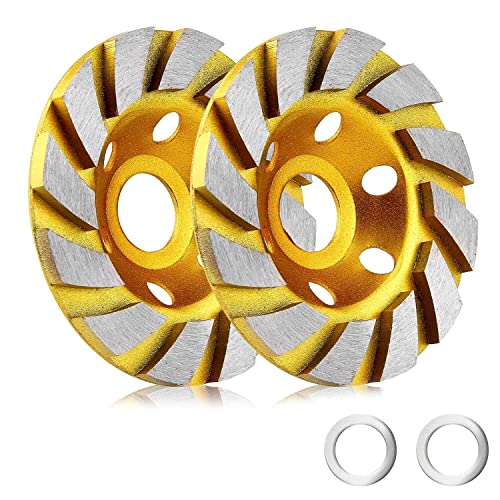
Unlike the thin discs, this 4-inch diamond cup wheel is shaped for grinding broad surfaces. It has 12 segments and is described for dry or wet smoothing of concrete and fieldstone, as well as grinding marble, tile, concrete, and rock. That makes it the most direct match here for removing material from a tile surface rather than making a narrow cut. Its limitation is the 4-inch cup format: buyers needing a slim edge-polishing rim or a 4.5-inch blade should choose a different style. Use eye, hearing, and respiratory protection when grinding.
Bottom line: Choose this for surface grinding where a segmented cup wheel suits the task.
ONEGOTOOL 4.5-Inch Dual-Edge Diamond Disc

The dual-sided 30 mm diamond-sanded edges distinguish this 4.5-inch disc from a conventional cup wheel: they are intended for grinding and polishing on either side, alongside cutting. The thin 0.05-inch profile is suited to narrow cuts, while the maker says its fine-grained diamond particles support smooth tile cutting with less chipping. Its three-piece pack provides multiple discs. The trade-off is that this is a disc-style cutting tool, not a broad cup for sweeping over a large tile face; choose a cup wheel when surface-area grinding is the main job.
Bottom line: Choose this for tile edges that need cutting plus two-sided grinding or polishing.
FOXBC 4.5-Inch Multi-Material Diamond Disc

This disc stands out for its 7/8-inch arbor with a 5/8-inch bushing and its explicit cut-off and flat-abrasive polishing uses. The three-pack has a vacuum-brazed diamond edge, and the maker specifies dry and wet use across tile, ceramic, glass, stone, and several other materials. That range can suit a project involving more than ceramic tile. Its limitation is the flat disc format: it is not a segmented cup wheel for broad surface grinding. Verify the grinder’s arbor and permitted wheel diameter before fitting it.
Bottom line: Choose this when the work spans tile and other materials and the arbor fits.
Choose a wheel by the tile task
Choose a cup wheel for grinding a tile face and a thin diamond disc for narrow cuts or edge work. Cup wheels present a broad segmented working surface; flat discs work at their rim and can make controlled cuts or finish an edge. A common mistake is treating any diamond blade as a general grinding wheel: the shape determines how much surface contacts the tile and how controllable the pass feels. For a large flat area, favor a cup style; for an exposed edge or a narrow cut, use a disc explicitly intended for that operation. Do not use a cut-off disc for side grinding unless its design permits that use. Compare working shape and stated purpose before comparing pack count.
Match diameter, arbor, and grinder
Match the wheel diameter and arbor to the angle grinder before installation; a 4-inch wheel and a 4.5-inch wheel are not interchangeable if the grinder’s guard or rating does not permit both. Check the wheel’s maximum RPM against the grinder’s no-load RPM, and never remove the guard to fit a larger wheel. Arbor fit matters too: the FOXBC disc gives a 7/8-inch arbor with a 5/8-inch bushing, while the other products do not provide an arbor measurement. Confirm the grinder accepts that interface and the chosen diameter. For tile edges, a smaller contact area is easier to control than pressing a broad cup against a narrow edge.
Control dust and tile damage
Grinding ceramic tile can release respirable crystalline silica, especially when the glaze or body is abraded dry. Use wet grinding only when both the grinder and wheel permit it, and keep water away from electrical connections; otherwise use a suitable dust-control setup and a properly fitted respirator. Eye protection is essential because tile fragments can eject at high speed, and hearing protection is appropriate around an angle grinder. Avoid forcing the wheel: excess pressure can overheat the tile, chip its edge, or bind the wheel. Support the tile fully and make light, controlled passes. A glossy glaze chips more readily at an unsupported edge than a backed edge.
Compare wheel styles for tile work
Wheel shape is a better first filter than brand because the main distinction is surface grinding versus rim cutting or finishing. Use this task-to-style guide before choosing a diameter or pack size.
| Task | Wheel style | Why it fits |
|---|---|---|
| Grind a tile face | Segmented cup wheel | Broad working surface for material removal |
| Polish or grind an edge | Dual-edge diamond disc | Rim contacts the tile edge; some designs work on either side |
| Make a narrow cut | Thin diamond cut-off disc | Thin kerf and rim designed for cutting |
Do not infer wet capability, arbor size, or side-grinding permission from appearance alone. The wheel’s use and grinder compatibility decide whether a style suits the job.
Frequently Asked Questions
Can I use a cut-off blade to grind tile edges?
Only if the blade is designed for side grinding or polishing; many cut-off blades are intended to cut at the rim. For exposed edges, use a design with an explicit grinding or polishing purpose and make light passes.
Should ceramic tile be ground wet or dry?
Use wet grinding only if the wheel and grinder both allow it, and keep water clear of electrical connections. Dry tile grinding can release silica dust, so dust control and respiratory protection matter.
How do I check an angle grinder wheel will fit?
Match the wheel diameter, arbor, and RPM rating to the grinder before mounting it. The grinder’s no-load RPM must not exceed the maximum RPM marked for the wheel.
Why does ceramic tile chip while grinding?
Unsupported edges and heavy pressure increase chipping risk. Support the tile close to the work and remove material in light passes rather than forcing the wheel.
What protective gear is needed for tile grinding?
Wear eye protection, hearing protection, and respiratory protection because fragments, noise, and silica dust are hazards. Also use the grinder guard and secure the tile before starting.