
Sling for Fractured Humerus: 4 Options Compared

For a fractured humerus, Velpeau Sleep Arm Sling, Large is the closest match because its maker says it is designed to stabilize humerus injuries and can be worn on either arm. A fracture’s location and treatment plan determine whether a basic sling is enough; use the specific support your clinician recommends.
Choose another option if you need a T-shaped strap to limit arm swing, or a simpler adjustable pouch for a forearm injury.
We earn a commission if you buy through links on this page. As an Amazon Associate I earn from qualifying purchases. Products are compared on manufacturer specifications, not hands-on testing.
- Best overall: Velpeau Sleep Arm Sling, Large – The maker specifically says it provides fixation for humerus injuries and fits either arm.
- Best for limiting arm swing: Velpeau T-Strap Shoulder Immobilizer, Large – Its T-shaped waist strap holds the arm close to the body.
- Best for measured arm fit: Quiheat Adjustable Arm Sling, Medium – It offers three arm-length sizes and advises measuring with a cast or bandage in place.
| Product | Best for | Support design | Sizing basis | Fits which arm | Shop |
|---|---|---|---|---|---|
| Velpeau Sleep Arm Sling, Large | Humerus support | Soft immobilizer | Bust 39.5–51.3 in | Left or right | Check Price on Amazon |
| Velpeau T-Strap Shoulder Immobilizer, Large | Reduced arm swing | T-shaped waist strap | Underbust 33.5–41 in | Left or right | Check Price on Amazon |
| Quiheat Adjustable Arm Sling, Medium | Measured arm length | Adjustable shoulder strap | 11–13 in arm length | Left or right | Check Price on Amazon |
| Comforband Breathable Arm Sling | Ventilated arm pouch | Foam wrist cushion | One size fits most | — | Check Price on Amazon |
Slings for a fractured humerus
Compare the support style and fit measurements, then use the option recommended for the fracture and treatment plan.
Velpeau Sleep Arm Sling, Large

Velpeau Sleep Arm Sling, Large is the only option whose maker specifically names humerus injuries among the conditions it supports. The sling uses sponge and sweat cloth, with hook-and-loop fastening for adjustment; its maker says it has no hard plastic or metal components. Large is associated with a 39.5–51.3-inch bust measurement in the product name.
This is the clearest match when the prescribed plan calls for a soft shoulder immobilizer. It may not suit someone who needs rigid stabilization or a different prescribed brace; confirm the required support type with the treating clinician before choosing.
Bottom line: Pick this if your clinician recommends a soft immobilizer for the humerus injury.
Velpeau T-Strap Shoulder Immobilizer, Large

Velpeau T-Strap Shoulder Immobilizer, Large differs from a basic arm pouch by adding a T-shaped waist strap intended to keep the arm close to the body and reduce swinging. It is a shoulder immobilizer, and the maker says it is free of neoprene and latex.
Large corresponds to a 33.5–41-inch underbust range, with a separate forearm-length limit below 13.8 inches. This may suit a wearer needing more torso restraint, but it is not specifically identified for a humerus fracture in the specifications; choose it only if its support style matches the clinician’s plan.
Bottom line: Pick this if limiting arm swing is the priority and the fit measures match.
Quiheat Adjustable Arm Sling, Medium
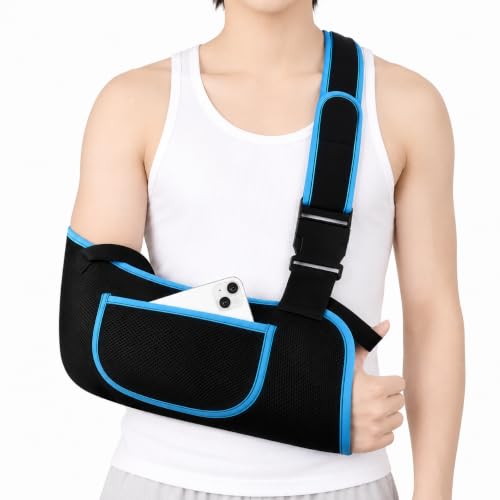
Quiheat Adjustable Arm Sling, Medium separates itself with three arm-length sizes and advice to measure while wearing a cast, brace, bandage, or thick clothing. The medium size fits an 11–13-inch measurement from elbow to the base knuckle of the middle finger. Its shoulder strap is padded and adjustable.
This is a straightforward choice when a measured fit and forearm support are central. The specifications describe forearm fracture support, not a humerus-specific immobilizer, so it may not provide the level of shoulder control required for an upper-arm fracture. Check that the prescribed support matches this sling’s design.
Bottom line: Pick this for a measured arm fit when a basic sling is prescribed.
Comforband Breathable Arm Sling

Comforband Breathable Arm Sling uses a stretchy cotton pouch, a mesh forearm panel, and a foam wrist-lifting cushion, making its support style distinct from the torso-wrapping immobilizer. The shoulder strap is adjustable and has foam padding; the sling is also reversible.
It may suit someone seeking a ventilated pouch for a forearm injury. The specifications do not identify humerus-specific stabilization or a defined size range, so a person with an upper-arm fracture should not assume it supplies enough restraint. Measure the forearm using the maker’s sizing chart and confirm appropriateness with the treating clinician.
Bottom line: Pick this only when a breathable pouch is appropriate for the prescribed support.
How to choose a sling for a fractured humerus
Choose by fracture location and the immobilization plan, not by comfort features alone. The humerus runs from shoulder to elbow, so an upper-end fracture may need shoulder control while a lower-end fracture may be managed with different support. A simple sling primarily supports the forearm; an immobilizer adds straps that limit movement of the upper arm.
Ask whether the plan calls for a sling, a shoulder immobilizer, or a brace, and whether elbow motion is allowed. A measurable decision rule: if the clinician specifies that the arm must stay against the torso, choose a design with a torso strap rather than an open pouch. Do not substitute a more restrictive design without approval, since permitted movement depends on the injury and treatment.
Fit and positioning for an arm sling
Fit the sling so the elbow reaches the pouch corner and the forearm is supported without forcing the shoulder upward. Common fitting guidance keeps the elbow near a right angle and the hand slightly higher than the elbow, unless the treating clinician gives a different position. Straps that pull the shoulder toward the ear can create avoidable neck pressure.
Measure the body or arm in the exact way the chosen design requires. Bust or underbust measurements are not interchangeable with elbow-to-hand length; a cast or bulky dressing can change the required arm measurement. If the sling slips, the elbow hangs out, or fingers become numb, blue, unusually cold, or increasingly swollen, contact a clinician promptly rather than tightening the sling blindly.
Arm sling and shoulder immobilizer differences
A basic arm sling carries the forearm, while a shoulder immobilizer usually adds a strap around the torso to reduce arm movement. That distinction matters for a humerus fracture because the fracture’s position determines which joints and motions need restriction. More straps do not automatically mean safer care; the prescribed device and fit are the deciding factors.
The table compares the support styles represented here. Choose by the clinician’s requested restraint and the measured fit, not by a label alone.
| Support style | Main restraint | Fit measurement |
|---|---|---|
| Soft shoulder immobilizer | Arm supported with added restraint | Body circumference may apply |
| Torso-strap immobilizer | Arm held close to torso | Underbust and forearm length |
| Arm pouch sling | Forearm carried in pouch | Arm length or maker’s chart |
Safe wear and common sling mistakes
Keep the hand visible and check circulation and sensation regularly, especially after adjusting the strap. A sling should support the arm without compressing the neck, cutting into the wrist, or letting the elbow slide out. Avoid tying or modifying straps in a way that changes the position prescribed for the fracture.
Do not assume that every humerus fracture should remain fully immobilized for the same length of time. The fracture pattern, stability, and treatment plan govern when movement begins; prolonged stiffness is a reason clinicians plan motion carefully. Seek prompt medical advice for worsening pain, new numbness, color change, or fingers that become cold, and follow the clinician’s specific instructions for skin checks and removal.
Frequently Asked Questions
How high should my hand sit in a humerus sling?
In common sling fitting, the hand sits slightly higher than the elbow, with the forearm supported and elbow near a right angle. A fracture-specific plan may require a different position, so use the treating clinician’s instructions if they differ.
Can I use a basic sling for a humerus fracture?
Some humerus fractures are supported with a basic sling, while others need a shoulder immobilizer or brace. The deciding factors are fracture location, stability, and the clinician’s prescribed motion limits.
How often should I check my fingers in a sling?
Check finger color, warmth, sensation, and swelling several times through the day, particularly after changing strap tension. New numbness, blue or pale color, cold fingers, or rapidly increasing swelling calls for prompt medical advice.
Should I sleep wearing a humerus sling?
Sleep guidance depends on the fracture and prescribed device, so ask the treating clinician whether the sling should stay on overnight. A supported arm position with pillows can reduce rolling and strain, but should not replace the clinician’s positioning plan.
When can I start moving my elbow after a humerus fracture?
Elbow movement timing depends on where the humerus is fractured and how stable the injury is. Do not use a fixed week count; begin motion only when the treating clinician allows it.