
Wall Mounted Kindling Wood Splitters Compared by Fit

Gioventù Dual-Handle 7-Tooth Splitter is the closest match for frequent kindling splitting because its 7-tooth clamp accommodates logs up to 18.11 inches and it has two handle lengths. Choose another option if you need a splitter that can also be used on the ground, since that use is claimed for iToolMax Wall-or-Ground Splitter.
A wall-mounted kindling splitter holds wood against a fixed blade as a handle drives the log through it; mounting strength and a stable work area matter as much as leverage.
We earn a commission if you buy through links on this page. As an Amazon Associate I earn from qualifying purchases. Products are compared on manufacturer specifications, not hands-on testing.
- Best overall: Gioventù Dual-Handle 7-Tooth Splitter – Its seven-tooth clamp and 15.9-inch long handle suit longer logs and repeated splitting.
- Best for ground use: iToolMax Wall-or-Ground Splitter – Its design allows wall mounting or direct use on the ground.
- Best for carbon steel: Frezon Wall Mount Carbon Steel Splitter – Its blade and body are carbon steel, with a rust-resistant surface treatment.
| Product | Best for | Handle setup | Log length | Overall dimensions | Shop |
|---|---|---|---|---|---|
| Gioventù Dual-Handle 7-Tooth Splitter | Longer logs | 15.9 in and 7.6 in | Up to 18.11 in | 22.63 × 3.74 × 7.28 in | Check Price on Amazon |
| BCOJUN 7-Tooth Extended-Handle Splitter | Portable setup | 16 in and 8 in | Up to 18 in | 20 × 5 × 20 in | Check Price on Amazon |
| Frezon Wall Mount Carbon Steel Splitter | Fixed installation | — | — | 21.65 × 5.12 × 3.94 in | Check Price on Amazon |
| iToolMax Wall-or-Ground Splitter | Ground operation | — | — | 19.7 × 4.9 × 7.76 in | Check Price on Amazon |
| Meyoppm Dual-Handle Firewood Splitter | Dry softwood | Extended detachable handle | Up to 13.8 in | 22.83 × 16.53 × 3.94 in | Check Price on Amazon |
Wall Mounted Kindling Wood Splitters
Compare handle choices, gripping designs and dimensions to match a splitter to your logs and mounting space.
Gioventù Dual-Handle 7-Tooth Splitter

Gioventù Dual-Handle 7-Tooth Splitter combines a 7-tooth clamp with a long and short handle, making it the strongest fit here for longer pieces and frequent splitting. Its dimensions are 22.63 × 3.74 × 7.28 inches, so check that the mounting area can accommodate its length. The maker says the leverage setup reduces effort by over 30% and that the splitter is made from 65Mn manganese steel. The maker calls it suitable for soft firewood, so buyers splitting other wood types should account for that narrower stated use.
Bottom line: Choose it if your logs reach 18.11 inches and you want two handle lengths.
BCOJUN 7-Tooth Extended-Handle Splitter

BCOJUN 7-Tooth Extended-Handle Splitter pairs a 7-tooth grip with detachable 8-inch and 16-inch handles, and its dimensions are 20 × 5 × 20 inches. That gives buyers a second long-log option with a slightly shorter stated maximum than Gioventù Dual-Handle 7-Tooth Splitter. The maker says the clamp prevents shifting and that the extended handle adds leverage.
Bottom line: Pick it if detachable handle options and an 18-inch log capacity suit your setup.
Frezon Wall Mount Carbon Steel Splitter

Frezon Wall Mount Carbon Steel Splitter is the simpler fixed-style option in this group: its maker describes a wall-mounted tool rather than detachable handle choices or a tooth count. The splitter measures 21.65 × 5.12 × 3.94 inches and weighs 9 pounds. Its blade and body are carbon steel, and the maker says the surface treatment resists rust and deformation. Because no log-length limit or handle configuration is supplied, this choice is harder to match to unusually long wood; verify the intended log fit before committing to a fixed installation.
Bottom line: Choose it for a carbon-steel wall splitter when your log size already fits.
iToolMax Wall-or-Ground Splitter
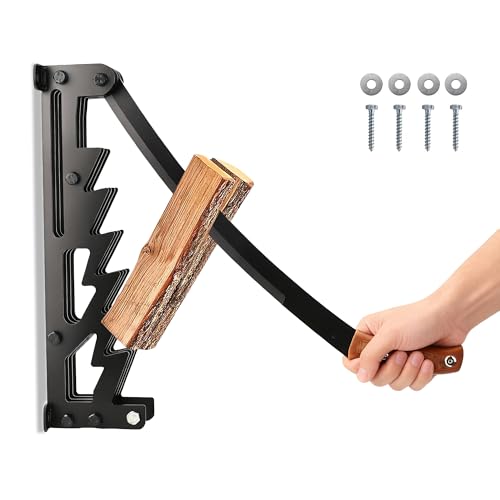
Its carbon-steel construction and 19.7 × 4.9 × 7.76-inch dimensions suit buyers who need that placement flexibility. The maker also says the frosted finish provides a non-slip grip and rust resistance. The maker gives neither a handle length nor a log-size limit, so buyers who need to split long rounds should verify those fit points before installation; the dual-use claim does not establish capacity.
Bottom line: Pick it when ground use is important alongside wall mounting.
Meyoppm Dual-Handle Firewood Splitter

Meyoppm Dual-Handle Firewood Splitter is aimed specifically at dry softwood such as pine and fir, unlike options that emphasize longer log capacity. Its gear-style jaws are stated to accommodate logs up to 13.8 inches, and it includes a standard grip plus a detachable extended handle. The splitter measures 22.83 × 16.53 × 3.94 inches. The maker says the jaws keep wood from shifting and that its high-carbon steel construction supports durability. The shorter stated log limit makes it a less suitable match for rounds over 13.8 inches.
Bottom line: Choose it for dry pine or fir pieces within its 13.8-inch limit.
How to choose a wall mounted kindling splitter
Handle leverage and log restraint are the first things to compare for a manual wall splitter. A longer handle increases leverage, but it also needs a clear swing path; keep people, glass and loose objects outside that arc. Clamping teeth help hold irregular wood, while the maximum log length sets a hard fit limit. Wall installation is part of the tool system: mount into framing or masonry with suitable fasteners, not drywall alone, and keep the blade path clear of the wall and floor. If you need use away from a fixed mount, choose a design whose maker explicitly allows ground operation rather than assuming any model is freestanding.
| Need | Choose by |
|---|---|
| Longer rounds | Stated log limit of at least your round length |
| More leverage | Long handle, with room for a controlled swing |
| Changeable location | Explicit wall-or-ground use |
Log size and mounting fit
Measure the wood length and diameter before selecting a splitter; length limits are not interchangeable with the diameter the clamp can grip. For a log of 16 inches, a 13.8-inch maximum rules that option out, while an 18-inch maximum leaves only 2 inches of length margin. The splitter must also fit the chosen mounting surface: allow clearance for the handle to travel and for hands to stay away from the blade. Wall-mounted tools transfer splitting force into their anchors, so fasteners need to suit the wall material and must engage a structural support. If the mounting location cannot provide that support, do not treat a wall-only tool as safe to use loose on the ground.
Manual splitter types and handle choices
Manual wall splitters use leverage rather than a motor: a fixed blade meets a log as the handle moves, and the user supplies the force. Short handles take less swing space, while longer handles provide more leverage but need more clearance. A toothed clamp adds restraint, but it cannot make every knotty or crooked piece safe to split. Wood species and moisture affect effort; dry, straight-grained softwood is generally easier to split than wet or knotty hardwood. The feature claims of these models distinguish handle arrangements, clamp designs and placement options, not a guarantee that every wood type or shape will work. Start with small, straight pieces and stop if the log shifts.
Safe setup and routine care
Secure the splitter firmly before every session, and never hold a log near the blade while applying force. Wear eye protection and work gloves, keep feet clear of falling pieces, and do not use a cracked, loose or visibly damaged tool. A splitting blade can cause severe cuts even when operated by hand; keep children and bystanders outside the work area. After use, brush away chips and check the blade edge, pivot and mounting fasteners for looseness or corrosion. Carbon and other steels can rust when stored damp, so wipe the tool dry and store it in a dry place. Replace damaged fasteners with ones suited to the mounting surface rather than tightening into weak material.
Frequently Asked Questions
How long can logs be for a wall splitter?
Use the maximum log length given for that specific design, not a general wall-splitter rule. The limits here range from 13.8 to 18.11 inches, so measure each piece before setting up.
Does a longer handle make splitting easier?
A longer handle provides more leverage but requires more swing clearance. Keep the arc unobstructed and use controlled strokes rather than adding a second person to the handle.
Can a wall mounted splitter sit on the ground?
Only if the design explicitly allows ground use. A wall-only splitter relies on a secure mount to resist splitting forces, so do not use it loose on the ground.
What wall should a manual splitter attach to?
Use a structural support such as a wall stud or suitable masonry, not drywall alone. The anchor and fastener must match the wall material and withstand repeated force.
What wood is easiest to split by hand?
Straight-grained, dry softwood is generally easier than wet, knotty hardwood. Knots and crooked grain can redirect force, so split small, straight pieces and stop if a log shifts.