
Battery Maintainer for AGM Battery: 5 Options Compared

For a 12V AGM battery needing routine storage maintenance, Battery Tender Junior 12V 750mA is the straightforward choice because it supports AGM batteries and uses a four-step charging program. Choose a different option if you need 6V compatibility, higher charging current, or a charger that mounts near the battery.
An AGM battery is a sealed lead-acid battery that absorbs its electrolyte in a glass mat, so select a charger explicitly compatible with AGM and the battery’s voltage.
We earn a commission if you buy through links on this page. As an Amazon Associate I earn from qualifying purchases. Products are compared on manufacturer specifications, not hands-on testing.
- Best overall: Battery Tender Junior 12V 750mA – Supports 12V AGM batteries and includes a four-step charge program with a 750mA output.
- Best for 6V batteries: NOCO GENIUS2 6/12V 2A – Supports both 6V and 12V lead-acid batteries, including AGM.
- Best for onboard installation: NOCO GENIUS2D 12V 2A – Direct-mount design attaches near the battery and provides 2A output.
| Product | Best for | Supported battery voltage | Charging current | Installation style | Shop |
|---|---|---|---|---|---|
| Battery Tender Junior 12V 750mA | 12V storage maintenance | 12V | 750mA | Portable | Check Price on Amazon |
| NOCO GENIUS2 6/12V 2A | 6V or 12V flexibility | 6V / 12V | 2A | Portable | Check Price on Amazon |
| NOCO GENIUS2D 12V 2A | Mounted battery setup | 12V | 2A | Direct mount | Check Price on Amazon |
| Schumacher SC1355 1.5A | Multi-voltage upkeep | 6V / 12V | 1.5A | Portable | Check Price on Amazon |
| MOTOPOWER MP00205A 12V 800mA | 12V desulfation function | 12V | 800mA | Portable | Check Price on Amazon |
Battery Maintainers for AGM Batteries
Match the charger to the battery voltage first, then choose by charging current and where you plan to install it.
Battery Tender Junior 12V 750mA

For a dedicated 12V AGM maintainer, this compact charger uses a four-step program: initialization, bulk charge, absorption, and float. The maker says it switches to float mode after charging and is compatible with 12V lead-acid, flooded, AGM, and gel batteries. A 12-foot output cord, fused-ring terminal harness, and alligator-clip cables provide options for reaching battery terminals. The 750mA output is suited to maintenance rather than rapid charging, so choose a higher-current unit if you need to replenish a substantially discharged battery more quickly.
Bottom line: Choose this for a 12V AGM battery in seasonal storage when a low-current maintainer is the goal.
NOCO GENIUS2 6/12V 2A

The key distinction is voltage flexibility: this charger supports both 6V and 12V lead-acid batteries, including AGM, and also supports LiFePO4 batteries. Its 2A output can serve as a charger, maintainer, trickle charger, and desulfator, according to the maker. An integrated temperature sensor adjusts charging for ambient conditions. That broad compatibility can suit a mixed garage, but the battery chemistry and voltage still need to match a supported mode; the extra capability is unnecessary if you only maintain one 12V AGM battery.
Bottom line: Pick this when you need AGM maintenance across 6V and 12V batteries or also own LiFePO4 batteries.
NOCO GENIUS2D 12V 2A
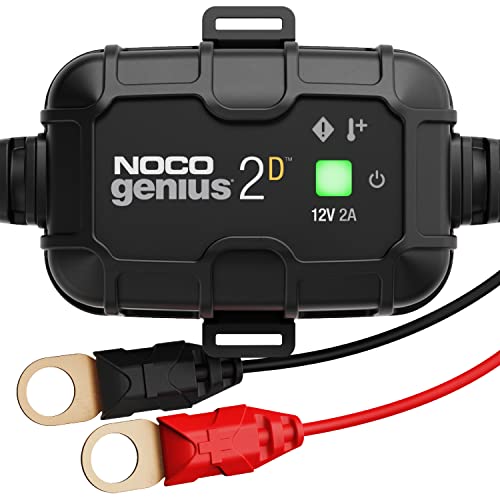
Unlike portable-style maintainers, this 12V unit is designed for direct mounting near the battery, making it the fit for an onboard charging setup. It supports lead-acid types including AGM, gel, SLA, and VRLA, as well as flooded, deep-cycle, marine, and RV batteries. The maker says its thermal sensor adjusts charging with ambient temperature and lists overcharge protection, desulfation, and Force Mode. The fixed installation approach is less suitable if you want one charger to move among several vehicles; it is also limited to 12V.
Bottom line: Choose this for a 12V AGM battery that will stay connected to an onboard, mounted charger.
Schumacher SC1355 1.5A

This charger combines 6V and 12V support with a 1.5A output and a reconditioning function, distinguishing it from the 12V-only options. The maker says it works with standard, AGM, and deep-cycle batteries and includes automatic voltage detection, multi-stage charging, desulfation, and smart trickle charging. It is intended for a range of vehicles and marine batteries, which can make it useful in a garage with mixed equipment. Confirm the battery’s voltage before connecting; the reconditioning feature does not remove the need for AGM compatibility and correct voltage selection.
Bottom line: Pick this if you want AGM support plus 6V/12V detection and reconditioning features.
MOTOPOWER MP00205A 12V 800mA

This 12V option combines an 800mA maintenance charge with automatic desulfation, setting it apart from a basic maintainer. It supports 12V lead-acid batteries, including AGM and gel, and the maker describes pulse-current desulfation and spark-free lead connection. A standby mode with zero output is also specified. The modest output is best viewed as a maintenance choice rather than a fast recovery charger, and this model does not cover 6V batteries; buyers with a mixed-voltage garage should select a dual-voltage alternative.
Bottom line: Choose this for a 12V AGM battery if automatic desulfation is a useful extra.
How to choose an AGM battery maintainer
Start by matching voltage and chemistry: a 12V AGM battery needs a charger with a 12V AGM-compatible mode. AGM is a type of sealed lead-acid battery, not the same chemistry as lithium iron phosphate, so do not assume that every charger mode is interchangeable. Charging current helps distinguish maintenance from faster charging; the options here range from 750mA to 2A. For a battery left connected in storage, look for a maintainer or float function rather than relying on an ordinary trickle charger. If you maintain more than one vehicle, 6V/12V support may matter; a fixed onboard installation is more appropriate when the charger will stay by one battery.
AGM voltage, charging and storage fit
A typical 12V lead-acid battery has six cells, with about 2.1V per cell when fully charged at rest, or roughly 12.6V total. AGM batteries still need a charger mode intended for AGM because charging voltage settings differ from other chemistries. A basic fit rule is simple: select a 12V mode for a 12V battery, and use a 6V/12V model only after confirming the battery voltage. For long-term storage, a maintainer’s float stage holds charge after the main charging cycle; do not leave a battery on a charger that lacks an appropriate automatic maintenance mode. Keep battery terminals clean and connections secure before use.
Portable and onboard maintainers compared
Portable chargers are useful when one unit will move between vehicles, while direct-mount models suit batteries that need a permanent charging connection. Installation choice changes convenience, not battery chemistry: every connection still needs correct polarity and a supported voltage.
| Need | Choose | Why it fits |
|---|---|---|
| Move a charger between vehicles | Portable maintainer | Can be connected where needed |
| Keep a charger near one battery | Direct-mount unit | Mounting hardware supports a fixed setup |
| Maintain batteries of either voltage | 6V/12V model | Supports both listed voltage classes |
For a setup that remains installed, plan cable routing away from heat, sharp edges, and moving parts. Disconnect power before attaching or removing clamps unless the charger instructions specify a different safe sequence.
AGM maintainer safety and common mistakes
Connect charger leads with power disconnected, observing positive-to-positive and negative-to-negative polarity; reversing clamps can cause sparks or damage. Charge lead-acid batteries in a ventilated area because even sealed AGM batteries can vent gas under fault conditions or overcharging. Keep flames and sparks away from any charging battery. Do not use a lithium-only charging mode on an AGM battery, or an AGM mode on a LiFePO4 battery. A maintainer is not a substitute for repairing a damaged battery: swelling, leakage, unusual heat, or a cracked case are reasons to stop charging and address the battery safely.
Frequently Asked Questions
Can I leave an AGM battery maintainer connected all winter?
A maintainer with an automatic float or maintenance mode is intended to keep a compatible battery charged during storage. Use a ventilated location and inspect the battery and cable connections periodically, especially if temperatures vary widely.
What voltage should an AGM battery charger use?
A common automotive AGM battery is 12V nominal and has six lead-acid cells. Choose a charger’s 12V AGM mode for that battery; confirm the label before connecting if the battery may be 6V.
Is a trickle charger the same as a battery maintainer?
Not necessarily: a basic trickle charger can continue supplying current, while a maintainer typically changes to a float or maintenance stage after charging. For storage lasting weeks or months, choose an automatic unit explicitly described for maintenance.
Can an AGM battery use a lithium battery charger?
No, use a charger mode intended for AGM lead-acid batteries. LiFePO4 charging uses different voltage and charging behavior, even when a charger supports both chemistries through separate modes.
How often should I check a stored AGM battery?
Check connections and the case about once a month during storage, and verify that the maintainer indicates normal operation. Heat, a damaged battery, or a loose connection can change the storage routine and warrant more frequent checks.