
Best End-of-Life Organizer: 5 Planners Compared

For most people, Spiral End-of-Life Planner, 7.9 × 10.4 in. is the strongest end-of-life organizer because its 16 tabs divide records into sections and its spiral binding turns 360 degrees. Choose Large-Print End-of-Life Planner, 7 × 10 in. instead if large-print is your priority, or Purple End-of-Life Binder, 11 × 12.6 in. if you want pockets for storing documents flat.
An end-of-life organizer is a paper record for personal, financial, medical, and final-wish information; it does not replace legal documents or professional advice.
We earn a commission if you buy through links on this page. As an Amazon Associate I earn from qualifying purchases. Products are compared on manufacturer specifications, not hands-on testing.
- Best overall: Spiral End-of-Life Planner, 7.9 × 10.4 in. – Sixteen tabs, spiral binding, an inner pocket, pen holder, and elastic band combine record organization with handy storage.
- Best for large print: Large-Print End-of-Life Planner, 7 × 10 in. – Bold, high-contrast text and a large-font layout are designed for easier reading.
- Best for documents: Purple End-of-Life Binder, 11 × 12.6 in. – Eight envelope pockets fit standard A4 and Letter papers without folding.
| Product | Best for | Size | Section layout | Storage or binding | Shop |
|---|---|---|---|---|---|
| Spiral End-of-Life Planner, 7.9 × 10.4 in. | Tabbed organization | 7.9 × 10.4 in. | 16 tabs | Inner pocket; pen holder; elastic band | Check Price on Amazon |
| Lamorial End-of-Life Planner & Journal, A4 | Guided prompts | A4; 8.39 × 11.18 in. | 83 pages; 9 sections | Bound pages; cannot add or remove | Check Price on Amazon |
| Purple End-of-Life Binder, 11 × 12.6 in. | Flat document storage | 11 × 12.6 in. | 10 tabbed sections | 8 envelope pockets; 12.2 × 8.66 in. | Check Price on Amazon |
| Large-Print End-of-Life Planner, 7 × 10 in. | Large-print layout | 7 × 10 in. | 16 tabs | Inner pockets | Check Price on Amazon |
| Clever Fox End-of-Life Planner, A4 | Broad record keeping | 8.5 × 11 in. | 16 sections | — | Check Price on Amazon |
Best End-of-Life Organizers
Compare each planner’s format and organization features to find a fit for your records and writing preferences.
Spiral End-of-Life Planner, 7.9 × 10.4 in.
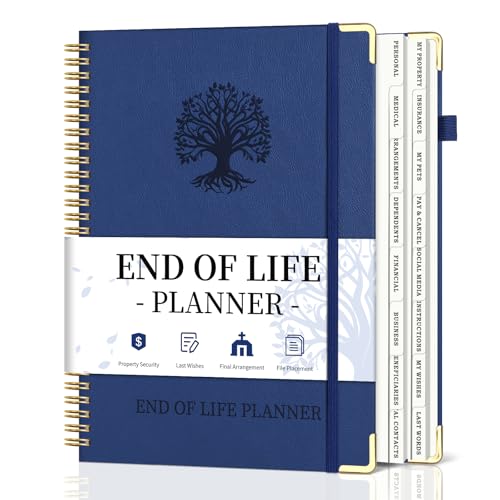
Spiral End-of-Life Planner, 7.9 × 10.4 in. pairs 16 tabs with a twin-wire spiral, making it the most sectioned option here with a binding that allows 360-degree page turning. The 7.9 × 10.4-inch B5 format also includes an inner pocket, pen holder, and elastic band. Its sections cover personal and family information, medical information, property and financial assets, and final wishes. Brand materials call out large-print, which may suit readers who prefer more visible text. The tradeoff is its smaller footprint than the A4-size choices, so compare the page size with the space you want for handwriting.
Bottom line: Choose it if you want many tabs plus spiral binding and built-in everyday storage.
Lamorial End-of-Life Planner & Journal, A4

Lamorial End-of-Life Planner & Journal, A4 is the only option here with a page count and a fully prompted journal format: 83 pages across 9 sections. Its prompts cover access information such as phone passcodes, two-factor authentication backup codes, recovery emails, financial accounts, and final wishes. The A4 cover measures 8.39 × 11.18 inches, and the pages are bound in place rather than removable. Brand materials describe the tone as calm and comforting. That fixed-page format is a limitation for anyone who wants to insert or rearrange pages; the maker suggests working through sections and updating entries as circumstances change.
Bottom line: Choose it if you prefer prompted writing and a fixed, guided journal structure.
Purple End-of-Life Binder, 11 × 12.6 in.

Purple End-of-Life Binder, 11 × 12.6 in. stands out for document storage: its eight envelope pockets measure 12.2 × 8.66 inches and are intended for standard A4 and Letter-size papers without folding. The 11 × 12.6-inch binder also has 10 colored guided tabbed sections, including areas for personal and family records, assets and finances, pets, funeral arrangements, and a letter to important people. This format suits someone who wants paper records stored alongside written guidance. Its larger footprint may be less convenient if shelf or desk space is tight, and the 10-section layout has fewer tabs than some alternatives.
Bottom line: Choose it if you want multiple pockets for full-size papers alongside guided sections.
Large-Print End-of-Life Planner, 7 × 10 in.
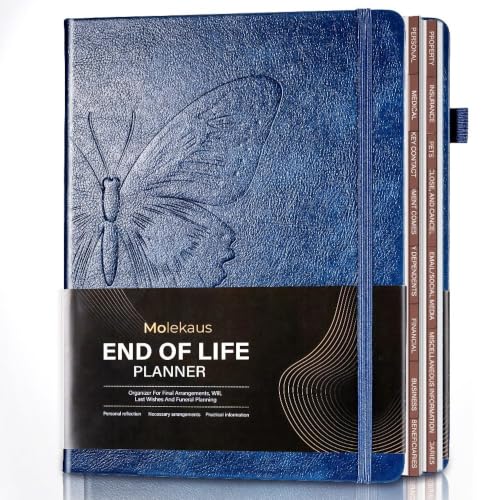
Large-Print End-of-Life Planner, 7 × 10 in. centers on readability, with bold fonts, high-contrast ink, and a large-text layout; it is the clearest match for someone prioritizing legible prompts. The 7 × 10-inch format includes 16 tabs and inner pockets, while the paper is 120 GSM. Its ample writing space is described by the maker as suitable for handwritten records. Compared with the larger A4 options, this planner has a smaller page footprint, so it may be less comfortable for someone who wants a wide writing area. Choose it for its large-print emphasis rather than for document-pocket capacity or spiral binding.
Bottom line: Choose it when large, high-contrast print matters more than page size or spiral binding.
Clever Fox End-of-Life Planner, A4

Clever Fox End-of-Life Planner, A4 uses 16 sections to organize a broad set of records, including medical information, passwords, financial records, insurance policies, memberships, dependent and pet care instructions, and personal property. Its 8.5 × 11-inch A4 format provides a larger writing surface than the 7 × 10-inch choice. Brand materials describe the layout as easy to follow and complete; those are maker claims rather than a guarantee that every person will find it straightforward. The features do not identify a pocket or special binding, so this is a better fit for someone focused on sectioned record keeping than on built-in storage features.
Bottom line: Choose it if you want 16 sections on a full-size page for varied records.
How to choose an end-of-life organizer
Choose by how you plan to record and retrieve information: tab count, prompts, readability, and space for papers matter more than the cover. A guided journal can help someone who wants specific prompts, while a tabbed planner lets readers navigate by subject. For a decision rule, choose a pocket-based format if you need to keep original-size documents with notes; choose a prompted book if you mainly need help deciding what to write. Paper organizers can hold sensitive personal and account-access information, so decide where the completed book will be kept and who should be allowed to access it. A paper record does not itself grant authority to manage accounts or carry out legal wishes.
Page size and document fit
US Letter paper measures 8.5 × 11 inches, while A4 measures about 8.27 × 11.69 inches; these formats are similar but not interchangeable in every pocket. Purple End-of-Life Binder, 11 × 12.6 in. gives pocket dimensions of 12.2 × 8.66 inches and says they fit standard A4 and Letter documents without folding. If storing originals or copies is important, compare pocket opening dimensions with the actual paper and any sleeves before choosing. Smaller formats such as 7 × 10 inches may be easier to handle, while larger pages provide more area for handwriting. A larger cover does not necessarily mean larger pockets, so use pocket measurements rather than the binder’s outside dimensions for document fit.
What to record and how to protect it
Separate practical access instructions from legally operative papers. An organizer can point family members toward account contacts, medical information, insurance records, and final wishes, but a written note in a planner is not a substitute for a will, health care directive, or power of attorney. Passwords and two-factor recovery codes can expose accounts if an unauthorized person finds the book; store it in a controlled place and tell a trusted person how to locate it. Avoid writing a master password in the same book as account details if that would create an unacceptable single point of access. Review entries after major changes, such as changing banks, phones, beneficiaries, or emergency contacts.
End-of-life organizer formats compared
Format affects whether the planner is best for prompts, navigation, or document storage. Tabbed organizers separate subjects for quick navigation, whereas a prompted journal guides the writing sequence. Pocket organizers are useful when paper documents need to remain with the written record. Use this comparison to match a format to the job before deciding based on appearance.
| Need | Format to consider | What to check |
|---|---|---|
| Quick subject navigation | Spiral End-of-Life Planner, 7.9 × 10.4 in. or Large-Print End-of-Life Planner, 7 × 10 in. | Whether large-print or spiral binding matters more |
| Writing prompts | Lamorial End-of-Life Planner & Journal, A4 | Fixed pages versus removable pages |
| Full-size paper storage | Purple End-of-Life Binder, 11 × 12.6 in. | Pocket opening against actual document size |
| Broad sectioned records | Clever Fox End-of-Life Planner, A4 | Whether built-in pockets are needed |
Frequently Asked Questions
How often should I update an end-of-life organizer?
Review an end-of-life organizer at least once a year and after a major change, such as a new phone, bank, insurance policy, or emergency contact. Frequent changes to account access may justify more frequent updates.
Should passwords go in an end-of-life organizer?
Only record access information if you can store the book securely and control who can reach it. Passwords, phone passcodes, and two-factor recovery codes can expose accounts, so avoid creating an unsecured single place containing every credential.
Can an organizer replace a will or advance directive?
No; a planner is a place to organize information and wishes, not a substitute for legally valid documents. Requirements for wills and health care directives vary by state, so use the appropriate state process or professional guidance for those documents.
Will A4 papers fit in a US Letter binder pocket?
Not every pocket made for US Letter paper will fit A4 without folding, because A4 is about 8.27 × 11.69 inches and US Letter is 8.5 × 11 inches. Compare the pocket’s opening and usable depth with the paper dimensions before storing documents.
Where should a completed end-of-life planner be kept?
Keep a completed planner somewhere protected from casual access, but make sure a trusted person knows how to reach it when needed. If it contains account credentials, treat it like a sensitive access document rather than ordinary household notes.