
Aweec Wireless Dog Fence: GPS and Remote Models Compared

For the widest adjustable GPS boundary, choose Aweec GPS Wireless Fence, Orange: its radius ranges from 65 to 3,280 feet, in 1-foot increments. Choose Aweec GPS Wireless Fence and Training Collar only if you want the GPS collar and can confirm its fit and operating range; Aweec Transmitter Fence, Two-Dog Set uses a transmitter instead of a GPS boundary.
Wireless fences use a collar response rather than a physical barrier, so they suit supervised training—not keeping a dog safe around roads, pools or other hazards.
We earn a commission if you buy through links on this page. As an Amazon Associate I earn from qualifying purchases. Products are compared on manufacturer specifications, not hands-on testing.
- Best overall: Aweec GPS Wireless Fence, Orange – Offers a customizable GPS boundary from 65 to 3,280 feet and supports up to three dogs.
- Best for a basic GPS option: Aweec GPS Wireless Fence and Training Collar – A GPS collar fence with a training collar, for buyers who do not need specified range or fit options.
- Best for transmitter setup: Aweec Transmitter Fence, Two-Dog Set – Uses a transmitter with a 10- to 990-foot adjustable radius and supports two dogs.
| Product | Best for | Boundary radius | Dog capacity | Shop |
|---|---|---|---|---|
| Aweec GPS Wireless Fence, Orange | Wide GPS range | 65–3,280 ft | Up to 3 dogs | Check Price on Amazon |
| Aweec GPS Wireless Fence and Training Collar | GPS collar basics | — | — | Check Price on Amazon |
| Aweec Transmitter Fence, Two-Dog Set | Two-dog transmitter | 10–990 ft | 2 dogs | Check Price on Amazon |
Aweec wireless dog fence options
Compare the GPS-based collars with the transmitter-based system by the boundary size and dog setup you need.
Aweec GPS Wireless Fence, Orange

Aweec GPS Wireless Fence, Orange is the GPS choice with the widest adjustment span here: set its boundary radius from 65 to 3,280 feet in 1-foot increments. Its silicone collar adjusts from 8 to 22 inches and is intended for dogs over 3 months old. The app supports setup for up to three dogs; Aweec says the app is free for life with no subscription fees. Containment and training functions are combined in the collar. The limitation is that a GPS boundary is virtual, so choose another approach if you need a physical barrier or cannot supervise training.
Bottom line: Choose this if you need a widely adjustable GPS boundary for as many as three dogs.
Aweec GPS Wireless Fence and Training Collar

Aweec GPS Wireless Fence and Training Collar is another GPS wireless fence paired with an electric training collar, making it the straightforward alternative if the GPS-and-training combination is the priority. Its product name identifies the orange version. Compared with Aweec GPS Wireless Fence, Orange, the maker does not give a boundary radius, dog capacity or collar size, so this option is harder to match to a particular yard or dog. Before choosing it, confirm the collar will fit and that its usable boundary covers the area you need. Like other virtual fence systems, it does not create a physical obstacle or replace supervision.
Bottom line: Pick this only after confirming the fit and coverage meet your needs.
Aweec Transmitter Fence, Two-Dog Set
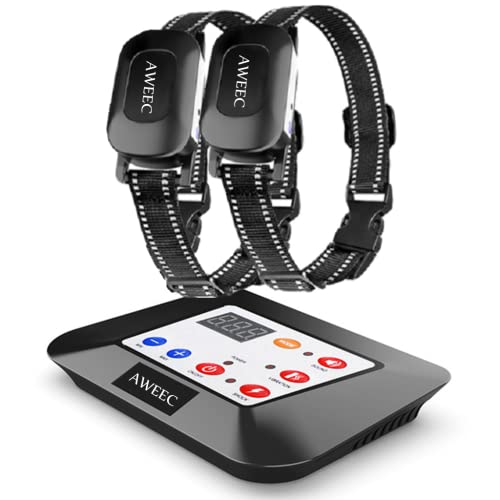
Aweec Transmitter Fence, Two-Dog Set differs from the GPS collars by using a transmitter to set a radius of about 10 to 990 feet, and its package is sized for two dogs. The system combines wireless containment with a remote training collar; the collars connect automatically after power-on, according to Aweec. Its range is much shorter than the maximum GPS radius of Aweec GPS Wireless Fence, Orange, which can make it a better match for a smaller defined area.
Bottom line: Choose this for a transmitter-based boundary and a two-dog setup.
How to choose an Aweec wireless dog fence
Choose the boundary technology first: GPS models define a virtual radius, while a transmitter model uses a local transmitter. Aweec GPS Wireless Fence, Orange gives a 65- to 3,280-foot radius; Aweec Transmitter Fence, Two-Dog Set gives an approximate 10- to 990-foot radius. Measure the area from the likely boundary center and compare the needed radius, not just the yard’s longest side. A 100-foot-wide square needs about a 71-foot radius from its center, while a 200-foot-wide square needs about 141 feet. Allow room between the warning boundary and hazards; electronic containment is not a substitute for a fence, leash or supervision.
GPS and transmitter boundaries compared
GPS collar fences and transmitter fences establish their boundaries differently, which affects where each makes sense. A GPS system uses location signals to define a virtual perimeter; a transmitter system sets a radius from its transmitter. Local terrain, nearby structures and signal conditions can affect boundary consistency, so train in a controlled area and observe how the collar responds before expanding access. Use this table to match the boundary style to the area and setup you have.
| Need | Better match | Reason |
|---|---|---|
| Large adjustable radius | GPS collar | Aweec GPS Wireless Fence, Orange reaches 3,280 feet |
| Defined local radius | Transmitter collar | Aweec Transmitter Fence, Two-Dog Set adjusts to about 990 feet |
| Physical separation from hazards | Physical fence or leash | An electronic boundary is not a barrier |
Check collar fit and dog count
Fit each collar snugly enough to remain positioned, while leaving room for comfort; a common collar fit check is to slide two fingers beneath the strap. Aweec GPS Wireless Fence, Orange gives an 8- to 22-inch adjustment range and says it is suitable for dogs over 3 months old. The two-dog transmitter set is specifically sized for two dogs, while Aweec GPS Wireless Fence, Orange supports setup for up to three. Do not assume collar fit transfers between dogs: measure each dog’s neck at the place the collar will sit and compare it with the range. If a system’s fit range is unknown, confirm it before ordering.
Train safely with an electronic boundary
Electronic boundaries require a learning period; they do not stop a dog from crossing the perimeter. Start with a leash and supervised sessions, and do not leave a dog relying on the collar near traffic, water or other hazards. Use boundary flags or another visible marker during early training, then remove them gradually only after the dog reliably recognizes the edge. Keep the collar clean and check the skin beneath it daily; remove it if irritation appears. Never use an electronic fence as the sole protection for a dog that may chase, panic or bolt.
Frequently Asked Questions
How wide can the Aweec GPS fence boundary be?
Aweec GPS Wireless Fence, Orange adjusts from a 65-foot to a 3,280-foot radius in 1-foot increments. Measure from the intended boundary center, since the radius is not the same as the full width across the area.
Can one Aweec GPS collar system support multiple dogs?
Aweec GPS Wireless Fence, Orange supports app setup for up to three dogs. The transmitter-based package is specified for two dogs, so match capacity to the number of collars needed.
Does a wireless dog fence physically keep dogs inside?
No; an electronic fence defines a boundary but does not create a physical barrier. Use a leash or secure physical fence near roads, pools and other hazards.
How should I measure a dog’s neck for a fence collar?
Measure around the neck where the collar will sit, then compare that measurement with the collar’s adjustment range. Aweec GPS Wireless Fence, Orange fits 8- to 22-inch necks; verify fit for other options before choosing.
How long does it take to train a dog to a wireless fence?
Training time varies by dog, but use several short, supervised sessions rather than expecting immediate boundary recognition. Begin on leash and keep the dog away from hazards until it responds reliably to the boundary cues.