
Best Floor Vent Filters for Dust and Odor Control

Duck Brand 4 x 12-Inch Polyester Filters is the best fit for most people seeking a floor vent filter because its 4-by-12-inch polyester sheet can be trimmed and is intended to catch dust, dander and pollen. Choose a carbon option instead if odor control is your priority, or a 4-by-10-inch filter if that matches your register.
Floor vent filters sit at individual registers to catch some airborne debris; they do not replace the central HVAC system’s main filter.
We earn a commission if you buy through links on this page. As an Amazon Associate I earn from qualifying purchases. Products are compared on manufacturer specifications, not hands-on testing.
- Best overall: Duck Brand 4 x 12-Inch Polyester Filters – Its 4-by-12-inch polyester sheet is trim-to-fit and intended for dust, dander and pollen.
- Best for odors: Northwest Enterprises 4 x 10-Inch Carbon Filters – Its activated carbon layer is intended to absorb cooking, pet and musty odors.
- Best for quantity: 30-Pack 4 x 10-Inch Sponge Vent Filters – The pack contains 30 porous sponge filters sized for 4-by-10-inch registers.
| Product | Best for | Filter size | Material | Pack count | Shop |
|---|---|---|---|---|---|
| Duck Brand 4 x 12-Inch Polyester Filters | General dust capture | 4 x 12 in | Polyester | 12 | Check Price on Amazon |
| Northwest Enterprises 4 x 10-Inch Carbon Filters | Odor-focused filtering | 4 x 10 in | Activated carbon | 24 | Check Price on Amazon |
| 30-Pack 4 x 10-Inch Sponge Vent Filters | Porous sponge media | 4 x 10 in | Porous sponge | 30 | Check Price on Amazon |
| 4 x 10-Inch Activated Carbon Filters, 20-Pack | Carbon and particle capture | 4 x 10 in | Activated carbon/electrostatic | 20 | Check Price on Amazon |
Best floor vent filters
Compare the size, media and intended use before choosing a filter for each register.
Duck Brand 4 x 12-Inch Polyester Filters

Unlike the 4-by-10-inch options, Duck Brand 4 x 12-Inch Polyester Filters starts with a 4-by-12-inch sheet, which can suit longer registers or be trimmed to fit. The polyester material catches airborne and fine particles, and the maker says the filters are intended to reduce dust, dander and pollen while keeping debris out of ductwork. Installation is at the register: place the filter in the register or opening, then reinstall the register. This is a practical choice for general particle capture, but it is not the odor-focused pick; choose a carbon option if cooking or musty smells are the main concern.
Bottom line: Pick this if your priority is trim-to-fit particle capture rather than odor control.
Northwest Enterprises 4 x 10-Inch Carbon Filters
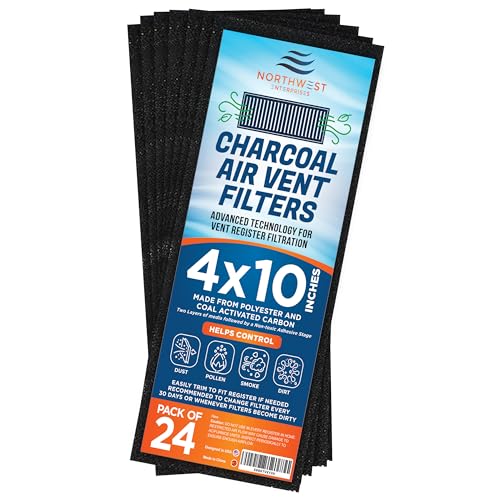
For odor control, Northwest Enterprises 4 x 10-Inch Carbon Filters differs from plain particle-catching media by adding an activated charcoal layer. The maker says it absorbs cooking, pet and musty odors as well as dust, and describes the filter as trim-to-fit for floor or wall registers. Each filter measures 4 by 10 inches and is 0.3 inch thick. That combination suits a register that matches the starting size and a household prioritizing odors. Its fit is narrower than a universal-size solution: measure the register before trimming, and choose another size if 4 by 10 inches cannot cover the opening.
Bottom line: Choose this when a 4-by-10-inch register and odor-focused media match your needs.
30-Pack 4 x 10-Inch Sponge Vent Filters

30-Pack 4 x 10-Inch Sponge Vent Filters uses porous sponge rather than the polyester or carbon-based media of the other choices. The maker says the material blocks dust and debris while allowing air to pass, and the filters can be trimmed for other locations. The pack has 30 pieces sized for 4-by-10-inch registers, making it a fit for buyers who want this sponge construction in that starting size. The maker also cautions against excessive airflow blockage, so avoid stacking filters or cutting one so it bunches across the register; unrestricted supply airflow matters for the heating and cooling system.
Bottom line: Pick this for porous sponge media in a 4-by-10-inch register.
4 x 10-Inch Activated Carbon Filters, 20-Pack

4 x 10-Inch Activated Carbon Filters, 20-Pack combines activated carbon with an electrostatically charged filter, unlike the simpler sponge option. The maker says the media attracts dust, dirt, pollen, smoke and other airborne particles, and also describes carbon filtration for air from heating and AC vents. Each piece is 4 by 10 inches and the pack contains 20. This can suit buyers seeking both carbon and electrostatic media in one filter. The product name and claims do not establish a measured filtration rating, so choose by the specified size and media rather than assuming a particular level of particle removal.
Bottom line: Choose this if you want carbon and electrostatic media in a 4-by-10-inch filter.
How to choose floor vent filters
Choose floor vent filters by matching the register opening first, then selecting media for the debris or odor concern. Register filters sit at individual supply or return vents, while the central HVAC filter is installed at the equipment or return-air path; a register filter is not a substitute for that system filter. Measure the clear opening beneath the grille rather than relying only on the outside grille dimensions, since grille frames can extend beyond the duct opening. For a register opening close to 4 by 10 inches, compare the 4-by-10-inch options; for a longer opening, the 4-by-12-inch sheet can be trimmed. Keep the filter flat and avoid blocking the grille’s free area.
Floor vent filter materials and uses
Carbon media is the relevant distinction when odor adsorption is a goal, while polyester and porous sponge are particle-catching options in this selection. Activated carbon has a porous surface that can adsorb some odor compounds, but it does not make a small register filter equivalent to a room air cleaner. A sponge’s open structure is intended to pass air while catching larger debris; denser media can raise airflow resistance. Electrostatic media uses electrical charge to attract particles, but a product’s marketing description alone does not establish a MERV rating. Use the following distinctions to match the filter to the need, not as a ranking of measured performance.
The material-to-need match is a starting point; filter size and unobstructed airflow still decide fit.
| Need | Media to consider | What to check |
|---|---|---|
| Dust and general debris | Polyester or porous sponge | Register opening and airflow |
| Cooking or musty odors | Activated carbon | Filter size and carbon layer |
| Mixed particle-catching claims | Carbon/electrostatic | Do not infer a filtration rating |
How to size a floor register filter
Measure the opening in inches before cutting a filter, because a register’s outside grille size may differ from the duct opening it covers. A filter should sit flat beneath or within the register without folding over the airflow path. If the opening is smaller than the filter, trim the media carefully to the opening shape; if the filter is too small to cover it, do not rely on overlapping scraps to seal the gap. A change in heating or cooling airflow after installation can signal that the filter is too restrictive or poorly positioned. Remove the register and check the fit rather than forcing a thick filter into a shallow frame.
Using and replacing floor vent filters safely
Keep floor vent filters clear of rugs, furniture and debris, since supply registers need an open path to move conditioned air. A filter that blocks airflow can reduce delivery from that register and add resistance to the system; never layer filters or cover multiple vents to increase capture. Replace or clean a register filter when dust visibly loads its surface or airflow changes, and inspect it during routine HVAC filter checks. The central system filter still needs its own schedule: common residential HVAC filters are often checked monthly and replaced about every 1 to 3 months, with the interval affected by filter type, runtime, pets and dust. Follow the equipment filter size and keep airflow unobstructed.
Frequently Asked Questions
Do floor vent filters replace the HVAC filter?
No, a floor register filter does not replace the central HVAC filter. The central filter protects the equipment and should be checked about monthly, with many residential filters replaced every 1 to 3 months depending on type and conditions.
How do I measure a floor vent filter?
Measure the clear duct opening in inches, not just the grille’s outside edge. A grille frame can extend beyond the opening, so a nominal 4-by-10-inch product should be checked against the actual area the filter must cover.
Can activated carbon vent filters remove odors?
Activated carbon can adsorb some odor compounds, which is why carbon media is used for odor-focused filtration. A small register filter has limited media area, so it should not be treated as a replacement for ventilation or a dedicated room air cleaner.
Can a vent filter restrict airflow?
Yes, a filter can add airflow resistance, especially if it is dense, dirty, folded or layered. Keep the register unobstructed and remove or reposition the filter if airflow at that vent drops noticeably after installation.
How often should floor vent filters be changed?
Inspect floor vent filters during routine HVAC filter checks and replace them when dust loads the surface or airflow changes. The central HVAC filter has a separate schedule; many household filters are checked monthly and changed every 1 to 3 months.