
Mini Cooper Code Reader: 4 Scanners Compared

For a Mini Cooper, choose a BMW/MINI-specific reader if you need more than engine codes; ANCEL BM700 PRO combines full-system scans with battery registration. Choose a universal OBD-II reader for basic engine faults, but it may not access Mini-specific modules.
We earn a commission if you buy through links on this page. As an Amazon Associate I earn from qualifying purchases. Products are compared on manufacturer specifications, not hands-on testing.
- Best overall: ANCEL BM700 PRO – BMW/MINI coverage includes multiple systems and battery registration.
- Best for Mini system scans: Creator C501 – Supports BMW/MINI diagnostics across drive, chassis and body systems.
- Best for basic engine codes: ANCEL AD310 Classic – Reads and clears emission-system trouble codes and displays live data.
| Product | Best for | Vehicle coverage | Diagnostic scope | Special functions | Shop |
|---|---|---|---|---|---|
| ANCEL BM700 PRO | Full-system diagnostics | BMW/MINI/Rolls-Royce | Full system | Battery registration; reset services | Check Price on Amazon |
| Creator C501 | BMW/MINI service tasks | BMW/MINI after 1997 | Drive, chassis, body | Battery registration; oil and CBS resets | Check Price on Amazon |
| ANCEL AD310 Classic | Basic engine codes | 1996+ OBD-II vehicles | Emission system | Live data; freeze frame | Check Price on Amazon |
| FOXWELL NT301 | Engine-code diagnosis | OBD-II vehicles | Engine trouble codes | Live data | Check Price on Amazon |
Mini Cooper Code Readers
Match the reader’s system coverage and model-year range to the diagnostic work you need.
ANCEL BM700 PRO

BMW/MINI module coverage sets this reader apart from basic engine-only scanners. The BM700 PRO supports automatic VIN detection and scans systems including engine, ABS/DSC, transmission, airbag, electric power steering and air conditioning. It also includes battery registration and other reset services, making it a fit for owners addressing module faults or replacing a battery. The wired connection suits a garage workflow without relying on wireless pairing. Its limitation is the vehicle scope: this is a BMW-family tool, not a general-purpose scanner for every make.
Bottom line: Choose this for broad BMW/MINI system access and battery registration.
Creator C501

Battery registration and service resets distinguish this BMW/MINI-focused scanner from generic code readers. Creator says the C501 supports BMW/MINI vehicles after 1997 and covers drive, chassis and body systems, with trouble-code reading, live data, adaptation clearing, oil reset and CBS reset. For 1997–2004 cars, a separate 20-pin adapter may be needed, so confirm the connector before ordering. Its compatibility window and service functions suit owners handling maintenance alongside fault diagnosis; it is less suitable if you only want a simple engine-code reader.
Bottom line: Pick this for BMW/MINI diagnostics with maintenance reset functions.
ANCEL AD310 Classic
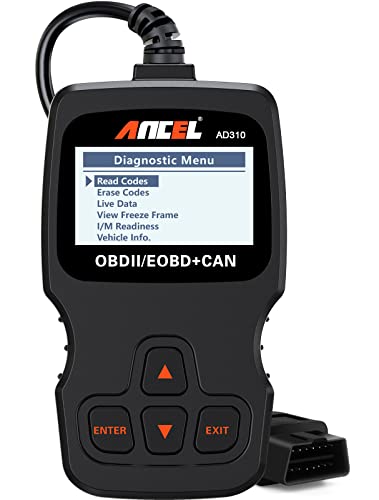
Unlike the BMW/MINI-specific tools, the AD310 focuses on OBD-II engine and emission diagnostics. It reads and clears emission-system trouble codes and displays live data, freeze-frame data and I/M readiness status. Its 2.5-foot cable gives room to position the handheld unit while connected. This is a straightforward choice for checking a check-engine light on a compatible Mini, but its functions do not reach the broader ABS, airbag or body-module coverage provided by BMW/MINI-specific scanners. Choose it when engine faults are the main concern.
Bottom line: Choose this for basic OBD-II engine and emissions checks.
FOXWELL NT301

The NT301 centers on engine trouble codes and live data rather than BMW/MINI system diagnostics. It reads code definitions and can clear eligible engine codes after repair; if the fault remains, the check-engine light may return. Its simple engine-focused role can suit a Mini owner who wants to investigate an illuminated engine light before deciding on repairs. The tradeoff is scope: the functions do not include Mini-specific module scanning or service resets, so it is not the right pick for ABS, airbag or battery-registration work.
Bottom line: Pick this when engine codes and live data are the priority.
How to choose a Mini Cooper code reader
Choose by the modules and service functions you need, not just the ability to clear a check-engine light. Generic OBD-II tools focus on emissions-related engine faults; BMW/MINI scanners can reach additional systems such as ABS, airbags and transmission, depending on the tool. A reader that supports live data can show changing sensor values, while freeze-frame data captures conditions around a fault. Battery replacement is another dividing line: use a tool with battery registration support when that function is required for the job. For occasional engine-light checks, an engine-only scanner may be enough; for module faults or resets, select a BMW/MINI-focused unit.
Use this decision guide to narrow the type before choosing a model.
| Need | Reader type | What to look for |
|---|---|---|
| Check-engine diagnosis | Universal OBD-II | Engine codes, live data |
| ABS, airbag or module faults | BMW/MINI-specific | Full-system coverage |
| Battery replacement or service reset | BMW/MINI-specific | Battery registration and reset functions |
Check Mini Cooper year and connector fit
Model year and diagnostic connector determine whether a scanner will communicate with a Mini. OBD-II became mandatory for US passenger cars from the 1996 model year, but older BMW/MINI models may use a 20-pin connector rather than the standard 16-pin port. The C501 calls out BMW/MINI support after 1997 and notes that 1997–2004 cars may need a separate 20-pin adapter. Before ordering a BMW/MINI scanner for an older car, confirm the year and connector; for any tool, check that its vehicle coverage includes the specific Mini.
Physical access matters too: locate the diagnostic port before starting, and avoid pulling or forcing a connector at an angle. A compatible tool still cannot communicate if the port or vehicle circuit has a fault.
What code readers can and cannot tell you
A diagnostic trouble code points to a detected condition or circuit, not automatically to a failed part. For example, a sensor-related code can reflect wiring, a connector, or another system condition, so use live data and the vehicle’s diagnostic procedure before replacing components. Freeze-frame data, where available, records operating conditions when a fault was stored; it can help narrow the circumstances but does not prove a cause. Clearing a code erases the warning temporarily, not the underlying fault, and an unresolved problem can turn the light back on.
Engine codes also differ from manufacturer-specific codes stored by systems such as ABS or airbags. A generic scanner may not access those modules, so match the scan tool’s coverage to the warning or repair task.
Frequently Asked Questions
Can a code reader reset a Mini Cooper check-engine light?
Many OBD-II readers can clear eligible engine codes, but clearing does not repair the cause. If the fault is still present, the warning may return.
Will a basic OBD-II scanner read Mini Cooper ABS codes?
A basic OBD-II reader is generally focused on emissions-related engine codes, not ABS modules. Choose a BMW/MINI-specific scanner that explicitly supports ABS when that is the system you need to scan.
When does a Mini Cooper need a 20-pin adapter?
Some older BMW/MINI cars use a 20-pin diagnostic connector; the C501 identifies 1997–2004 vehicles as potentially needing an adapter. Check the car’s connector and tool compatibility before purchase.
Does a Mini Cooper battery replacement require registration?
Some BMW/MINI service procedures use battery registration after replacement, and the BM700 PRO and C501 include that function. Confirm the requirement for the specific Mini and battery work before relying on a scanner.
What does freeze-frame data show on a code reader?
Freeze-frame data captures vehicle operating conditions when a fault code was stored. It can help place an engine fault in context, but it does not identify the failed part by itself.